
* Blog & notes for last week.
DAYLOG MON 27 APR 26 / UNHAPPY AMERICANS: One Derek Thompson, writing on Substack, posed a question in the title of his essay: "If America's So Rich, How'd It Get So Sad? (23 apr 26)" -- subtitled: "Or: How the 2020s broke our brains".
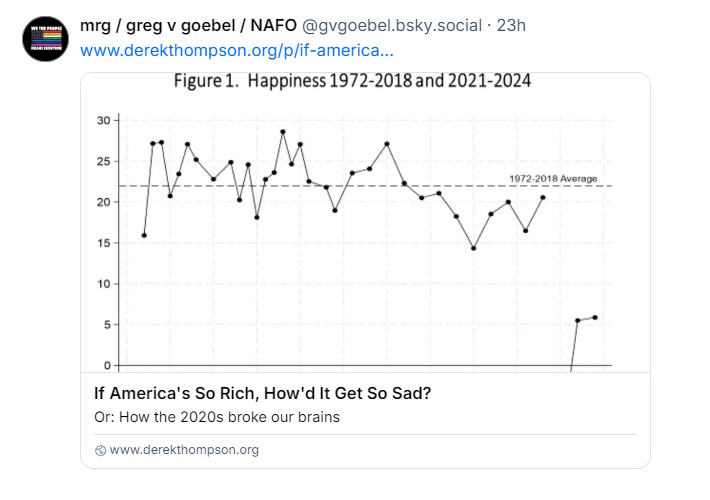
Thompson started out quoting University of Chicago economist Sam Peltzman: "The United States was a reasonably happy country for a long time. It is not happy now." Citing the General Social Survey of the National Opinion Research Center (NORC) at the university, Peltzman showed that from 1972 to 2018, self-reported happiness in the US population averaged over 20 points above unhappiness -- but in 2021, it plunged below zero and has since gone up to only about five.
OK, there's fair reason to be skeptical of such surveys, but other surveys of American happiness follow the same trajectory. So what's going on?
One big hint is that 2021 was the tail end of the COVID-19 pandemic, which had a major negative impact on the US economy. Overall, the US economy is not doing all that badly, in fact doing better than most others. However, inflation has been running high since the pandemic, and the relentless upward creep of inflation makes Americans very nervous.
Of course, inflation only aggravates the belief of Americans that everything is falling apart. There is a broad sense of social decline -- in large part due to the corrupt, incompetent, and witless Trump Regime, as it does all it can to turn back the clock. The fact that the Trump Regime is doomed to failure is no great consolation. Trump is not so much a disease in himself as the symptom of a disease: the decay of the Republican Party into corruption, fascism, and white supremacy.
Americans know the system is badly broken. The fact that 77.3 million Americans voted for Trump in 2024 suggests to those of us on the Left that a lot of our neighbors can't be trusted and should be avoided. The broken news media does little to inspire confidence, either.
Those taking the longer view can see the Republicans are falling apart and that a better day will come, but the resistance against Trump of necessity works slowly. There are many of the impatient, encouraged by Kremlin trolls, who call the Democrats corrupt and ineffectual.
In sum, the Left has good cause to be unhappy -- but what about the Right? They've got what they voted for, shouldn't they be happy? In reality, they were driven by unhappiness, nothing makes them happy, and they can't admit to themselves that made a big mistake.
DAYLOG TUE 28 APR 26 / COAL STILL FADING: The war against Iran has been bad news all around, but there are a few glimmers of light in it -- one being that it seems it's boosting renewable energy. As discussed in an article from EURONEWS ("Solar and wind outpace coal as energy crisis fails to spark fossil fuel revival" by Angela Symons, 20 apr 26), there were concerns that Iran's blockade of the Strait of Hormuz, shutting off oil shipments, would boost coal power.
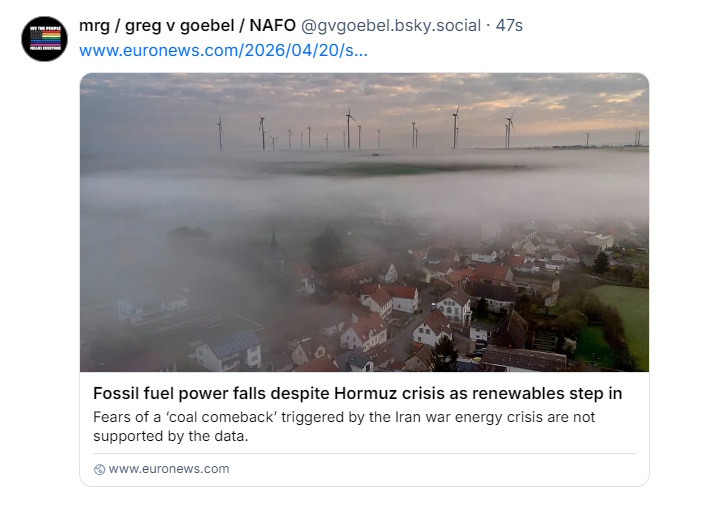
A report from the Center for Research on Energy and Clean Air (CREA) -- a nonprofit think tank out of Helsinki -- says that while coal-fired generation increased by 2% in China as some plants switched from gas to coal, coal power fell by 3.5% outside of China. At the same time, oceanic coal transport volumes fell by 3% globally, bringing them to a level not seen since 2021. Total fossil-fuel generation fell by 1%, with gas-driven generation falling by 4%. Meanwhile, in March Chinese solar exports rose by a staggering 68 GW, compared to a base of about 2,300 GW, while wind power is growing at about 8% a year.
As far as a "coal comeback" went, there were projections after Russia's full-scale invasion of Ukraine that coal would bounce back, which did happen initially. However, European countries learned from the crisis, pushing clean energy and working to get off fossil fuels, with a record fall in European coal use and CO2 emissions in 2023.
In the wake of the current crisis, coal-fired power generation actually noticeably fell. The reason is that coal-fired power generation is in overall decline, though some new plants have been built in China and elsewhere; there's little room for growth. According to CREA, no coal plants returned to service or had their closure delayed in any country in March.
Europe has been accelerating electrification, heat pumps, and solar to cut reliance on imported fuels. It's a global trend: even in the USA renewables continue to gain grounds, in spite of the Trump Regime's inept efforts to turn back the clock.
DAYLOG WED 29 APR 26 / RFK JR SINKS: As discussed in an article from the BBC ("Trump said RFK Jr could run 'wild' with health policy. Instead he's reined him in" by Madeline Halpert, 25 apr 26), Robert F. Kennedy JR, Secretary of the Department of Health & Human Services (HHS) has been finding his job getting ever harder. RFK JR, long America's face of resistance against vaccines, struck an alliance with Donald Trump in the 2024 election, with Trump elevating him to HHS Secretary after the election win. [2/more]
The alliance between the two men was puzzling. RFK JR's background was in the "Left outfield", and he had been sharply critical of Trump -- calling him a "bully" and a "terrible president". Then, after the collapse of RFK JR's 2024 presidential campaign, he turned around and endorsed Trump. Trump, it seems, made RFK JR grand promises to bring him on board.
Trump's motivations for recruiting him were obscure. One reason appears to have been the mystique of the Kennedy name, Trump having long been a sucker for "class". Trump also demonstrated no great interest in fringe medicine; although he promoted ivermectin, a deworming agent, as a COVID-19 cure, when he got COVID-19 himself, he received the latest medical treatments. Apparently, Trump promoted quack cures to bring in voters who were enthusiastic for it. In any case, he told RFK-JR that he could "go wild" as HHS Secretary.
During his confirmation hearing, RFK JR was careful to put on a reasonable face, in particular downplaying his antivax views. Anyone familiar with antivaxxers knows they're doubletalkers; only Republican senators, who didn't care, voted to confirm him. Since then, as is well-known, RFK JR's reputation for crackpottery has soared, earning him the reputation as the nuttiest cabinet secretary ever. More to the point, he's worked hard to undermine the US healthcare system, and place other crackpots in positions of authority.
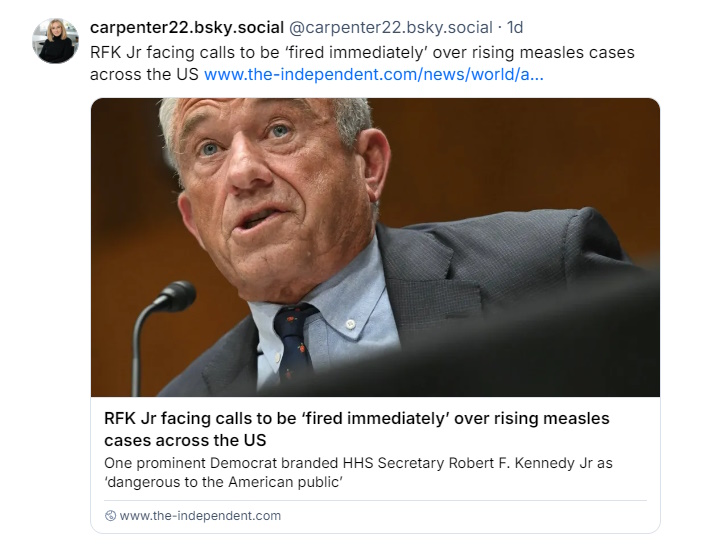
His efforts to downgrade vaccination have resulted in a measles epidemic the likes of which haven't been seen in a long time, leading to calls for his resignation. His reputation, never good, has sunk so low that Trump, worried about the midterm elections, has been leashing him in, notably telling him to cool it on antivax rhetoric and stop attacks on big pharma.
RFK JR's loyal followers have noticed, particularly after he passed approval on the herbicide glyphosate, a possible carcinogen. Those who ride the Trump Train are slowly learning to regret it.
DAYLOG THU 30 APR 26 / UKRAINE'S DRONES ASCENDANT: The war in Ukraine has, as is well-known, become a war of drones, with Ukraine and Russia competing to build more and better drones. As discussed in an article from UKRAINSKA PRAVDA ("Drones every day. How Ukraine has caught up with Russia in long-range UAV numbers" by Hlib Voloskyi and Bohdana Bakai, 27 apr 26), Ukraine has been getting the edge on Russia in drones, striking with devastating effect behind the front lines and deep into Russia.
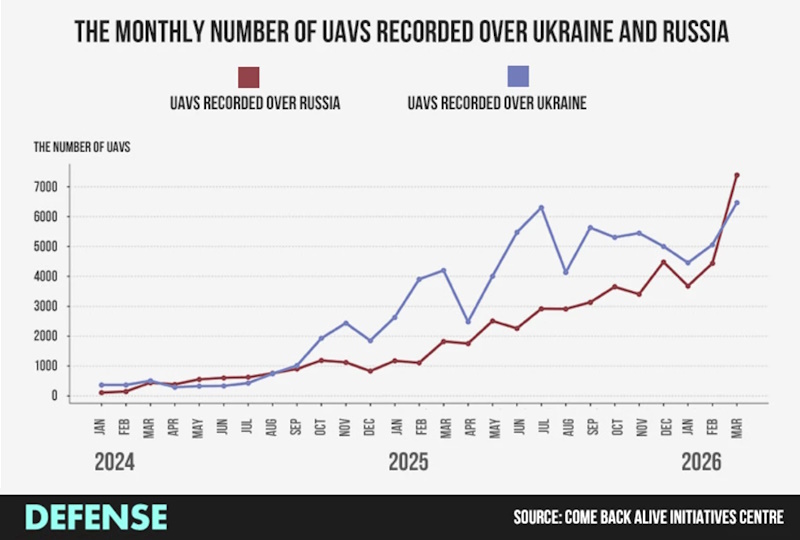
In recent months, the number of drone strikes performed by Ukraine has matched or exceeded those performed by Russia, with targets in Russia being hit at ever longer ranges, while Russian air defenses are increasingly suppressed.
Analysts from the Come Back Alive Foundation Initiatives Center have been tracking the drone war -- using data provided by Russian and Ukrainian government source, as well as public reports. None of these sources are fully reliable, but they can be pieced together to give a credible picture. They reveal that Ukrainian long-range drone attacks have been ramping up, from 110 drones in January 2024 to more than 7,000 in March 2026. During 2025, drone launches ramped up fivefold. In 2024 Russia was launching on average 250 more drones per month than Ukraine; by 2026 this figure had narrowed to 150. In March 2026, Ukraine managed to overtake Russia in the number of launched UAVs.
Ukrainian drone strikes in Russia's border regions have become a daily occurrence, while deep strikes have reaching steadily farther. The prime target is Russia's oil system, with lower priority on plants that provide critical components for munitions, or chemical plants that are similarly crucial for the production of explosives and propellants. The chemical plants are particularly attractive targets because they burn well, and are hard to repair since they demand expensive imported plumbing. Purely military targets in Russia are lower priority, since they are well-defended.
Russia has a problem in having so much more airspace to defend than Ukraine, that problem getting worse as Ukraine extends the range of its strikes deeper into Russia. Countermeasures and decoy drones aid the strikes, while attacks on air-defense systems grind them down, with the Ukrainians carving out "corridors" through the Russian air-defense system. Russia continues the fight -- but Putin is slowly losing the war. He thought it would be over in three days, but it's over four years.
DAYLOG FRI 01 MAY 26 / IRAN STRIKES BACK: Donald Trump keeps proclaiming the win in his war on Iran, saying he's completely crushed Iranian forces -- but it seems the Iranian's weren't informed of their defeat, and have been striking back hard. As discussed in an article from STARS & STRIPES ("Iran war reveals vulnerabilities of US Middle East bases" by Lara Korte, 29 April 2026), since the war began, Iran has launched thousands of ballistic missiles, cruise missiles, and drones in reply, inflicting widespread damage.
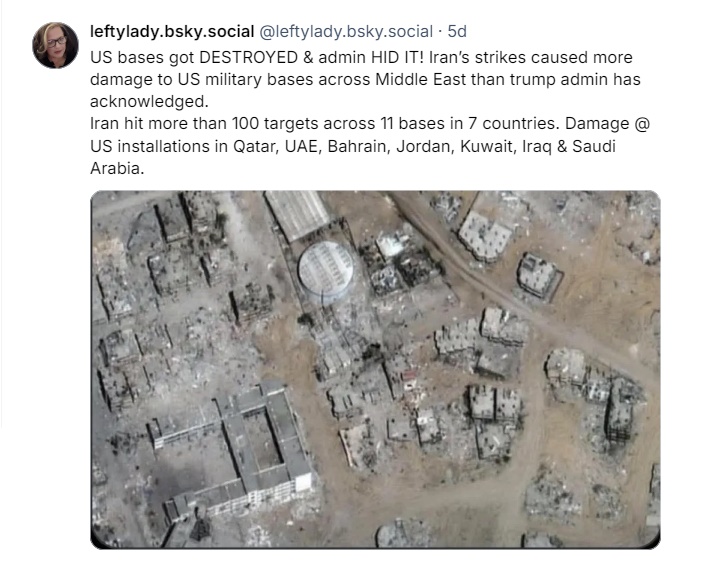
At least 16 US military installations in the lands of America's Gulf allies have been hit, some severely. Bahrain, a small island nation in the Persian Gulf, sits about 190 kilometers (120 miles) from the Iranian coast, in easy range. For about three decades, it has hosted the headquarters of the US Navy's Central Command, as well as US Marine and Coast Guard elements. At the start of the year, it was home to 8,300 Americans, including service members, civilians and their families. Within hours of the first US attacks on Iran, the base was pounded by Iranian missiles and drones that proved highly effective and destructive; dependents and non-essential personnel were hastily evacuated.
In Kuwait, Iran struck four US bases, hitting warehouses, runways, radar-protection structures, satellite communications centers, and administrative buildings. A strike in early March, on a makeshift operations center near Shuaiba, Kuwait, killed six Army soldiers and wounded dozens of others. Similar attacks have been reported at US bases in Iraq, Jordan, Qatar and the United Arab Emirates. On 27 March, Iranian drones destroyed an E-3 Sentry Airborne Warning & Control System (AWACS) radar aircraft, an elderly but significant air-defense asset. Along with the damage, the US has heavily depleted its stock of offensive and defensive missiles, leaving US forces less able to react to new emergencies.
The Iranians were expecting to be attacked, and many of their assets were sheltered or hidden. They have been receiving space intelligence for targeting from China and Russia. A Pentagon official estimated the cost of the war so far to be $25 billion USD -- but it appears that's a selective cost analysis, in particular not factoring in repair of damage. Pete Buttigieg, who has a background in naval intelligence, says it's more like $50 billion USD. Over 60% of the US public is against the war.
As of today, the war has passed the 60-day mark, and now in principle requires congressional approval -- but although the war is very unpopular, Trump is not showing signs of seeking an exit. Indeed, he seems to be more interested in using it to manipulate the stock market. America's Gulf allies were not consulted about the war, and are disgusted with the USA. One prominent Emirati commentator said: "It is time to think about closing the American bases, as they are a burden and not a strategic asset."

