
* This is an archive of my own online blog and notes, with monthly entries.
MUELLER REPORT MUDDLE: In news for April, events in the USA seem to have settled into a tense muddle. Attorney General Bill Barr, after releasing a short summary of the Mueller report in late March that said "no collusion" between Russia and the Trump Administration, issued the redacted version of the report in early April that set off a firestorm.
Trump advocates continue to crow that the report didn't show any collusion between Russia and Trump. Actually, even in the early days of the Mueller investigation, knowledgeable commenters said that it was most unlikely that charges of collusion would come out of it. To make a collusion charge stick would have required a paper trail, in effect a validated document in which the two parts agreed to collude -- and that was just not going to happen.
Indeed, on consideration, it didn't seem likely that the release of the report was going to change the status quo very much: on one hand, it wouldn't contain any "smoking guns", and on the other, it would leave many loose ends hanging. The report indicated there were indeed plenty of loose ends, with 14 ongoing investigations, 12 of them redacted in the released report. The report also showed that Trump was incompetent, tiny-minded, mean-spirited, and amoral.
That was not news to anyone with sense -- but it was established by a rigorous and impartial investigation, meaning its credibility was beyond sensible dispute. Republican Senator Mitt Romney released a statement:
QUOTE:
I am sickened at the extent and pervasiveness of dishonesty and misdirection by individuals in the highest office of the land, including the President. I am also appalled that, among other things, fellow citizens working in a campaign for president welcomed help from Russia.
END_QUOTE
To the extent the report did change the status quo, it was to intensify the struggle, with the Left making loud calls for impeachment of Trump. Democratic leadership was not keen on that idea, mostly because without Republican support, an impeachment attempt was likely to fail. The result might be to boost Trump's standing enough to get him re-elected in 2020, and certainly leave the Democrats looking like losers.
The Democrats are focused on "flipping" GOP Red states to Democrat Blue states -- and that means shifting voters from the GOP to the Democrats. A failed impeachment effort would be no help to that end. If things got so bad that Republicans called for Trump's impeachment as well, that would give the Democrats political cover and give chances of success -- but again, that doesn't seem likely to happen.
WILD IMPEACHMENT TALK: The calls for impeachment on Twitter demonstrate that people are not thinking things out:
There's no prospect of impeachment. House Speaker Nancy Pelosi is too smart and experienced to take on futile battles; she has also repeatedly made it clear that she isn't concerned with the tantrums of the hard Left. There's no agreement among the voters for it anyway, with the arguments becoming heated at times. That's all for the good, really, since talk of impeachment clearly drives Trump up the wall.
The Democrats do have every good reason to continue their investigations of the Trump Administration -- with Trump's belligerent stonewalling only strengthening the drive towards further investigation. The Democrats are also attempting to get their hands on Trump's tax returns. A well-established IRS rule says that the chair of the House Ways & Means Committee gets tax returns for the asking. There is the catch that the request has to be for a valid legislative reason, not out of animus -- but Trump's failure to properly divest himself of his business interests on becoming president has given all the basis for the request that anyone might need. The Trump Administration would find it hard to prove animus.
Of course, second-guessing the Supreme Court decision on the request for the tax returns is tricky. However, Trump believes, with plenty of good reason, that he personally owns the GOP in Congress. He is likely to also believe that the Supreme Court is beholden to him -- and to the extent he makes that belief evident, as he is likely to, he will only antagonize the justices. Besides, the sorry story of the Trump White House is only too evident in the Mueller report. It's not a good bet the Supreme Court will side with him.
It is all for the good for the Democrats to keep Trump on the defensive, leaving him under the heavy thumb of the question: What is he trying to hide? Trump fans have taken the Mueller report as a win, jeering at the Democrats, saying they've lost the game. It wasn't a win by any means, the game's only at half-time. Of course, the Trumpies complain bitterly, but they always do. They would in any case; the people who voted for the Democrats either insist on continued pressure on Trump, or don't really concern themselves with it much. As for Trump, he has no win if he can't make the investigations go away.
TRUMP AGAINST OBAMACARE: In the meantime, the Trump Administration has continued its assault on ObamaCare, with the Justice Department endorsing a decision by a Texas court striking it down. That decision is very likely to be reversed, its propriety being entirely dubious. The rational of the judge was that, since the Republican-controlled Congress had zeroed-out special taxes implemented for ObamaCare, the entire ObamaCare Act was then invalid. In reality, if anything could be inferred from the zeroing-out of taxes without killing off ObamaCare, it's that the taxes should be restored. That's not likely to happen, but certainly the Texas court judgement is preposterous.
Trump got very enthusiastic about the renewed assault on ObamaCare, saying that a new plan would be generated, without giving any details. Senate Majority Leader Mitch McConnell made it publicly clear that the Senate was not going to touch healthcare with a ten-foot pole. The Republicans got beaten up on that score by the voters in 2018, and didn't want to try it again. Trump then declared that healthcare would be revisited, but only after the 2020 elections.
Along similar lines, Trump made threats to close off the border with Mexico, to then reverse himself, and say it wasn't going to happen. It appears that the border states complained very loudly -- it would have been an economic disaster for them -- and Trump was finally convinced it would be "government shutdown 2.0": it wouldn't work, and he'd have no sensible exit strategy. While Trump's behavior has always been erratic, it seems it is becoming more so as of late. It is likely to continue to deteriorate. The pressure is not going to let up, it's just going to get worse.
TRUMP & CURRENCY WARS: Donald Trump's dubious ideas about international economic relations were an important element in his 2016 election campaign. Nothing in the time since then suggests Trump was right all along -- and as discussed in an article from BLOOMBERG.com ("Despite Trump's Claims, There's No Currency War Against the US" by Peter Coy, 20 June 2019), Trump hasn't learned any better either, insisting that Europe and China are engaged in a currency war with the USA. On 18 June, Trump tweeted:
QUOTE:
Mario Draghi [outgoing president of the EU Central Bank] just announced more stimulus could come, which immediately dropped the Euro against the Dollar, making it unfairly easier for them to compete against the USA. They have been getting away with this for years, along with China and others.
END_QUOTE
OK, Trump is technically correct; the euro really did decline against the dollar, to $1.12 USD from $1.16 USD a year ago, after Draghi, said "additional stimulus will be required" if the economic outlook for the 19-country euro zone doesn't improve. In addition, a cheaper euro will indeed make exports from the euro zone to the USA less expensive, while making exports in the reverse direction more expensive.
Trump's misunderstanding is that Draghi is weaponizing the euro. That's an extreme read on a practice that isn't necessarily controversial. It is perfectly sensible for the ECB to cut interest rates, to stimulate domestic economic growth by lowering borrowing costs -- the "cost of money" -- for consumers and businesses. Of course, cutting rates also tends to depress the value of the euro; that does add to the stimulus, but it's a side effect, not the goal. In a recent public panel discussion, Draghi said: "We don't target the exchange rate."
If the fall of the euro did make the US trade deficit worse, bad enough to slow down America's economy, the US Federal Reserve would cut interest rates to boost the economy again. That would, in turn, lower the value of the dollar, with the previous exchange rate relative to the euro restored. However, as with the euro, the Fed's goal would not be to target the exchange rate. The ECB would certainly not believe the Fed was engaged in economic warfare against the EU.
It may seem futile for both the EU and the US to cut interest rates, with the end result of leaving the euro-dollar exchange rate intact -- but once again, the exchange rate isn't the target, it's economic growth for both parties. Brad Setser -- a senior fellow at the Council on Foreign Relations -- says: "In principle, that's just a coordinated easing that increases the level of demand."
Trump's claim that China is manipulating its currency is even weaker than his case against the EU. In fact, the People's Bank of China (PBC) hasn't been trying to push down the value of the yuan; the PBC has refused so far to cut the benchmark one-year lending rate at 4.35%, where it's been since October 2015 -- despite the fact that the Chinese economy has been soft. If China wanted to drive down the yuan, another approach would be to sell yuan to build up foreign currency reserves, and China has not been building up foreign reserves. China plans to move up the economic pyramid, selling more expensive products with higher value and profit margins. Competing on price is no longer the objective, and so neither is a weaker yuan.
That leads to the question: so how would anyone know if a country is really trying to lowball its currency? One give-away, as mentioned above, is the country's central bank buying lots of foreign currency to drive down its own currency's value, even though the country has a healthy surplus in trade and investment income with the rest of the world. China was playing that game up to 2014; Singapore, South Korea, and Thailand have played it on occasion.
According to a recent article by Setser, at the present time, one of the biggest offenders is Taiwan. The Taiwanese central bank says it had the equivalent of $464 billion USD in foreign exchange at the end of May -- more than the holdings of bigger nations such as Brazil, Germany, and India. Trump, however, doesn't feel like picking fights with Taiwan; he is certain to keep on complaining of the unfair trading practices of China and Europe.
WAR ON HUAWEI: As discussed in an article from BLOOMBERG.com ("The US-China Race for Tech Dominance Is the Worst Game of Twister Ever" By Marc Champion, 11 June 2019), appearances suggest that the US and China are engaged in a new Cold War, run along technological lines. The Trump Administration has in particular targeted Chinese tech giant Huawei -- claiming that Huawei telecommunications gear represents a "Trojan horse" that could grossly undermine Western security.
A closer inspection gives a more confusing picture. At an industrial park in Oxfordshire, just off Britain's M40 highway from London to Birmingham, there is a nondescript brick building that houses the Huawei Cyber Security Evaluation Centre. The only things that seem unusual about the structure are the one-way glass used for the window, the considerable number of CCTV cameras littering the installation, and the oversize air-conditioning units that cool the arrays of telecom servers.
The center is run by the British government, with its few dozen employees given thorough security screenings. Those employees, however, are paid for by Huawei. The workers inspect Huawei gear for security faults -- looking for a Trojan horse, in effect. It's not a bad deal for Huawei, since the company gets a thorough debugging of their gear for their money. More to the point, thanks to the evaluation by the center, the British government is perfectly happy to allow Huawei to sell server gear for the UK's emerging high-speed "5G" telecom network.
The Trump Administration has exerted great pressure on America's allies to shut out Huawei, arguing that the Chinese firm cannot be trusted. Huawei officials reply that deliberately building a "back door" into their gear would be business suicide; if one such were found, nobody would ever buy Huawei gear again. The Trump Administration counters that the Chinese government could legally compel Huawei to do whatever the government wanted -- but what sense would it make for the Chinese government to force Huawei to do something so rash, that is very likely to be found out?
The Trump Administration's efforts to proclaim a technological "Iron Curtain" between China and the West doesn't wash. The Iron Curtain between the Soviet Union and the West was a manifestation of a rivalry between a statist anti-capitalist regime and the Western capitalist democracies. In the current case, it's a rivalry between a statist capitalist regime and the Western capitalist democracies -- whose economies are deeply interconnected, and much more cooperative than not at an economic level.
A recent Chinese government white paper released on June 2 described the two economies as a single industrial chain "bound in a union that is mutually beneficial." Nothing of the sort would have come out of the Soviet Union, even in its warmest phases. Of course, security concerns haven't disappeared, and the rivalry between the two modern systems is often edged, with the US and China doing their best to get the edge on 5G, artificial intelligence, robotics, gene editing, and the data flows that fuel them all.
It is by no means beyond belief that the world will end up divided between users of Western technology and users of Chinese technology. The breach, for the time being, appears to be widening, with China seeking means to retaliate against American economic sanctions. The Chinese government is also trying to discourage tourism to the USA, warning Chinese that America is very dangerous, that visitors may well be robbed or killed.
Nonetheless, it would be very difficult for the two countries to cut off communications, and not to the advantage of either. Efforts of American authorities to step on Chinese cancer researchers for "stealing secrets" have been derided as absurd; the more cancer research gets spread around, the better off the world will be. Andrew Gilholm -- who directs analysis for greater China and North Asia at Control Risks, a consulting firm -- also asks: "How do you restrict exports of AI? These are intangible things that are not developed by one company or country, but are developed globally on open platforms."
The US has not had much luck convincing its allies to stop doing business with Huawei. Huawei sells good products at good prices, and the security risks are seen as manageable -- or for that matter, not so different from technology obtained from the USA. We live in an age of malware and Black Hats; instead of setting up a system to vet Huawei for security holes, we might be better off to set up a system that vets everybody who makes gear that presents a security challenge.
In addition, the Trump Administration's blindly self-serving concepts of international diplomacy have not fostered an inclination to agree with the White House. The Chinese don't have much incentive to play nice with the USA, either. Trump Administration policy is chaotic, and nobody believes Trump keeps his word. If the Chinese made a deal with him, that would help him get re-elected, so they have an incentive to hold out until he leaves office -- likely in 2021, 2025 if it comes to that. The new administration, by acting reasonably, will be in a good position to come to a deal, and stabilize the relationship between China and the USA.
ASSANGE ARRESTED: On 11 April, "hacktivist" Julian Assange -- the driving force behind the WikiLeaks website, which distributed stolen government secrets to the world -- was bodily hauled out of the Ecuadorian embassy building in London by British police. He had sought asylum in the embassy in 2012, jumping bail while under criminal proceedings from the British government, and had been there since that time. The new Ecuadorian president, Lenin Moreno, had enough of Assange, and arranged for his removal.
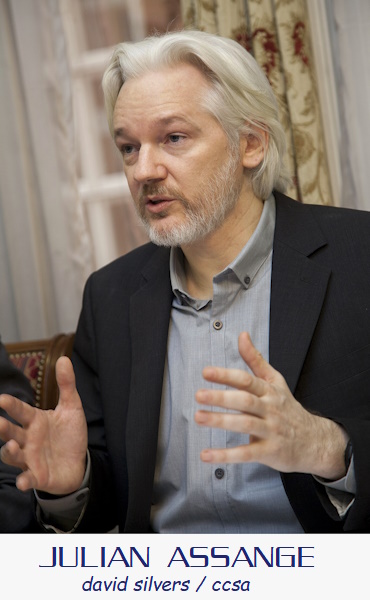
The announcement of his arrest stated that there had been no request for Assange's extradition; the Americans requested it mere hours later, on charges of helping to crack into US government computers. It is expected that the list of charges will grow longer. An essay from ECONOMIST.com ("Julian Assange: Journalistic Hero Or Enemy Agent?", 12 April 2019), posed a question:
QUOTE:
[Assange's supporters believe] his expulsion and arrest was a grave assault on press freedom. Others think it a long-overdue reckoning with justice for a man who had unleashed information anarchy upon the West, culminating in the destabilization of American democracy. Is Mr. Assange a heroic journalist, reckless activist, or even an enemy agent?
END_QUOTE
Wikileaks proved a prolific source of leaks of classified information, including suppressed evidence of atrocities conducted by US forces in Afghanistan and Iraq, along with a massive haul of US diplomatic cables released by Chelsea Manning, then a junior enlisted soldier. Wikileaks then really turned up the volume in 2016 by releasing Democratic Party National Committee emails, obtained by Russian hackers, in an attempt to discredit Democratic presidential candidate Hillary Clinton.
There was little of significance in the DNC emails, no "classified information", just personal comments that were "cherry picked" for their value in undermining Hillary Clinton. This wasn't leaking secret government information; it was an invasion of privacy worthy of a tabloid sheet, but without the titillation. The end result was to help hand a narrow win to Donald Trump. Assange thereby ended up antagonizing many on the Left, save the extreme; he's never had any friends on the Right -- least of all Trump, who has no sense of obligation to anyone. Assange still has his defenders, but they're on the back foot:
QUOTE:
Mr. Assange's admirers ask: what distinguishes him from the NEW YORK TIMES, which published the leaked Pentagon Papers in 1971, exposing damning details of the Vietnam War? In some ways, Mr. Assange was doing no more than following in the footsteps of such illustrious news organizations, which had long given a platform to anti-government leakers -- and enjoyed First Amendment protections while doing so.
END_QUOTE
Assange, however, went beyond journalistic norms, prominently in helping Chelsea Manning crack a Pentagon network, becoming an accomplice in the crime. Wikileaks also contacted Russian hackers, operating under the pseudonym of "Guccifer 2.0" -- who turned out to be agents of Russian GRU intelligence -- asking them for compromising materials. Reputable journalists would not do such things, and feel safe; and if they had information they felt it was proper to release, they would make it clear, in general terms, where it came from. Patience with Assange gradually ran out:
QUOTE [EXCERPTS]:
President Barack Obama's justice department acknowledged that it could not prosecute Mr. Assange's leaking without criminalizing the quotidian work of the media. But it warned, reasonably, that journalists did not have carte blanche: if they were believed to be agents of a foreign power, or conspiring in crimes with one, they could be legitimately booked.
WikiLeaks' willingness to serve as an uncritical and enthusiastic laundromat for Russian intelligence reflects the group's longer history of publishing material with little or no newsworthiness, but calculated to undermine American interests. A cache of CIA hacking tools published in 2017 was one example. In contrast, WikiLeaks almost never publishes leaks that might undermine America's autocratic rivals. Mr. Assange may not be an enemy agent, but he has at least been a useful idiot.
In 2011 he published the unredacted version of the American diplomatic cables, having disagreed with the decision of several newspapers to publish only redacted ones the previous year. His five partners -- THE GUARDIAN, THE NEW YORK TIMES, EL PAIS, DER SPIEGEL, and LE MONDE -- condemned the move, pointing out that Mr. Assange had revealed sensitive personal information and national-security details with little news value. Some named sources, such as an Ethiopian journalist, were forced to flee their countries.
If Mr. Assange deems himself to be a journalist, he is in desperate need of a remedial course on the basic ethics of the profession. Whether in Britain or America, he is likely to have plenty of time for that in the months ahead.
END_QUOTE
A later essay from ECONOMIST.com made a case for the extradition of Assange. Britain's Leftist Labour boss Jeremy Corbyn is of the camp that sees Assange as heroic, but that doesn't wash:
QUOTE:
Some critics gripe that going after Mr. Assange for hacking is like going after Al Capone for tax evasion -- that it was the only charge prosecutors think they can make stick, and that the real reason they want to lock him up is because he threatens national security. But there is nothing wrong with prosecutors acting pragmatically, and they were right not to file bigger charges, such as espionage, that might threaten press freedom if they were successfully used to convict the WikiLeaks founder. Mr. Corbyn is therefore misguided when he suggests that Mr. Assange is being targeted for extradition "for exposing evidence of atrocities in Iraq and Afghanistan". If that were really how the system worked, hundreds of American journalists would be in jail.
END_QUOTE
British courts now have to judge on whether the American request for extradition is legal, and then it will fall into the lap of the home secretary, Sajid Javid. The case for extradition is strong, but there's a complicating factor, in that from 2010, he was wanted by the Swedish government on a sexual assault rap. The Swedes closed their case in 2017, but could re-open it. In that case, the Swedes would get Assange first, and the Americans would need to extradite him from Sweden.
How that plays out remains to be seen, but it can be assumed everyone will get their piece of Assange. On consideration, it seems less important that Assange be punished than he answer for his actions in court. He will have an opportunity to make a case that what he did was right -- though it is unlikely a jury will buy it.
EUROPE V PUTIN: Although Assange is now in lockup, Russian President Vladimir Putin, the puppet master, remains active in the shadows. As discussed in an essay from BLOOMBERG.com ("Europe Needs a Plan to Fight Putin's Trolls", 24 March 2019), elections for the European Parliament are to take place in May. The European Union (EU) is expecting trouble, with the European Commission (EC) warning that Russian disinformation operations will be "systematic, well-resourced, and on a different scale".
Putin sees the world as a zero-sum game; he believes that weakening the EU will make Russia stronger. His goal, then, is to help elect Euroskeptics to the Parliament. To counter Russian interference, the EC has more than doubled its spending on counter-disinformation, to 5 million euros this year, and is growing its staff of analysts dedicated to tracking disinformation. That won't be enough: Europe will need to educate its citizens, and be prepared to make use of legal and diplomatic countermeasures.
The EU is confronted with a formidable threat. Russia's Internet Research Agency alone has a budget that substantially exceeds all EU counter-disinformation agencies combined -- and that doesn't include the 1.4 billion euros the Russian government spends annually on RT and other mass-media outlets that disseminate Kremlin propaganda.
The EU, as a confederation of independent states, usually does not come to agreement easily, and so obtaining more funding is troublesome -- but the EC should at least give more money to two EU bodies, the "East StratCom Task Force" and the "EU Hybrid Fusion Cell", which monitor fake news and coordinate responses of EU governments to it. The Commission should also push member states to get on board its proposal to create a pan-European "Rapid Alert System" that would zero in on and expose suspicious social media activity close to elections; and it should make sure social media companies take down fakebot accounts and disclose the funding sources behind political ads on their platforms.
And then there's the public education angle. European governments can, for example, support fact-checking sites such as Lithuania's Debunk.eu, which is a collaboration among journalists, civil society groups, and the military. They can also reinforce digital-media literacy instruction in public schools, as Sweden has. Estonia, a country with a substantial minority of Russian-speakers, has even set up its own Russian-language public broadcasting channel as an alternative to Kremlin-backed media like the odious RT.
European leaders should also be willing to push back directly on Russia, giving fair warning that attacks will not be passively accepted; the EU will retaliate with the kind of sanctions and indictments the US has imposed on both Russian election meddlers and Chinese corporate hackers. The EU can make it clear that the present set of EU sanctions against Russia, imposed after the 2014 annexation of Crimea, will be automatically extended if evidence of Russian interference surfaces. Germany could also cancel the Nord Stream 2 pipeline, which critics see as more serving Putin's interests more than Europe's. Europe needs to remind Putin that election interference is a form of hostile foreign aggression that cannot, and will not, be ignored.
NOTRE DAME ON FIRE: The arrest of Julian Assange was upstaged on 15 April, when the roof of the cathedral of Notre Dame de Paris -- built from 1160 to 1260 -- caught fire. It took French firefighters 15 hours to extinguish the blaze; onlookers sang, wept. The damage was severe, but fortunately the structure did not burn to the ground, the stone vaulted ceiling under the roof preventing the fire from reaching the lower sections of the structure. Some works of art and artifacts were damaged or destroyed, but many others were rescued. The cathedral's two pipe organs, and its three 13th-century rose windows, were not significantly damaged.

There was a global wave of sympathy for the French; within days, over a billion dollars had been donated to restore the building, the lion's share of that being from France's ultra-rich. There were criticisms that so much money was being spent on saving a building, instead of helping people when there was so much else wrong with the world. The truth of the matter is that there are some things in the world that are irreplaceable, priceless, treasuries of the souls of our ancestors.
If all of Las Vegas burned down, that would be a tragedy, but there would be little lost of real significance that couldn't be replaced -- indeed, some people who would be glad to see it reduced to ashes. Not so with the cathedral of Notre Dame de Paris. It carries too much history, too much ancestry, too much soul -- mostly of France, but by extension, the rest of the world as well.
* I ran into a Frenchman on Twitter the day of the fire, who was reporting on the event. He said it was "hardly damaged" -- an interesting linguistic misfire, since it revealed the peculiarity of the word "hardly". I gently asked if he meant "severely damaged", since "hardly" implied "only slightly".
He apologized, but I then took pains to reassure him: "Your English is vastly better than my French." He was flattered when I said I would donate a little money. I slipped them a fifty -- which, at least as far as I was concerned, put the complaints about priorities into perspective. I have a fixed budget for charity; along with my regular targets, I set aside $50 USD, a small portion of it, to donate to whatever catches my fancy, whatever comes along. I don't know about anyone else, but I have my priorities thought out.
It was worth a fifty. The planet seems to have become a more dismal and hostile place in this decade, and it is good to know there still are better values in the world. I'm getting tired of all the bad-mouthing. Speaking of which, the troll media of course exploited the fire, distributing a video of a mysterious figure in the upper levels of the cathedral, the hint being that Islamic terrorists had started the fire. A better video of the same scene showed it was a fire-fighter.
Along the same lines, there's been a nasty measles outbreak in the USA as of late, with the troll media blaming it on illegal aliens. That's preposterous, the legal traffic across America's southern border being substantially greater than the illegal traffic. More importantly, when epidemics are traced down to a source, they are usually due to citizens visiting a foreign country, picking up the bug, then bringing it back home. The airports are the portal. A Twitter poster said there were tales of outbreaks in detention camps -- but if so, outbreaks elsewhere would be easily traced back to them. The poster also plausibly suggested that the measles outbreak in California was due to students coming back from spring vacation.
BRAILLE BLOCKS: An article from TIME.com ("The Google Doodle Honoring Seiichi Miyake Will Make You Think About What's Under Your Feet" by Ashley Hoffman, 18 March 2019) commented on a Google Doodle run in March as a tribute to Japanese inventor Miyake Seiichi (1926:1982). Few have heard of him, but everyone has seen his invention: "braille blocks" AKA "Tenji blocks", which are sections of walkways with sets of bumps to assist the visually impaired. Arrays of bumps warn of a hazard ahead; straight bars guide towards safety.
Miyake came up with the idea back in the 1960s, as a scheme to help a friend who was going blind. The "tactile pavement" began to emerge in Japan from mid-decade, with the braille blocks becoming part of municipal codes and common across the country. In the 1990s, they went global, with variations -- for example, color-coding to help those with sight.
[UPDATE: I found this article interesting because I've seen braille blocks here and there for decades -- but I not only didn't know what they were for, I never bothered to wonder about them. "Well, duh!" I found a neat little video from a Thai lad, who simply started walking with a camera pointed to the pavement, following the braille blocks and strips.]
SMARTPHONE ZOMBIES: In related news from REUTERS.com, South Koreans are extremely fond of smartphones, so much so that the authorities are now installing warning systems to prevent "smartphone zombies" AKA "smombies" from wandering mindlessly into the path of an oncoming car. It uses infrared cameras and radar to track pedestrians and cars, to then use LED lights and lasers to provide warnings. The system even sends a message to the smartphone of the user at risk. It costs about $13,000 USD per intersection.
On writing up notes, I got to wondering if the date on the article was 1 April, but it wasn't. REUTERS had a video to show how the system worked, and looked slick. They installed blinking LEDs alongside crosswalks; at night, it looked very pretty. They also had videos of people walking into lamp-posts or the like, while being excessively engrossed in their smartphones.]
CONTERFEIT LEGOS FROM CHINA: China has long been known for product conterfeiting. An article from BBC.com ("Fake Lego Gang Dismantled In $30m Chinese Raid", 27 April 2019), discussed how Chinese police raided a toy manufacturer in the southern city of Shenzen, arresting four people. The manufacturer was turning out fake Lego blocks, with a total of 630,000 pieces worth about $30 million USD on hand.
They called their product "Lepin blocks", but they were straight ripoffs of Legos, and they were turning out copies of Lego kits for STAR WARS and other media franchises. They were selling them at a fifth of the price of equivalent Lego products. The raid demonstrates that the Chinese government is serious about cracking down on product piracy.
Lego sells about 75 billion bricks each year in over 140 countries, with kits manufactured in five countries -- Mexico, China, the Czech Republic, Hungary, and Denmark. There used to be a Lego facility here in Loveland, Colorado, the building being characterized by front columns in the form of Lego blocks. However, the building's since changed hands a number of times, and the columns were remodeled to a conventional configuration. Pity, they gave the building a distinction, but I suppose they sent the wrong message for the later tenants.
AMAZON WORKERS ASSESS VOICE CLIPS: As discussed in an article from CNN.com ("Amazon Reportedly Employs Thousands Of People To Listen To your Alexa" by Jordan Valinsky, 11 April 2019), Amazon's Alexa virtual assistant, generally hosted on the Echo smart speaker, has been a big hit. However, Amazon has recently been taking hits over the fact that the company has a development team that transcribes the voice commands captured after the Echo "wake word" is detected, using the samples to improve Alexa's ability to understand speech.
Amazon is believed to employ thousands of full-time workers and contractors in several countries, including the United States, Costa Rica, and Romania, to listen to as many as 1,000 audio clips in work shifts. While the most of the clips are described as "mundane", a few have been seen as "possibly criminal", including the sounds of what appears to have been a sexual assault.
Amazon officials admit the company samples Alexa conversations, but it's only to improve the product offering. They also say the company takes people to listen to what customers say to Alexa. But Amazon said it takes "security and privacy of our customers' personal information seriously" -- and that they only survey "extremely small number of interactions from a random set of customers." They also point out that conversations are only stored in response to the "wake word".
One difficulty for Amazon is that customers are not specifically told that people might hear their conversations -- only stating in a "frequently asked questions" list that it uses "requests to Alexa to train our speech recognition and natural language understanding systems." Customers can specifically opt out of the training, The Amazon staffers don't know the specific names and addresses of the customers whose requests they sample, but they do have the device's serial number and the Amazon account number associated with the device.
[UPDATE This is something of a non-issue, in that all it demands of Amazon is that they clarify company policy, and if necessary, make it more obvious when Alexa is "live". More humorously, GIZMODO.com noted that Amazon's Jeff Bezos has repeatedly dropped hints about the matter: "You have to listen to customers." "You need to listen to customers." "You listen."]
BACK_TO_TOPMUELLER REPORT FALLOUT: The news for May focused, of course, on the congressional investigation of the Mueller report. Donald Trump's allies claim the report vindicates Trump, clearing him of collusion with the Russians, and revealing no "smoking guns".
That's true, but as far Trump's adversaries go, that's missing the point. The key is the puzzling statement in the brief initial note on the report that, while charges of obstruction of justice could not be made against the president, he wasn't exonerated. The White House complained that either Mueller needed to bring an indictment, or give Trump the all-clear.
That brought the issue into sharp focus. The trick is that the rules say Mueller couldn't indict a sitting president, and Trump knows that -- which means the White House was, once again, dissembling. What Mueller was actually saying was: "I've taken this investigation as far as I can, the investigation needs to be continued, and so it's Congress's baby now."
That seemed obvious to me, but on 29 May, Mueller got up in public, and delivered a brief statement that said exactly that. A frenzy followed. Trump supporters claimed that the matter was now closed, but it certainly wasn't. Trump himself reacted with great excitement, even by his excessively-animated standards, generating an extended tweetstorm of nonsense that fact-checkers had a party with.
Mueller's statement did put House Speaker Nancy Pelosi in a difficult position; she doesn't like the idea of pressing for an impeachment attempt that, in the absence of Republic support, will fail miserably -- but there's pressure to do something, even if it's hopeless. That, of course, is merely desperation at work. One can only hope that, if Pelosi stays the course, the furor will die down.
She probably will, since the case for impeachment is so weak, rooted in mindless emotion. An impeachment attempt would do no good, and might do harm -- worst of all, poisoning efforts to press a case on Trump once he leaves office. Helpful judgements from the Supreme Court backing up congressional oversight should also cool things off. Impatience isn't the answer. It's less than a year and a half to the 2020 election; best to keep on investigating, and see what turns up.
TRUMP TAKES ON IRAN & CHINA: In the meantime, the Trump Administration has been beating the war drums against Iran, dispatching a carrier task force to the Persian Gulf, and accusing Iran of all manner of wrongdoing. It is not clear what is going on; the US military activity is not much above the routine, and the accusations against the Iranians are nothing new or surprising. Possibly the theatrics are for domestic consumption.
Trump has also been lively in the trade wars as of late, pressing the trade war against China, and making trade threats against Mexico to get them to do something about illegal immigration. The Mexico business also appears to be theatrics for domestic consumption; the Mexican government will give assurances, and then things will go back to the (unstable) normal. As far as the Chinese go, they don't seem to be budging.
Chinese President Xi Jinping has little reason to cave in to Trump's attempts to bully China. The Chinese are touchy about being bullied by Western powers, and Xi does not want to look weak. Xi also doesn't care so much about public opinion, and he really doesn't have to -- since he can, with perfect justice, blame any hardship imposed on China by US actions on Trump.
Xi also knows that, if he gives Trump a deal, it will help Trump get re-elected -- so the Chinese have good reason not to want to give him a deal. They know his chances for re-election are weak, and it's not so long to the election. They can wait. Trump is of the opinion that if he makes a deal with somebody and they're happy with it, then he hasn't got the best deal. Whatever else might be said about such a mindset, it doesn't work in diplomacy.
SNL SKEWERS GOP: Republicans have been generally keeping low profiles as the storm swirls around them. A SATURDAY NIGHT LIVE skit, in the form of an episode of MSNBC's MEET THE PRESS, posed the question to senior Republicans, or at least SNL's proxies for them, of what it would take for them to give up on Trump.
Host Chuck Todd (played by SNL's Kyle Mooney) asked: "You all have opposed tariffs in the past. Do you all support the President's tariffs now?"
Senate Majority Leader Mitch McConnell (Beck Bennett): "Well, Chuck, there's a simple answer to that: There was no collusion."
Senator Lindsey Graham (Kate McKinnon): "When you have a President who's a financial genius and a business Jesus like Donald Trump, you've just got to trust him. This man has lost a hundred times more money than I have ever made!"
Todd (Mooney) asked what would happen if Special Council Robert Mueller testified before Congress that he believed Trump had committed obstruction of justice. Graham (McKinnon) replied: "The best way to uphold the law is to be above it."
Asked what might happen if Mueller testified that Trump colluded with the Russians, Senator Susan Collins (Cecily Strong) replied: "I'd have to write a strongly worded email, and send it straight to my draft folder."
Trump is a political dead end. The Republicans are going to very much regret riding the Trump Bozo Bus -- if they haven't already. [UPDATE: As of early 2021, they still haven't figured out that Trump is a dead end, even though it is far more obvious now.]
UKGOV & CLIMATE CHANGE: As discussed in an article from ECONOMIST.com ("Carbon neutral by 2050?", 2 May 2019), on 2 May 2019, an advisory panel to the British government released an official plan to deal with climate change. The Committee on Climate Change (CCC) said Britain country should aim to eliminate net emissions of greenhouse gases by 2050. The government is considering the report; Michael Gove, the environment secretary, says he is open to a stricter target.
Members of Extinction Rebellion, a noisy British environmental group, will not be happy with the 2050 target, having called for emissions to end by 2025. That's clearly unrealistic; in fact, the CCC's target is one of the most ambitious in the world:
The CCC assessment says these goals can be met with existing technology, but it won't be easy. Britain's electrical power system will need to go renewable, with all cars going electric, and gas boilers replaced with electric heating or the more efficient heat pump. The public would need to eat 20% less meat and dairy products. In sum, the CCC believes the measures outlined in the report should cut emissions by 95% by 2050, with the rest up by a vast tree-planting program and a new industry to capture CO2 and store it underground, or beneath the North Sea.
While all the technology is available, not all of it is ready for large-scale use. Nonetheless, the cost and learning curve of renewable energy and other green technologies encourages optimism. In 2008, the CCC estimated that lowering emissions by 80% by 2050 would cost up to 2% of GDP annually by then. Unforeseen drops in the cost of renewable energy and batteries, among other things, mean the committee now says net-zero can be achieved for the same price.
Lord Debden, the CCC's chairman, announced along with the release of the report: "This is not about what we hope or we think ought to happen, it's about what can happen, We can do it, and therefore if we don't it's because we have chosen not to."
[UPDATES: One of the particularly annoying tropes of the climate-change deniers on Twitter is the insistence that climate action is futile, unless China and India get serious about it. The rejoinder is that it might help a lot if we can show them how to do it. China, at least, seems to take the problem very seriously.]
NO LIGHT IN NORTH KOREA: As discussed in an article from ECONOMIST.com ("When The Lights Go Out", 4 May 2019), North Korea is a tightly closed society, and so it is hard to know much about the place. However, the country is perfectly visible from orbit, and much can be reasonably inferred about the place by how well-lit it is at night. It isn't, looking like a black hole, surrounded by the glittering lights of China, Russia, and South Korea. It suggests North Korea's economy is poorer, more unstable, and more vulnerable to the whims of nature than had been thought.
A recent paper from the International Monetary Fund concludes that night lighting accounts for almost half of a country's GDP per person, that correlation being about as strong as that between a person's height and hand size. That's not such a tight correlation, but there's not much else to go on when trying to obtain economic data about authoritarian states. They do release official figures, but nobody with sense believes them.
Working from estimates of production output, South Korea's central bank has estimated North Korea's GDP is about $2,500 USD per person. However, an analysis on night lighting from World Data Lab, a startup, and a team of scholars suggests that North Korea's GDP is only about $1,400 USD per person -- making North Korea one of the world's ten poorest countries.
In addition, luminosity fell in 2013 to 2015 by 40%, though it recovered in 2016. It doesn't appear the fall in luminosity was due to economics as such, as it was to the fact that North Korea runs on hydropower, and there was a drought. Nonetheless, the fall in night lighting meant economic hardship -- and this year, 2019, the government has publicly admitted that heatwaves, floods, and drought have created a painful shortage of food. Sanctions hurt North Korea; they hurt worse when nature gangs up on the country as well.
SUSTAINED US ECONOMIC BOOM: To this time, the USA has had one of its longest economic booms in its history, lasting over ten years, with the stock market soaring in pace. Stock market growth can't last forever, but it seems to be hanging in there steadily. What's going on?
As discussed in an article from BLOOMBERG.com ("The US Stock Market Can't Stop, Won't Stop Its Endless Rally" by Michael P. Regan, 3 May 2019), the continuing stock market boom gets even more puzzling, since money has been draining out of stock mutual funds for months. The dizzying heights of the current market are making individual investors nervous with the prospect of a nosedive -- the worries aggravated by the market instabilities of 2018 -- so they are cashing in now and moving to safer investments.
So what, then, is driving the boom? It appears to be corporations buying back their own stock, at about twice the pace that individual investors have been bailing out of mutual funds. Corporate profits are very strong, and boosted by the Trump tax cut; companies have more money than they need for new factories or research & development, so they use the excess to buy back their own stock.
That the buy-back is at inflated prices doesn't concern them as much as it does individual investors. Indeed, there's an advantage to high-priced buybacks. It might seem more proper to distribute excess profits to shareholders, but if a corporation gives shareholders a generous deal on the buy-backs, the shareholders have no cause for complaint. Besides, not all stocks yield dividends. Since investors are cashing in anyway, this seems like a peculiar combination of a buyer's and a seller's market.
For now, the corporate stock buybacks are keeping the market going. How much longer can the boom last? Who knows? What is known is that corporate inventories are rising, meaning there are likely to be production cutbacks, -- and that will mean cooling of corporate profits, with stock buy-backs fading in turn. That the boom will end is not in doubt, it's only a question of when, and that timing represents a political radioactive hot potato. A deep stock-market fall before the 2020 elections would be very bad news for Donald Trump; a fall in 2021 would be bad news for an incoming Democratic administration, since it would hobble the government at the outset. There's nothing to be done but wait and see.
TINKERING WITH VR: I mentioned the Nintendo Switch game box some time back, saying I was interested in it because of its virtual reality (VR) accessories. I got to thinking more about the idea, and decided to look for better options -- and find the Samsung Gear VR headset, which uses a Samsung Galaxy phone as its core. I already had a Galaxy phone, and I could get a Gear VR set from Amazon.com for about $40 USD, so I ordered it.
I had a Samsung Galaxy J3 and that wasn't on the supported list -- but the Samsung J-series are basically Galaxies that are handed out as part of service provider contracts, not sold directly by Samsung. My J3 was an unlocked AT&T surplus item; it shows the AT&T "Death Star" logo on boot-up, but that's the only giveaway. I figured I could try it, if it didn't work, I'd get a renewed Galaxy S6 for cheap.
I got the Gear VR headset, and tried to plug the J3 into it. Nothing happened. Well OK then, I ordered a renewed Galaxy S6 for $123 USD, and waited on it to arrive. When it did, I plugged it in ... and nothing happened. One problem was that I hadn't noticed I had bought a Galaxy S6 Active -- which has a modestly reinforced and thicker case. It made a fit into the Gear VR headset troublesome. I use a bit of judicious filing to get to fit, but it still didn't work. I googled around for ideas, to find little more than: "If you plug it in, it should just work. If it doesn't, you're in big trouble."
I was in big trouble. I tried everything I could find or think of, for example doing a factory reset on the phone. As I burned away hours on the exercise, I became more and more flustered, and also began to realize that the Gear VR was a pretty klunky idea -- never mind the details, it was just a klugey scheme. I finally decided I should give up on it.
What to do about VR, then? I found out about Google Cardboard, which was cheap-&-dirty VR -- just a cardboard frame with lenses, no smarts to it at all, the smartphone doing all the work, the smartphone accelerometer array tracking movements. It was unimpressive, but it was inexpensive, too. Maybe a good way to get started? I actually went so far as to order a made-in-China headset that could be used with a phone running Google Cardboard -- but then, I got to poking around some more, and found out that Oculus makes a self-contained headset, the Oculus Go, with a 32 GB version selling for $200 USD.
I thought they were all more expensive than that. I looked around online for information on the Oculus Go, and decided it was workable -- really what I wanted all along. Having resolved matters in my mind, I immediately downloaded the paperwork to return the Gear VR headset. I handed it off to the UPS Store in my neighborhood the next morning, and was glad to be rid of it, not wanting to have any reminders of failure.
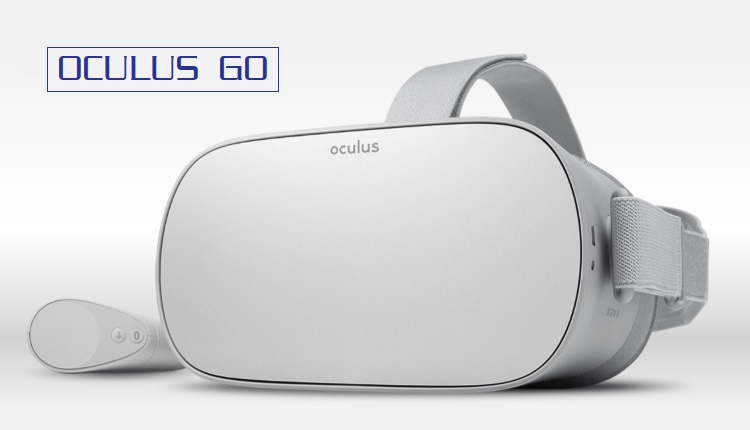
When I got the Oculus Go a few days later, I was excited to try it out. I unboxed it, recharged it via USB, and got it configured -- which was via the Oculus app, downloaded from the Android store. I did the tour to figure out how to run it, then bought and downloaded a roller-coaster game app. Soon I was riding the roller-coaster, and greatly impressed by the experience ... but not for long, because I quickly ran into the next snag in the exercise: motion sickness, or more precisely "VR sickness". I was very nauseous; I've had worse, but this was bad, and my illness lingered for a day.
Oh dear, another obstacle -- but I didn't think it was a show-stopper by any means. I'm not particularly prone to motion sickness, and I like to ride roller coasters. I do have inner ear problems that can get me sick, but I do therapy exercises every day, and they're very much under control. Scouting around online told me that VR sickness is nothing unusual, and in time people work through it, getting their "VR legs" -- like a sailor's "sea legs". It helps to be sitting in a comfortable office chair and sit in front of a fan. The ventilating effect of the fan helps to fight nausea, and it also appears to keep me referenced to the real world.
I figured I'd ride the coaster once a day until I got the hang of it, even if it took months. The second time I tried, I couldn't make it all the way through the coaster ride -- but the third time, I made it, though with my eyes closed about two-thirds of the time. That was faster progress than I expected. With every day, it got easier. It seems it just takes time to convince the brain that there's nothing wrong, and stop making trouble for me. I also pick up tricks, for example squinting or blinking repeatedly, with the "strobe" effect making the imagery easier to deal with.
Controlled breathing -- taking a gasp of breath on a turn, for example -- also helps. VR apps are rated for difficulty, and coasters are rated as aggressive; it appears some VR enthusiasts don't like them. However, at the rate I'm going, I should be okay with it by July. I'm not planning on buying apps beyond the coaster, until I adapt to the headset. However, if I'm not up to speed on the headset by the end of July, I'll have to reconsider my options. [UPDATE: I reconsidered and got rid of the headset, since it always made me sick.]
I was somewhat curious as to what the distinction is between the Oculus Go and the well more expensive Rift. It appears that the Rift, which unlike the Go is dependent on a PC for most of the horsepower, has much more detailed and realistic apps, like a modern high-end videogame. The Go is more along the lines of smartphone games, running an Android system. Think of it as Google Cardboard done right. I'm fine with that -- no problems with a cartoony experience.
I decided not to return the Galaxy S6 phone, since I can always use another computer. Indeed, when I tried to watch an anime video with it, the imagery was much improved compared to the J3. On checking specs, I found out it has twice as much display resolution. The S6 also has an 8-core processor, instead of the four-core processor of the J3. Four of the 8 cores are low speed -- still incrementally faster than the cores of the J3 -- and four are high speed.
I was somewhat curious about how process threads were allocated to the cores by the operating system. Does the OS track the duty cycle of the threads allocated to the cores, and hand the high-duty-cycle threads off to the fast cores? I'll have to learn more. Anyway, other improvements of the S6 over the J3 include:
On the minus side, I couldn't add a flash chip to the S6. It appears that smartphone makers have been giving up on allowing users to install a flash chip -- which makes a certain amount of sense, since few would buy a smartphone with more flash, if they could install a cheaper flash chip. Oh well, my S6 had 32GB, plenty for my needs.
I was particularly interested in the 16MP camera. There appears to be a new wave of AI-enabled camera apps coming out that offer, among other things, really nice night photography. My lackluster road trip Back East in 2016 was partly hobbled by not having adequate low-light photography capabilities at the USAF Museum in Dayton, Ohio. I'm gonna try it again with better gear one of these years. Night modes gang four pixels together, meaning a 16MP camera becomes effectively a 4MP camera -- but that means pictures with about 1750 x 2250 resolution, which is workable.
I got a hard case for my S6 -- it cost about ten bucks, and it's hefty, giving the S6 a militarized look. I'm reserving the old J3 as a game machine, I take it to places where I have to stand in line and kill time. I'm trying to bring both smartphones up to a common software configuration, so I can do the same things on both of them transparently. I'll have to pile up more games, and I'm thinking of getting a cheap made-in-China bluetooth game controller. More fun every day.
BACK_TO_TOPTRUMP CAUSES MORE TROUBLE: The news for June started out slow, to gradually move up to nerve-wracking. Early in the month, President Trump began to make threats about slapping stiff tariffs on Mexico, if the Mexican government didn't do more to deal with illegal immigration. There was a last-minute agreement, whose details weren't all that clear -- suggesting that there really hadn't been much change in the status quo, and the whole kerfuffle was theatrics.
As far as Trump's ongoing trade war with China, there did seem to be some movement by the end of the month, with Trump saying he was willing to give up on his war against the Chinese Huawei company. Unfortunately, Trump says a lot of things, and it's impossible to know what of it to believe. It is also obvious that the Chinese have a motive to bide their time, and wait for Trump to go away.
The Trump Administration also continued to stonewall Congress, blowing off all requests for information and subpoenas of administration officials. Indeed, Trump is fighting back, with Attorney General William Barr promising to investigate the origins of the investigations against Trump. How that will work out remains to be seen. It will either be a dud -- much like Trump's Voter Fraud Commission, which simply died of irrelevance -- or will be a lunatic fiasco that won't do the Trump Administration any good. That one is hard to read.
Trump did raise a cloud of dust in mid-month when he told ABC's George Stephanopoulos that he, Trump, would listen to foreign governments if they provided dirt on political opponents. The dust settled quickly, to be forgotten, since we're all used to this sort of thing. Indeed, later in the month, another woman accused Trump of sexual assault -- getting uncomfortably detailed in the description of what he did to her -- but there was little fall-out from it. People who don't care for Trump know he's like that, his fans don't care, so what could be said?
And then, late in the month, the Environmental Protection Agency released its new emissions standards for the states, which were: "Do whatever you feel like doing." That also didn't amount to much, being no surprise; besides, it's obvious that the next administration will revoke all such Trumpian nonsense ASAP after entering office. More ominously, as discussed in the previous posting, the Trump Administration seems to be drifting blindly towards a war with Iran. The other shoe is yet to drop on that, but it could be any time now.
TRUMP POPULARITY IN DECLINE: It is possible that Trump will win re-election, but it's not the way to bet. Tim Mullaney, a writer for MARKETWATCH.com, gave "Five Reasons Trump Won't Win In 2020" (20 June 2019) -- the first reason being Trump's poor poll numbers:
QUOTE:
Everybody has already made up their mind about Trump -- and his numbers stink. Right now, Trump's net approval rating is -8.5 percentage points in the REALCLEARPOLITICS polling average. FIVETHIRTYEIGHT.com says it's -10%, as 53% disapprove, 43% approve, and 4% won't say. That spread was first "achieved" in March 2017. Trump hasn't narrowed it below nine since, FIVETHIRTYEIGHT says.
In other words, no one's changing their minds about Trump. About 40% of us like his act, if only to "own the libs." Everyone else? Nope.
END_QUOTE
Trump's approval / disapproval ratio is effectively fixed at 45% / 55%. That's not counting the people who don't have a fixed opinion on the matter, but they're the kind of people who say: "Don't talk to me about politics." -- and they don't vote. The Wikipedia page on presidential approval ratings gives a set of charts at the bottom for approval ratings during the terms of modern presidents. The Trump chart is the clearly odd one, since it's effectively flat.
Maybe Trump could eke a win out of the electoral college? After all, he lost the popular vote in 2016 by 2.9 million votes. Maybe he could pull the same rabbit out of his hat? Okay, moving on to the second reason, that's a NO:
QUOTE:
Like, in Michigan, where MORNING CONSULT puts Trump's net approval at minus 12? Trump's Michigan numbers haven't been green in 26 months. MORNING CONSULT says he's doing two points worse than in October, before Republicans lost two House seats there and the governorship.
Trump's polling in Wisconsin? He's minus 13. In Iowa, minus 12, and his party lost two of its three House seats. In Pennsylvania, birthplace of former Vice President and possible 2020 rival Joe Biden, Trump is minus 7, a point worse than last fall. Democrats won the generic House vote in Pennsylvania by 10 points.
Just on those four, Trump's 306 2016 electoral votes fall to 254 (270 needed to win), and it's over. But as many as 215 Trump electoral votes could be in play, based on state-by-state polls.
END_QUOTE
The Red states will vote for Trump, but he's not doing well in the swing states. The Democrats were listless in 2016, voter turnout being only 56%, when it had been 60% or better in the previous three presidential elections. The 2018 mid-term elections had unusually high turnout. The Democrats are determined to vote Trump out in 2020, and so the swing will be more against him than for him. Sure, as Mullaney admits, the race won't really heat up until 2020, and these early numbers are foggy. However, they're not likely to change much unless events make them do so. A war with Iran is likely to make them worse for Trump.
Reason number three ... Trump fans make much of the booming economy, but in yet another strangeness of the Trump Administration, it's not doing Trump much good:
QUOTE:
When the unemployment rate goes to 3.6% from 9.7%, the guy who came along at 4.7% doesn't get the credit. Trump's whole case on the economy is that he should -- but wage growth, already unexceptional, is slowing. So is job growth, at a year-to-date monthly average 26% below 2015, the third year of the last presidential term. Manufacturing job growth has slowed too.
The stock market (Trump's favorite indicator) has stalled ... driven by Trump's on-again-off-again tariff wars. The Dow peaked in January 2018, the S&P last September. That we are back near the peaks shows only that the Federal Reserve has taken the wheel, moving toward more interest-rate cuts.
END_QUOTE
Trump fans like to pretend that he turned the economy around from the economic disasters of the Obama Administration -- which is a preposterous lie, since any chart of economic indicators shows the US economy has been on a steady, gradual boom since 2009. The stock market has now peaked in an unstable fashion; it's only being supported by corporate buy-backs, which will dry up when profits go soft. Corporate inventories are rising, meaning sales are starting to weaken. Economic booms only last for so long, and the chances are fair this one will stall before the 2020 election.
Reason number four, Trump is a bumbler. As Mullaney puts it:
QUOTE:
Right now, Trump's meandering toward armed conflict with Iran. But wartime leadership requires trust, not telling 10,796 lies in office, Trump's count according to the WASHINGTON POST last week. That means Trump either climbs down (again) from his latest pseudo-crusade, or tries war without public support. Neither makes him more popular.
Next, he's throwing himself a July 4 rally at the Lincoln Memorial -- nothing tacky there. Trump will salute Abraham Lincoln's second inaugural, and the anniversary of the Battle of Gettysburg, offering charity toward none and malice for nearly all. Stories about his lack of respect will follow as night follows day.
Then he'll mess with trade again, making your portfolio more volatile. Open more barbed-wire refugee camps. Lose some of their kids. Blow off subpoenas -- keeping investigations of his inauguration, foundation, taxes and Russian influence alive. He even says he'll try another Obamacare repeal bill, after 2017's failures handed Democrats the House. All winners.
END_QUOTE
It is unlikely that another shot at ObamaCare repeal will go anywhere, Senate Republicans having made it clear they aren't going to dance with that elephant any more. Finally, reason number five -- in 2020, Trump won't have any targets as easy as Hillary Clinton:
QUOTE:
The reason Trump is president is Clinton's e-mail scandalette. That and her family's history of diving for dollars, even taking $675,000 for Hillary's speeches at Goldman Sachs. But who's he gonna chant "LOCK 'EM UP" about this time?
Of the Democratic candidates, Elizabeth Warren's well off -- she wrote books, her husband has a good job, and their house is worth five times its 1995 purchase price. All legit. Bernie Sanders became a millionaire through book sales, begrudgingly. Former Colorado Governor John Hickenlooper ran brew pubs. South Bend Mayor Pete Buttigieg has simple finances; he works, and his husband teaches at a Montessori Academy. Biden, who has unfortunately been cashing in on speeches too, made his tax returns public during his vice presidency, and surely will publish his 2016-2019 returns.
Not a lobbyist with his hand out, or foreign potentates staying in their hotels, to be found. Let alone a multi-year tax fraud, as asserted in Trump's case. Trump wants to make hay about Biden's son's businesses, but his own son-in-law met with potential lenders to his real estate business -- in the White House.
END_QUOTE
Mullaney says that Trump needs to retire to Florida, since he's not welcome in New York City:
QUOTE:
New Yorkers like you even less than Washington, so a cloister far from madding crowds is in order. You know the folks who would love you if you shot someone outside Trump Tower? They don't live here.
END_QUOTE
COLORADO BILLS: Locally, there's a movement in Colorado to get rid of our new governor, Jared Polis. The fuss, at least on the surface, is focusing on three bills that he signed: one to allow seizure of guns from people judged a hazard to themselves or others; another to regulate oil and gas exploration in Colorado; and a third to bypass the electoral college.
The first bill has raised the most controversy, with some sheriffs saying they wouldn't enforce it. It's really nothing radical, it just allows people who are worried that somebody they know is a clear and present danger to get a court order to have that person's guns seized.
The second bill followed one that was on the state ballot in 2018 that would have implemented very stiff regulations on oil and gas exploration, amounting to an effective ban. Polis opposed it. The new bill does add modest regulations, but its main thrust is to give localities more power over oil and gas exploration in their backyards -- and also give more power to private citizens, in the face of oil and gas exploration on their lands.
The third bill is trickier to explain. It involved Colorado signing up with the "National Popular Vote (NPV)" pact. The idea is that states that have joined the NPV pledge to give their electoral votes to the presidential candidate who gets the majority popular vote. If states with half the electoral votes sign up, the electoral college is effectively neutralized. The NPV is about two-thirds of the way to that goal.
The amount of baloney the Right generates on the NPV is remarkable. "It's unconstitutional, and will be struck down!" Wrong, the Constitution explicitly allows states to handle their electoral votes any way they want. "Smaller states will lose their clout!" That one is particularly disingenuous. Only five presidents have won the electoral college vote, but lost the popular vote -- and none of them were Democrats. The Right's pitch on this is effectively: "It's only fair that our votes should count for more than yours."
With the reply: "Well, no." Besides, the third time a winner lost the popular vote was in 1888, with the fourth being in 2000; and during that interval of over a century, the electoral college was a non-issue. And another thing: why would anyone really want to be president when the majority of Americans are unhappy with the idea? It would seem like asking for trouble.
There's a fourth reason that the Right wants to get rid of Jared Polis: he's gay. He was my / our man in the House of Representatives for ten years, and I've voted for him repeatedly. I didn't know he was gay until the 2016 election, but then I didn't care. Not too much fuss is made about his sexual orientation in print, but one suspects it's a significant factor in the controversy ...
... such as it is. The push for a recall vote to get rid of Polis is working uphill, since they can't have a recall election until an official has been in office for six months, and they have to get a quarter of the people who voted in the original election to petition for the new election. Oh yeah, they also have to get the signatures in 60 days. "Good luck with that."
The real significance of this farce is that it gives a hint of what America after Trump will be like. Trump pumped up his voter base, giving them a sense of empowerment; they won't take his fall very well. How that plays out remains to be seen. It could be comical, it could be horrific; most likely, it will be mostly the first, and some of the second.
CLASSIC FINANCIAL TEXT: As discussed in an article from ECONOMIST.com ("The First Folio Of Finance", 6 June 2019), in mid-June, Christie's auction house in New York City put up for bid an original, first-edition copy of Luca Pacioli's SUMMA DE ARITHMETICA, GEOMETRIA, PROPORTIONI ET PROPORTIONALITA. Nobody needs to know any Italian to recognize that the SUMMA is a math text -- but on the face of it, it's hard to see what significance it has.
It started in Venice, Italy, when a prominent merchant named Antonio de Rompiasi hired young Pagioli to tutor his three sons in math. Working this start, Pagioli decided to write a survey of his field for a popular audience; and 30 years later, published the SUMMA, 615 pages long. It was a brilliant piece of work, innovative in several respects:
However, the greatest significance of the book was in a slim "how to" chapter that described the double-entry accounting system in use by Venetian merchants. Leveraging off examples from dealers in butter, to lemons, to silk, Pacioli laid out the method for tracking income and expenditure and the calculation of net profit or loss, which for the first time allowed an immediate snapshot of a firm's financial position.
Pacioli's book helped lay the foundations for the modern corporation. It wasn't just that he explained new ideas; he explained them clearly, and in a lively style. The book is littered with quotes from scripture and Dante, along with his own "bon mots" such as: "Without order there is chaos." -- well OK, and -- "Don't learn from ignoramuses who have more leaves than grapes." -- which is advice still relevant today. He wrote the accounting chapter to help aspiring traders in Venice, then the capital of the financial world, "sleep easily at night". Without double-entry book-keeping, he said, "their minds would keep them awake with worry."
Impressed by the book, Leonardo da Vinci suggested that his patron Lodovico Sforza to hire Pacioli to teach at the court of Milan. Pacioli and Leonardo collaborated on the treatise DIVINA PROPORTIONE, which linked math with art through the study of perspective -- and so linked Pacioli to the balance and harmonies of Da Vinci's THE LAST SUPPER.
About a thousand copies of the first edition were printed, of which about 120 survive. Christie's, in auctioning off the book, proclaimed it "the most influential work in the history of capitalism". The final bid was $1.215 million USD.
SAME-SEX MARRIAGES WITH KIDS: As discussed in an article from CNN.com ("This Gay Married Couple Wanted To Have A Child. Their Family Members Stepped In To Help" by Jay Croft and Deanna Hackney, 30 March 2019), a gay couple of the names Matthew Eledge and Elliot Dougherty, of Omaha NE, decided they wanted to start a family. As Eledge says:
QUOTE:
When you are gay and married and want to have a kid, you go into it with the knowledge that you are going to have to create a family in a special way. There are creative, unique ways to build a family.
END_QUOTE
Indeed. Eledge fathered the child through in-vitro fertilization, with Dougherty's sister, Lea Yribe, providing the egg. Now here's where it gets really imaginative: Eledge's mother, Cecile Reynek Eledge, age 61, was the surrogate mother. She gave birth to Uma Louise Dougherty-Eledge on 25 March 2019, the baby being in good health.
There were a few huffy comments about this on Twitter, but for myself, I was greatly amused. When I was a lad, reading sci-fi novels in the 1960s, I had this wonder of how the world would be in the 21st century. Now I'm finding out: "This is wild!"
[UPDATE: As of 2025, it turns out that maybe a fifth of same-sex marriages have kids, with lesbian couples being well more enthusiastic about kids than gay couples.]
CAR MP3 PLAYER: I took my spring day trip south to Denver early in June to take photos at Denver International Airport (DIA) and the Denver Zoo. The session at DIA went very well; I was shooting on a Friday morning, and the air traffic was much more substantial than on other weekdays -- I'd been missing a bet. The trip to the zoo didn't yield too many shots, since it was warm, and the animals were inactive.
The most interesting thing that came out of the trip concerned the digital music player that I had plugged into my car cigarette lighter socket, which played through the FM radio. It had a USB port on it for a flash drive; I wondered if I could use it to trickle-charge my smartphone. Bad idea -- it fried the player. "Duh."
Oh well, the player was cheap, and I got to wondering if a similar gadget was now available that also had USB charger outlets. I checked on Amazon, and found much more advanced players that did. I bought one for $20 USD, made by the Victor Tsing company, and had it shipped to me on two-day.

It's a really fun gadget, with dual USB outlets. The old player was a real pain to use, but this one has a nice display and is a snap to use. It even gives voice announcements of settings -- female voice, British accent -- which is most handy while driving. It has a microphone and a bluetooth link as well -- I think I could use it as a hands-off phone interface, but I've got no use for that. When I'm driving, I plug in my smartphone into it to keep it charged up. Next, I've got to get some bluetooth earphones, and see how I can fit them into my cobbled-together system of gadgets.
BACK_TO_TOP
