
* This is an archive of my own online blog and notes, with monthly entries.
TRUMP'S MUDDLING: The news for the month effectively began on the 4th of July, with President Donald Trump as master of an Independence Day parade in Washington DC. There was considerable sniping at Trump over the matter, which tended towards the overwrought; after all, we have had military parades and such on the 4th of July on occasion. There certainly was a basis for complaint in the way Trump used the event as self-promotion, though for once he generally stayed on script. The script, however, got a bit jumbled, with Trump announcing:
QUOTE:
In June of 1775, the Continental Congress created a unified Army out of the Revolutionary Forces encamped around Boston and New York, and named after the great George Washington, commander in chief. The Continental Army suffered a bitter winter of Valley Forge, found glory across the waters of the Delaware and seized victory from Cornwallis of Yorktown.
Our Army manned the air, it rammed the ramparts, it took over the airports, it did everything it had to do, and at Fort McHenry, under the rocket's red glare it had nothing but victory. And when dawn came, their star-spangled banner waved defiant.
END_QUOTE
"Huh? Who? What? Where? How?" Trump later said his teleprompter was acting up. Whatever; this matter being done with, we then moved on to other things.
For example, on 11 June, Trump conducted a "social media summit" at the White House, which was a very peculiar exercise. Big-name social media operations like Facebook and Twitter were not invited; it was instead populated by figures from Right-wing "alternative media" -- the focus of the event being to complain about the way social media has, allegedly, discriminated against conservatives. As Trump put it in a tweet:
QUOTE:
A big subject today at the White House Social Media Summit will be the tremendous dishonesty, bias, discrimination and suppression practiced by certain companies. We will not let them get away with it much longer.
END_QUOTE
Trump claims that Twitter has deleted his followers, and is making it hard for people to follow his account. True, Twitter has cracked down and deleted accounts that appear to be fakes, but other public figures like Barack Obama were given the same treatment; and as far as people following Trump's account go, he doesn't seem to realize that, eventually, everyone who is interested in him will follow him, and then follows will dry up.
Trump also complained about "shadow banning", meaning conservative outlets being suppressed in web search engines. This was over-reacting, attempting to see patterns in search engines that are simply not all that easy to second-guess. Anyone experienced user who frequents the online world knows that systems do puzzling things on occasion, and it's nothing personal. Naive users think it is.
In addition, the Right seems to have real problems understanding that social media has community standards, which vary from one outlet to another. The standards are sometimes whimsical, but in other cases only too justified; is it acceptable, for example, that people can spread bizarre and slanderous conspiracy theories? What's particularly ironic is that Twitter's standards are notably loose: I can get away with snark that would get me kicked off of some forums. To be sure, I don't use harsh or explicitly insulting language, preferring mockery instead.
One of the (multiple) little ironies of the "summit" was that nobody was invited who had actually been banned by Twitter or Facebook. It appears, from inquiries by journalists, that the Trump Administration was reluctant to spell out an association with well-known nutcases like conspiracy maniac Alex Jones.
Incidentally, after the complaining about Facebook and the like, that very same day the Federal Trade Commission hit Facebook with a $5 billion USD fine for user privacy violations. That's the biggest fine the FTC has ever imposed. The result? Facebook's stock value went up. The vote on the fine was 3 to 2, Republicans for, Democrats against; the Democrats were unhappy because the fine was seen as so lenient, a month or three of Facebook revenue, the Democrats wanting to add another zero to it. So ... Trump threatens Facebook in tweets, while the FTC lets the company off easy.
Actually, the fine seems appropriate: it was enough to get Facebook's attention; what sense did it then make to seriously injure the company? Again, it was the biggest fine the FTC had ever imposed. Facebook does seem to be contrite -- to no surprise, after the flogging the company has suffered -- and besides, as noted here before, the problems afflicting Facebook are not unique to it. As Facebook CEO Mark Zuckerberg has pointed out, the US government has still not articulated coherent policies on how online businesses should be run. It's hard to step on Facebook for breaking the rules, when the rules are unclear, and a lot of the politicians are clearly befuddled on the issue.
As another incidental, while Scott Pruitt was mismanaging the Environmental Protection Agency, he pushed for a debate on climate change. That didn't go anywhere; climate change denial is in flat-Earth territory, and the White House would have simply looked dishonest and ridiculous. Over the past few months, the notion of a debate started up again, this time under the direction of Bill Happer -- an elderly and dotty climate-change denying physicist who has the ear of the White House. At about the same time as the social-media summit, the word went out that the debate had been quietly called off again. It was a bit disappointing that it was: Happer would have been shot full of holes, and might well have been targeted by US science groups for professional misconduct.
SQUAD FEUD WITH PELOSI: These little flotches were followed by a noisier, but equally absurd one, beginning in mid-July, when the House of Representatives voted to pass an emergency funding measure to address the current difficulties in handling illegal immigrants on the US southern border. The bill, which originated in the Senate, wasn't what House Speaker Nancy Pelosi wanted, lacking protections for the immigrants -- but there was no way to get the votes for anything better, and something had to be done.
The bill led to bitter recriminations from "the Squad" -- four hard Left freshman Democrats in the House, including Alexandria Ocasio-Cortez (AOC) of New York, Ilhan Omar of Minnesota, Ayanna Pressley of Massachusetts, and Rashida Tlaib of Michigan. Irritated by comments by Pelosi that were dismissive of the Squad, and only lightly restrained, AOC hit back, saying: "... the persistent singling out ... it got to a point where it was just outright disrespectful ... the explicit singling out of newly elected women of color."
This was an only lightly veiled way of calling Pelosi a racist, and there was predictable bickering among the Democrats in the House. It didn't last long. In mid-month, Trump tweeted:
QUOTE:
So interesting to see 'Progressive' Democrat Congresswomen, who originally came from countries whose governments are a complete and total catastrophe, the worst, most corrupt and inept anywhere in the world (if they even have a functioning government at all), now loudly and viciously telling the people of the United States, the greatest and most powerful Nation on earth, how our government is to be run.
Why don't they go back and help fix the totally broken and crime infested places from which they came? Then come back and show us how it is done. These places need your help badly, you can't leave fast enough. I'm sure that Nancy Pelosi would be very happy to quickly work out free travel arrangements!
END_QUOTE
All four of the Squad are, of course, US citizens; Omar is the only one who wasn't born in the USA. The bickering among the Democrats in the House abruptly stopped, with a unified response that such a bigoted remark was entirely inappropriate for the White House. Trump backtracked a little, but then just doubled down again; the backtracking was just the usual gaslighting.
The furor was a little baffling, since Trump's comments were exactly what we've come to expect from him, they were no surprise. It does appear that Trump is now singling out the Squad, using them to paint the Democrats as "radical socialists", whatever that really means, to energize his voter base for 2020. Well OK, good luck with that: his voter base is loyal to him, no matter what, while everything he does to inspire them antagonizes everyone else.
IMPEACHMENT MUDDLE: Anyway, this bumbling exercise led directly to another one. The House passed a measure of censure for the president's remarks, with all Democrats voting for it, and four Republicans joining in. Representative Al Green, a Texas Democrat, then tried to push a motion of impeachment against the president through the House; it was voted down resoundingly, 332 to 95, with 137 Democrats voting against it.
Green says he's going to try again. One would wish this futile talk of impeachment would just fade out, but that may be too much to ask. That was underlined on 24 July, when Robert Mueller testified to Congress concerning his report on Russian interference in the 2016 election. It was something of a strange exercise; Mueller had made it clear ahead of time that he didn't want to testify, people should just read the report, and that he wouldn't go beyond the report.
He didn't. In other words, the testimony didn't change the status quo in the slightest. Somehow, even though Mueller said absolutely nothing new to encourage impeachment proceedings, many Democrats thought he had given them a green light, with an uptick in support towards that end. Even at that, however, the majority of Democrats in the House of Representatives weren't in favor of impeachment, and there was no chance of getting a motion of impeachment through the House, much less confirmed by the Senate.
Advocates say they only want an "impeachment investigation" -- but that sounds like either a meaningless gesture, or a back-door approach towards an impeachment vote. Either way, it still seems futile. One can only hope that, come New Year's 2020, the urge to get rid of Trump in the increasingly short time before the election will fade. There is, of course, the possibility that Trump could win another term; it's not likely, but if it were to happen, it would simply underline the futility of impeachment, demonstrating its lack of public support. In any case, there was no reason to think impeachment would, one way or another, ever amount to much.
The Republicans were in worse shape after the Mueller hearings, since Mueller repeated his statement that he could offer "no exoneration" for the White House concerning obstruction of justice; that his investigation could not pursue the matter further, because Department of Justice rules didn't allow him to do so; and that Donald Trump would be perfectly open to charges after he left office.
The Republicans tried to undermine the credibility of the investigation, but nothing they said made any headway -- while they also chained themselves more strongly to Trump, failing to acknowledge he's a slowly sinking ship. It was observed early on in the investigations against Trump that there was no cause to think they would uncover any smoking guns; but Trump would never be able to get them to stop, either. He hasn't, and there's no prospect he's going to. He's finding out what it's like to be pecked to death by ducks.
TRUMP V IRAN: The strain is showing on him. By the end of the month, the "send them back" nonsense against the Squad had been displaced, when Trump lashed out at Representative Elijah Cummings, a black Congressman from Maryland and a persistent Trump critic, describing Baltimore, parts of which lie in Cummings' district, as "disgusting" and a "rat and rodent infested mess". The BALTIMORE SUN replied with a flaming editorial, with Trump of course doubling down in turn, telling reporters:
QUOTE:
What I've done for African Americans, no president, I would say, has done. Now, I'll say this: they are so happy, because I get the calls. They are so happy at what I've been able to do in Baltimore and other Democratic-run, corrupt cities.
END_QUOTE
That was laughable, since Trump's approval ratings among black Americans are pathetic -- but again, it was all perfectly predictable, exactly what we've seen many times before from Trump. Everyone knows what he's like.
Much more ominously, the Iranians were continuing to ramp up the pushback on Trump's sanctions against Iran -- seizing a British-flagged oil tanker, arresting a group of people as CIA spies. It appears they are trying to ramp up provocations in a very slow and methodical fashion, not repeating any of them if they can help it. The message is simple: "America will honor its agreements with Iran, the US will drop sanctions, or you'll get a war."
The Iranians do seem to understand that Trump is essentially theatrical, and have offered "concessions" -- that don't amount to any change in the status quo. They know that doesn't matter; if Trump can claim a win, he doesn't worry whether it amounts to anything or not. For now, however, he's continuing to bluster. He hasn't got the message yet, and so the Iranians will keep on turning up the volume.
It seems in response to Iranian agitation, Trump briefly made comments about nuking Afghanistan, with the Afghan government asking for clarification. The answer, of course, was: "Pay it no mind -- it's just Trump talking wild nonsense to distract people from Iran." The Iranians, however, are not going to allow themselves to be ignored.
ENCRYPTION BACK DOORS: As a postscript, in late-breaking news, US Attorney General William Barr has now come out to push tech companies to build encryption "back doors" into their products, so the authorities can crack them. This controversy has been going on for a long time; the case of the authorities sounds convincing -- but the problem is, if the government can break a user's encryption, then so can the Black Hats.
US companies will also find it difficult to sell product outside the USA if foreign users know the US government can crack into them. Hasn't the Trump Administration made a huge fuss about the potential security threats from Huawei products? Besides, users will still be able to get encryption tools from off the internet -- but they will be badly corrupted by the Black Hats.
In other words, the request for a government "back door" into encrypted systems is about as backwards, naive, and unrealistic as the government demanding keys to everyone's houses. Apple, long a booster of user security, will reply with a loud NO, and get a lot of support from other tech industries. There will be a legal tangle that, assuming Trump isn't re-elected next year, won't be resolved before he leaves office. In the meantime, however, the matter is going to be a complete nuisance.
BORIS BECOMES PM: On 23 July, Boris Johnson became prime minister of the United Kingdom. He went into office with a promise to deliver Brexit -- saying that he would renegotiate the Brexit deal with the EU. If the EU didn't want to renegotiate, Johnson says that Britain will leave without a deal, on 31 October 2019.
The EU has repeatedly, wearily, stated they won't renegotiate the deal, and it appears that Johnson believes them -- since his government is, by all indications, working towards a no-deal Brexit. Since the clear majority of Britons don't want a no-deal Brexit, there's going to be a crash. Labour and the Liberal Democrats don't want a no-deal Brexit, and neither do many Tories. It has been suggested that Johnson's ministry may be one of the shortest in Britain's history. He was placed in office by a majority vote among the Tories, but he is only supported by a minority of the British public. He is unlikely to be able to stand a vote of no confidence if it comes to that.
Nobody, however, feels confident in predicting what's going to happen next. Indeed, the ascension of Johnson to #10 Downing Street is really just chaos as usual, only mildly newsworthy, since nothing has changed, nothing has become clear -- except that the Tories are in an ongoing implosion, and Labour isn't healthy, either. Where Britain stands a year from now is anybody's bad guess.
GOOGLE ENERGY KITE: As discussed in an article from NBCNEWS.com ("Enormous Energy Kite Promises A New Way To Harness Wind Power" by Denise Chow, 4 December 2018), the idea of flying kites to obtain wind energy is not new. In a recent such exercise, Makani -- a firm out of Alameda, California, one of the components of Alphabet's secretive Google X lab -- has developed a prototype power kite. It's actually in the configuration of a tethered sailplane, the tether transferring the power to a ground station. It has a wingspan of 26 meters (85 feet) and eight rotors, with four under and four over the wings, to generate power. It follows a smaller demonstrator with four rotors.
The kite's eight generators driven by the rotors can act as motors to allow the kite to climb to operational altitude. The kite orbits in a circle at an altitude of about 300 meters (1,000 feet), generating about 600 kilowatts. That's equivalent to a rather small ground-based wind turbine -- but the kite has access to stronger, less turbulent, and more persistent winds.
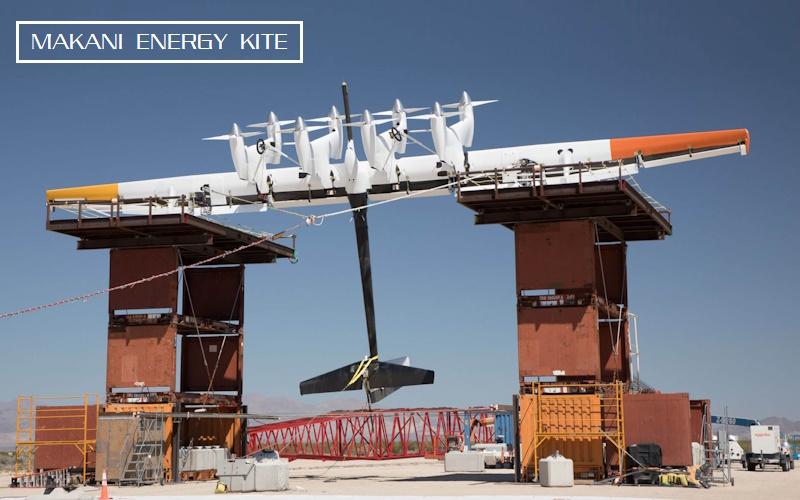
The company also says that, unlike a ground-based wind turbine, the kite is transportable, being made of lightweight carbon composites, and could be quickly sent to a location in need of emergency power, or which needs to set up a power system quickly. It is unclear just how competitive the price is compared to a ground-based wind turbine, and there are no specifics on when the kite system will be fielded.
STORM AREA 51: A Facebook posting early in July proposed that readers should: "Storm Area 51, They Can't Stop All of Us". Area 51 is, of course, the secret military test facility in Nevada, supposedly concealing aliens. The assault date was set for 20 September 2019.
It was obviously a gag, but the proposal got millions of LIKEs, and the assault became an internet meme. The military issued stern warnings about invading the top-secret site -- which seemed a bit humorless, but there are people who are clueless enough to do ridiculous and crazy things. Hotels in the area are now booked up. The assault may well become a yearly festival of sorts; small towns in the region are likely to encourage it, though anyone organizing the event will need to establish rapport with the authorities.
EMOJIS V THE COURTS: As discussed in an article from CNN.com ("Emojis Are Increasingly Coming Up In Court Cases" by Samantha Murphy Kelly, 8 July 2019), whenever a new technology comes along, the courts have to play "catch-up" and figure out how to deal with it.
As a case in point, consider the humble "emojis", the little icons that we use to decorate our emails and Twitter posts. They started more or less from the "happy face", but they have acquired a much wider range of expression from that time, with a correspondingly wider range of interpretation. For example: Does a knife emoji establish a threat of murder? Is a heart emoji sexual harassment? Lawyer Jason Levine, who has worked on cases involving emojis, told CNN:
QUOTE:
Many courts haven't had to deal with the emoji much, but the numbers are up, and it will likely increase. Judges aren't prepared for the influx, especially ones who are older and may not be familiar with newer vernacular.
END_QUOTE
Courts do not have guidelines on emojis; there are some judges who don't regard them as admissible evidence. About 50 cases in the USA involving emojis surfaced in the first half of 2019, mostly related to sexual harassment and criminal cases. They've been building up over the past few years. Emojis are increasingly showing up in workplace lawsuits, as well. For example, in an employee termination case related to a possible violation of family medical leave, a manager sent a series of smiley face emojis. The plaintiff's lawyers claimed it was evidence the company was happy to let her go. Lawyer Karen S. Elliott, who has also worked on emoji-related cases, says:
QUOTE:
Someone may use threatening symbols, a gun, a pointed finger, and then behind it put a symbol for JUST JOKING, There is a lot that could get lost in the translation. Was it a joke? Or was it serious? Or was the person just using the emoji to hedge so that they could later argue it was not serious?
END_QUOTE
The meaning of emojis can be ambiguous, and worse, a code for an emoji can have different appearances on different platforms. Nonetheless, Elliot says that courts are becoming increasingly skeptical of the old and weary: "I was just joking!" -- defense for emojis:
QUOTE:
As long as the threat is conveyed, it remains a threat, For example, you can't yell FIRE in a crowded theater and then say: JUST JOKING.
END_QUOTE
Law professor Eric Goldman -- of Santa Clara University in California, who tracks the emoji issue -- says:
QUOTE:
With the proliferation of any new technology, there is an adjustment period for everyone, including judges. As judges become more familiar and comfortable with emojis, they will figure out the best ways to adapt existing legal principles to [them].
END_QUOTE
BACK_TO_TOPTRUMP MUDDLE GONE WILD: In the news for August, everything's s starting to fall into a dull pained blur. Following another spate of mass shootings, there was the usual talk of gun-control measures, with President Donald Trump making noises about background checks -- which nobody imagines will amount to anything. His trade war with China continues unabated, with the Chinese seeming to push back harder the more he pushes them. It's making markets nervous. Nobody thinks that a fall is imminent, but the economy is showing signs of instability.
In the meantime, the usual nonsense is coming out of the White House. The suicide of Jeffrey Epstein -- one of the mega-rich, arrested on charges of running a sex-trafficking ring focused on juveniles -- in jail on 10 August did not change the tune being played over and over again. Epstein had many associations with the rich and powerful; Donald Trump, possibly to cover up his own links to Epstein, started spreading a ridiculous conspiracy theory that Bill Clinton had him murdered.
One David Frum -- once a staffer with the George W. Bush Administration, writing in THE ATLANTIC -- asked what the response would have been had Richard Nixon publicly played up the creaky conspiracy theory that Lyndon Johnson had John F. Kennedy assassinated. The result would have been public shock. The reaction to Trump? A shrug: "Like we'd expect anything else?" As Frum put it:
QUOTE:
By now, Trump's party in Congress, the members of his Cabinet, and even his White House entourage all tacitly agree that Trump's occupancy of the office held by Washington, Lincoln, FDR, and Eisenhower must be a bizarre cosmic joke, not to be taken seriously. CNN's Jake Tapper on August 2 quoted a "senior national security official" as saying: "Everyone at this point ignores what the president says and just does their job. The American people should take some measure of confidence in that."
Everybody at this point ignores what the president says.
END_QUOTE
There was, after Trump's 2016 upset electoral victory, smug proclamations from Trump's supporters that liberals had "taken Trump literally, but not seriously." To the extent that was true then, it isn't now: he can't be taken either literally or seriously, and no serious person on either side of the aisle does either. Frum adds:
QUOTE:
Neither the practical impediments to impeachment and the Twenty-Fifth Amendment process, nor the foibles and failings of the candidates running to replace him, efface the fact that this presidency shames and disgraces the office every minute of every hour of every day. And even when it ends, however it ends, the shame will stain it still.
END_QUOTE
One Joe Walsh, who runs a conservative radio talk show and did a term in the House of Representatives, seems to be looking beyond the Era of Trump, having announced he will challenge Trump in the primary election for Republican candidate for president. While ramping up attacks on Trump, he has retracted some of the extreme statements he made in the past, for example saying it was untrue to say Barack Obama is a Muslim. His radio show was promptly dropped by the Salem Radio Network, a conservative Christian operation.
It is of course absurd to think that Walsh will prevent Donald Trump from becoming the Republican nominee in 2020, and Walsh certainly knows it. What he may well be doing is positioning himself for a leadership position on the Right in the era after Trump. As the saying goes: "By being in the rear of the advance, you can be in the forefront of the retreat."
[ED: It was impossible to say in 2019 just how big a deal Trump's Epstein connection would become in 2025.]
TRUMP'S JUVENILE FOREIGN POLICY: The lunacy of the Trump White House, of course, is on a global stage. Late in the month, Trump went to the G7 Summit in Biarritz, France -- where reports indicate he got into a heated argument with the other G7 leaders for refusing to re-admit Russia to their ranks. Trump's fascination with Putin has always been difficult to understand, particularly since it has drawn so much suspicion down on Trump. More generally, it suggests the incoherence of Trump's foreign policy -- which was highly by an essay by one Daniel Larison in THE AMERICAN CONSERVATIVE in April, with the title of: "There Is No Trump Doctrine".
To the extent that the Trump Administration has articulated a foreign policy, it is, as Trump himself has said: "Don't be a chump." In this vision, Trump is a hard-nosed nationalist who, unlike his predecessors, doesn't put up with nonsense from other countries. Larison suggests there is nothing in Trump's conduct to suggest he is anything of the sort:
QUOTE:
If the "core" of Trump's foreign policy is not to be a chump, that can't account for why he has repeatedly given US clients in the Middle East whatever they want in exchange for nothing. It doesn't explain why he walked away from a nonproliferation agreement [with Iran] that was working exactly as intended, and proceeded to wage economic war on the country that was faithfully adhering to the agreement. It definitely doesn't explain why he has gone out of his way to insert the US into [Venezuela's] internal political crisis in a push for regime change that has nothing to do with American interests. The list could go on, but the point is that Trump has opted for policies that impose costs on the US without having anything to show for it.
END_QUOTE
Trump fancies himself cleverer than his predecessors, when he is simply juvenile. No other president ever met with one of the Kims? That's because the other presidents knew it wasn't in American interests to do so:
QUOTE:
[Trump] makes decisions that his predecessors chose not to make because they understood the implications and costs better than he does, and then he prides himself on having done something "nobody ever did before." There is no "Trump Doctrine" as such. There is a hodgepodge of competing influences and factions in the Trump administration, and depending on which ones happen to be ascendant on certain issues, the capricious president will go this way or that without any pretense of consistency or overall strategy.
END_QUOTE
Trump is noted for his practice of "ruling by chaos", playing his people off against each other, so he can ensure they are weak, and he is calling the shots -- if not exactly in control. One Michael Anton, previously a Trump Administration staffer, did try to articulate a Trump Doctrine:
QUOTE:
It can be stated like this: Let's all put our own countries first, and be candid about it, and recognize that it's nothing to be ashamed of. Putting our interests first will make us all safer and more prosperous. If there is a Trump Doctrine, that's it.
END_QUOTE
Larison calls this a "banality". CNN's Fareed Zakaria went farther, effectively labeling it a fraud: "What country has not put its own interests first? What president has argued to give preference to global interests over American ones?" Donald Trump simply does not understand what America's interests really are -- and as a result, all we end up with is a reality-TV show, broadcast to the world.
As parting comment on the Era of Trump, an innovation has been catching on in the USA: bullet-proof knapsacks for schoolkids. This is beyond any dark humor; it is simply appalling.
HOPEFUL SIGNS IN EASTERN EUROPE: As discussed in an article from ECONOMIST.com ("The Eastern Summer", 8 August 2019), this year Europe celebrated 30 years since the fall of the Iron Curtain. The celebrations are muted by the fact that the hopes for emergence of democratic states in the East have been dampened by the emergence of Right-leaning regimes, inclined to authoritarianism, in such countries as Poland and Hungary. The former Soviet states seem even more bogged down in retrograde governance. In the gloom, there are glimmers of hope, and they seem to be picking up pace:
Putin managed to fire up Russian nationalism with actions such as the annexation of Crimea, but such grandstanding has little staying power. There was another big demonstration on 3 August, even though the authorities were threatening to deal harshly with the protests -- and are believed.
Women have been taking a leadership role in the protest. One of the leaders of the Moscow opposition is Lyubov Sobol, an anti-corruption campaigner, who was arrested. Other woman leaders include Canan Kaftancioglu, prominent in the Turkish opposition; Laura Kovesi, a Romanian graft-buster who will become the EU's first public prosecutor; and Barbara Nowacka, who led women's protests against reactionary social "reforms" in Poland.
Eastern Europe is not yet ablaze; the protests and elections have been about local issues -- though they do have common elements, including large numbers of young people, and a slant towards the EU. They do not present any of the regimes with a substantial threat to their rule. Nonetheless, the rulers are facing challenges, and it seems unlikely the challenges will diminish. The EU, currently under pressure from nationalists, has yet to reach out to liberals in the East -- but if the European Union really stands for the best values of the democratic West, it can hardly avoid doing so.
TRUMP INADVERTANTLY BOOSTS XI: As discussed in an article from REUTERS.com ("Amid Crises, Frayed US Ties Give China's Xi Political Cover At Home" by Michael Martina and Kevin Yao, 16 August 2019), US President Donald Trump's trade war with China has put the country under severe economic pressure. However, Chinese President Xi Jinping doesn't seem to be under any particular political stress for the moment, since all the troubles Trump makes for China can, of course, be blamed on Trump. Indeed, Xi can blame Trump for troubles the US has little to do with.
One Chinese government advisor, speaking anonymously, said that there was internal discussion when the trade war began, but that has ended, the perception being that the USA "is trying to contain China no matter what we do." Trump has imposed tariffs, to back off of them to an extent, while then accusing China of currency manipulation -- even though the International Monetary Fund says there's no reason to believe so. According to the advisor, the Chinese see Trump as insincere and incoherent: "Many people will feel it is worthless to negotiate with Trump."
Trump has unified Chinese society against him. Jude Blanchette -- the Freeman Chair in China Studies at the Center for Strategic & International Studies in Washington DC -- says: "Xi Jinping is lucky insofar as he has a mercurial United States president who is making the case for him that the reason US-China relations have turned in such a dire direction is because there is an unpredictable US leader."
Indeed, Xi has found it convenient to blame the US for the actions of "violent radicals" in Hong Kong, America being labeled as the "black hand" behind the agitation. Still, the use of Trump as a bogeyman goes only so far, since Xi has no good options to deal with the Hong Kong protests, and is stuck with the economic damage Trump is doing China. Xi needs to make social and economic changes, and at present, Trump has effectively removed the pressure to do so. Another government advisor said: "Reforms are not moving forward and not going backward. The problem for the economy will not be big this year. We need to watch next year. It will definitely be troublesome."
For the time being, reform in China is stalled. To an extent, however, US presidential elections next year give Xi some hope. He can't trust a deal with Donald Trump -- and if Xi gave Trump a deal, it might help Trump get re-elected. On the other side of that same coin, if China makes as much trouble for Trump as possible in October 2020, it will work against him in the November election. The Chinese can threaten to raise tariffs sky-high, but say it won't happen until after the election.
Once a new US administration is in office, the two countries can work towards a deal, presumably under the relatively impartial judgement of the World Trade Organization. If Trump wins re-election, they'll just have to bear with him for four more years.
TRADE WITH VIETNAM: As discussed in an article from BLOOMBERG.com ("Vietnam Won the US-China Trade War, But Is Now in Trouble Itself" by Xuan Quynh Nguyen and Nguyen Dieu Tu Uyen, 5 August 2019), Vietnam has been a beneficiary of US-China trade slugfest, with foreign companies scrambling to set up production there. Vietnam has a young and relatively cheap labor force, a stable government, and business-friendly policies. Intel and Samsung were among the first big foreign companies to find Vietnam attractive: now they cumulatively employ more than 182,000 Vietnamese.
Makers of athletic shoes and video games are now moving in as well. In the first six months of 2019, the Vietnamese government granted investment licenses to 1,720 projects, 26% more than the same period last year. However, the Vietnamese trade surplus with the US grew by 39% as well, attracting the attention of the Trump Administration. Trump's people suspect that Vietnam is simply acting as an intermediary by other countries to evade tariffs, a scam known as "trans-shipment". In July 2019, the Trump Administration slapped 400% tariffs on Vietnamese steel that, so it is claimed, actually came from South Korea and Taiwan. Not surprisingly, the Trump Administration is also accusing Vietnam of being a currency manipulator.
The Vietnamese have responded to American concerns, promising to buy more US products, such as Boeing jetliners. Vietnamese Prime Minister Nguyen Zuan Phuc has ordered a crackdown on Chinese firms attempting to trans-ship product through Vietnam. Vietnam does have some leverage with the Trump Administration, in that Vietnam doesn't very much like China either, and is pushing back on China's ambitions in the South China Sea. Nonetheless, the Vietnamese clearly would like to see the back of Trump and his capricious, haphazard approach to international commerce. For now, business is booming in Vietnam, but a further change in the winds from the White House could well bring the boom to a whimper.
BREXIT & GLOBAL DEMOCRACY: As discussed in another article from BLOOMBERG.com ("There Are Better Ways to Do Democracy" by Peter Coy, 10 April 2019), the 2016 Brexit vote was a British experiment in direct democracy. It didn't go well: the Leave campaign went into high gear, presenting Britain's citizens with a long list of grievances against the European Union -- many of which were greatly exaggerated, when they weren't outright fabrications -- and a long list of benefits from leaving the EU -- which tended towards the fantastical as well.
Leave won, but only barely, ensuring continued social antagonism. To add to the difficulties, there was no working plan in place for carrying out Brexit, so Theresa May's government had to devise one. Remainers weren't happy with any Brexit plan, Leavers weren't happy with any realistic Brexit plan, and the result was a loud, angry gridlock that persists with no end in sight.
Brexit is a manifestation of a global problem: citizens want elected officials to be responsible, but the citizens don't necessarily want to be responsible themselves. Poorly-conducted referendums like Brexit then become gang fights between extremists that generate impossible problems, instead of solving them. Maybe there are better ways?
One possibility is "guided deliberation" AKA "deliberative democracy". Ireland, with a tradition of severe restrictions on abortion, chose that route when pressure for change became inescapable. In 2016 and 2017, a 99-person Citizens' Assembly -- selected to mirror the Irish population, and guided by a chairperson from Ireland's supreme court -- evaluated inputs from lawyers and obstetricians, pro-life and pro-choice groups, plus more than 13,000 written submissions from the public. The assembly recommended a major relaxation of Ireland's laws on abortion, with the recommendations presented to the voters in a 2018 referendum. The vote was YES, and abortion became legal in Ireland in January 2019.
A recent article on SCIENCEMAG.org commented that "evidence from places such as Colombia, Belgium, Northern Ireland, and Bosnia shows that properly structured deliberation can promote recognition, understanding, and learning." In response to the recent "yellow vest" protests, French President Emmanuel Macron conducted a three-month "great debate" to solicit the public's views on some of the issues raised by the sometimes-rowdy Yellow Vest movement. One key finding was that French citizens have "zero tolerance" for new taxes -- suggesting that citizens still don't quite get contradiction the between demanding responsible government while evading responsibility themselves.
Another scheme to improve democracy is to change how people vote. There's growing interest in "ranked-choice voting (RCV)", in which voters can select secondary preferences to their primary vote. If nobody wins a majority, the candidate with the least votes is winnowed out, with the secondary votes for that candidate added to the votes for the survivors. The process is repeated until there's a majority and a winner.
The idea is to avoid a winner who doesn't have a mandate from the majority of the voters. Possibly more significantly, it discourages politicians from taking an US versus THEM stand in electioneering. RCV is not new, and experience shows it to be perfectly workable: Australia has used RCV in national elections for a century. In 2018, Maine became the first US state to use it for Federal offices; San Francisco and Minneapolis, among others, use it for municipal elections.
As the US Constitution was originally devised, it had no strong spirit of direct democracy; senators were chosen by state legislatures, the president by the electoral college. In the early 20th century, the Progressive movement pushed direct democracy, introducing women's suffrage, direct election of senators, and a wave of state laws providing for referendums, ballot initiatives, and the like.
Direct democracy hasn't worked out perfectly, most notably reducing California to referendum chaos. Journalist Nathan Gardels and investor Nicolas Berggruen, in their book RENOVATING DEMOCRACY, offer a blueprint for revising American democracy. They've been working to put their ideas into practice; in 2010, they set up the Think Long Committee, a bipartisan group working toward improving governance in California. In 2014, then-Governor Jerry Brown signed a Think Long-backed measure requiring public hearings on ballot initiatives. The new process led to the first American digital privacy act last year. There's something to be said for thinking long.
TEQBALL: As reported by an article from CNN.com ("Teqball: What Ronaldinho Did Next" by Matias Grez & Tom Collins, 5 August 2019, sports are always evolving. One of the latest examples of this phenomenon is "teqball" -- a hybrid of football (soccer to Americans) and ping-pong.
The game was invented by Hungarian footballer Gabor Borsanyi, working with businessman Gyuri Gattyan and computer scientist Viktor Huszar. It is played using what looks like a ping-pong table curved up in the middle, with a small transparent fence. It can be played singles or doubles; each player makes contact with the ball, then returns it. Arms are never used, with contact typically with head or chest, return with a kick.

World-class footballers have become "Teqers", as they are called, one of the latest being two-time FIFA World Player of the Year Ronaldinho. He plays for hours on end, and is now planning to collaborate with his brother to set up an official Teqball Federation in Brazil. Ronaldhino says: "When I am at home, I play it every day. Once I discovered it, I started playing regularly with my friends. Today in Brazil, nearly everybody plays it, on the beach or wherever."
The third annual Teqball world cup will take place later in 2019. The 2017 and 2018 editions were hosted in Budapest, Hungary and Reims, France, and the gold medal winners last year in singles and doubles won $10,000 USD each. Ronaldinho won't be representing Brazil in 2019: "No, no, I'm not at that level yet," he laughs. "I like to play, but there are others who are very, very good."
ALIENSTOCK FESTIVAL: Regarding the "Storm Area 51" meme discussed here last month, the fellow who started it all, Matty Roberts, is now planning an "Alienstock" festival in the Nevada desert. Roberts wasn't serious about storming Area 51, he was just clowning around, and it went viral. Since actually storming into Area 51, a heavily guarded military reservation, would be a bad idea, Roberts thought it would be better just to throw a big party.
It will take place on September 20 to 22, near the town of Rachel NV. Admission is not being charged, but donations are being accepted. The people of Rachel -- population 98 -- are not happy about the prospect of a horde of possibly rowdy alien enthusiasts descending on their town. How it goes? We'll see. [ED: It was more or less a dud, but at least not a disaster.]
SMART SHOPPING CART: As discussed in an article from ENGADGET.com ("Caper's Smart Shopping Cart Uses AI To Skip Checkout Lines" by Saqib Shah, 11 January 2019), Amazon.com has been leading the charge towards "smart" stores with the Amazon Go concept, in which surveillance systems allow people to simply walk out with purchases and have them automatically paid for.
That requires quite a bit of infrastructure to get to work. Now a startup named Caper is taking an alternative approach with a "smart" shopping cart. The Caper Cart has an interactive display and card swiper -- presumably a near-field reader will be added in the future. A customer scans barcodes as items go into the cart, to then pay electronically when the cart is loaded up. The display not only tracks purchases, it can direct customers to deals. Presumably, the cart has location capability, so it can flag deals that are near at hand, and wireless communications, to keep it up-to-date.

The scheme is being trialed in two stores in New York. Caper is now working to get rid of scanning by using cameras in the cart with AI product recognition and a weight sensor. The company plans to expand to 150 more chains this year, and to develop a smart shopping basket.
SWASTIKA THEME PARK RIDE: As reported by GIZMODO.com ("Swastika Ride Shut Down At German Amusement Park After Going Viral On Social Media" by Matt Novak, 22 August 2019), Tatzmania -- a little theme park in southern Germany -- got a lot of unwanted publicity when a new ride, the "AdlerFlug (Eagle Flight)" went into operation. It's a tower with a large spinning arm, with rotating crosses at each end of the arm, and a stylized metal eagle at each end of a cross for riders to strap into.
Nobody really noticed that, when in operation, the AdlerFlug looked like twin spinning swastikas on the spinning arm. Worse, the eagle motif is common in Nazi regalia. The Germans are, for good reasons, very touchy about all things Nazi, and displaying Nazi symbols is illegal. The ride went viral online, being dubbed "HoloCoaster" and "2Fast 2Fuehrerious".
The park director, Ruediger Braun, apologized for the ride, saying: "We didn't notice the gondolas are in the form of a swastika. It wasn't obvious from the manufacturer's sketches." It's also not particularly obvious before the ride gets to its full operational height. The ride won't be dismantled, but the number of spinning eagles at the end of each arm will be reduced from four to three, resulting in a triskelion instead of a swastika. Problem solved.
BACK_TO_TOPSYRIAN CIVIL WAR: As discussed in an article from ECONOMIST.com ("Assad's Hollow Victory" 5 September 2019), the protracted and agonizing civil war in Syria seems to be winding down. Early on, it seemed as if the regime of Bashar al-Assad was not likely to survive -- but the Western powers, though they made menacing noises, had no stomach for getting seriously involved in Syria. The Russians, Syria having long been a client state, and the Iranians, culturally linked to the Alawite Shia ruling regime, had no such hesitations.
Now the Russians and Iranians claim that order has been restored. That is only true in that the shooting in the rubble has died down. Half of Syria's population has been displaced; eight years of fighting has destroyed the country's economy, with about a half-million dead. Syria is a sick man walking, and the sickness is likely to reach well beyond its borders.
When the shooting finally stops, it will not really mean peace. Bashar's father, Hafez al-Assad, was an iron-fisted tyrant, but he was a smart one, keeping order by achieving a balance between Syria's religious factions. Bashar, in contrast, painted Sunnis as terrorists to rally Christians, Druze, and secular-minded Syrians to his side. Millions of Sunnis have fled the country, creating what Mr Assad calls "a healthier and more homogeneous society", but millions remain. Their homes have been trashed, their property confiscated, and their districts overrun by Assad supporters. They are not likely to be obedient citizens.
On top of that, Syrians have long-standing grievances. Back in 2011 corruption, poverty, and social inequality united the uprising. To no surprise, now things are much worse. Syria lies in ruins; Syria's GDP is one-third of what it was before the war, and the estimates that more than eight in ten people are poor. The government has plans for reconstruction, but to do the job right demands money and resources that Bashar simply doesn't have. Not surprisingly, he has focused reconstruction on areas that were loyal to him. The Sunni slums that were not are being demolished and redeveloped for his supporters, with profits for the effort pocketed by cronies.
Next, there is Bashar's cruelty. His father kept order with a vicious secret police, and occasional applications of indiscriminate military force. Bashar has carried on the tradition, with estimates of at least 14,000 people tortured and killed in the regime's network of prisons. Another 128,000 are believed to still remain in custody, though no doubt many of those are now dead. The pace of executions is ramping up, as the war draws to a close.
Finally, Bashar owes his survival to Russia and Iran. They expect payment, and they will call the shots. In sum, for Syrians, Bashar's victory is a catastrophe -- and nobody has the power to unseat him. He may remain in power for decades.
During the conflict, Syria became a battleground for outside powers. The Iranians regard Syria as a second front against Israel, along with Hizbullah, the Iranian proxy in Lebanon. Israel has repeatedly and heavily pounded on the Iranians in Syria. Turkey, to the north, wants to crush Kurdish forces that have carved out an enclave in Syria, which the Americans would not like at all.
Refugees, of course, have poured out of Syria, and may not go back, since so many have nothing left to go back to. Their hosts tend to regard them as a nuisance at best, a threat at worst -- and under the circumstances, they are easily radicalized. Although Islamic State was driven out of Iraq and pounded in Syria, jihadists seem to be regrouping and growing again.
The Western powers, for better or worse, refused to seriously intervene in Syria. Some European leaders suggest it is time to engage with Bashar, participate in reconstruction, and send the refugees home. There's an obvious case for that, but an obvious case against it, since it would mean propping up Bashar's unpleasant regime. Better to let Russia and Iran pay,
Of course, the Western powers should offer strictly humanitarian assistance, ensuring that it is distributed properly and not pocketed, while taking military action against vicious acts by the Syrian regime. However, for the most part, assistance money would be better spent on Syria's neighbors. Under the circumstances, outsiders can do little to help Syrians, and indeed may only prolong their suffering.
FACEBOOK THRIVES UNDER REGULATION: As discussed in an article from BLOOMBERG.com ("The Techlash Is Only Making Facebook Stronger" by Sarah Frier, 14 August 2019), America's Big Tech companies have been under the gun in the last few years, none more so than social-media giant Facebook INC. In July, the US Federal Trade Commission (FTC) slapped a $5 billion USD fine on Facebook for its mishandling of user privacy, that being the biggest fine the FTC has ever imposed. After the judgement, Facebook released a video of CEO Mark Zuckerberg solemnly telling his people a new era of regulatory compliance was at hand.
Superficially, it seemed like justice had been done -- or had it? Facebook's stock price actually went up after the judgement was announced, since the markets had been expecting worse. In 2018, the company brought in $22 billion USD in profits, so the fine was readily affordable. A minority on the FTC board believed the fine should have been an order of magnitude greater. That's arguable: $5 billion USD is not chicken feed, and it was hard to understand what the point of financially wounding the company would have been. If the goal was to get the attention of Facebook's management, no doubt it succeeded. After all, it was obvious that if the company didn't clean up its act, the next fine would certainly be an order of magnitude greater. However, that leaves the question dangling of what "cleaning up their act" really means.
Facebook lives on data, closely tracking everything its 2.5 billion users -- a third of the world's population -- do on Facebook pages. The company integrates the data its users provide with data obtained from outside sources, to precisely target ads for Facebook and its other apps: Instagram, Messenger, and WhatsApp. That gives Facebook an ad business worth about $70 billion USD a year.
The FTC settlement placed no restrictions on how much data Facebook can collect or analyze, as long as users consent. Any time the personal information of more than 500 users is shared with a third party without those users explicitly agreeing to it, Facebook will be in violation. Alex Stamos, a former Facebook executive, commented that the company had got a really good deal: "I can't believe Facebook didn't pay more for this." For $5 billion USD, Facebook could collect all the data the company could get its hands on, and didn't have to share it with anyone.
Stamos, it seems unintentionally, put his finger on the peculiar state of regulation of online privacy: Facebook had been bitterly criticized for sharing user data, and now it's being criticized for not doing so. As far as collecting user data goes, most users don't worry much about it, as long as they can get perks out of it. They generally like targeted advertising, and indeed may be perfectly willing to help target it more precisely. As far as not sharing user data goes, there's no great need to do so: Facebook can offer precisely targeted markets to advertisers and distribute ads for them, without the advertisers knowing exactly who gets the ads, while Facebook exercises oversight over the ad content.
In other words, Facebook is in an enviable business position, and for all the flak blasted at the company, it is hard to see what substantial basis the authorities have for complaint now. As recent, ill-informed Congressional forays against supposed "online censorship" -- that is, social media outlets throwing out trolls and other bad actors who violate the stated terms and conditions -- have demonstrated, the authorities don't have a clear idea of what they're doing when it comes to Big Tech. Zuckerberg has, rightfully, declared in so many words that he would be happy to follow the rules, if anybody comes up with rules that made sense.
Zuckerberg has decided to combine all the messaging networks so people can communicate securely among them, one of the reasons being to help the company provide users with encryption that not even it can crack. That's another thing that makes some of the authorities unhappy, but then they can't complain that Facebook is failing to protect the privacy of its users. The government is particularly confused on the issue of encryption: the Trump Administration screams about the security threat of communications gear sold by China's Huawei, and then turns around to complain about Apple making smartphone encryption the government can't crack.
In the face of such confusion, Zuckerberg has good reason to think he's holding the well stronger hand of cards. Facebook's size does make people uneasy, with some complaint about the company's efforts to consolidate -- not just combining messaging apps, but also giving employees of the subordinate Instagram and WhatsApp operations @fb.com email addresses. That suggests that Zuckerberg doesn't feel the Facebook brand name is tainted, or at least isn't going to be tainted for long. He's probably right. For now, Zuckerberg's on a "don't be evil" kick, establishing oversight boards and other measures to stay on the straight and narrow. Seen from another point of view, he's handily staying a step ahead of the muddled regulators.
FACEBOOK LIBRA CURRENCY: In closely related news, as reported by GIZMODO.com ("France Vows to Block Facebook's Libra Currency in Europe, Suggests 'Public Digital Currency' Instead" by Matt Novak, 12 September 2019), on considering the Facebook-backed Libra digital currency, the French government has replied with a big thumb's-down. French Finance Minister Bruno Le Maire, bluntly announced:
QUOTE:
I want to be absolutely clear: in these conditions, we cannot authorize the development of Libra on European soil. This eventual privatization of money contains risks of abuse of dominant position, risks to sovereignty, and risks for consumers and for companies.
END_QUOTE
Le Maire said that he's been talking with the European Central Bank about a "public digital currency", though he didn't discuss specifics. It seems likely he doesn't have them yet. The Libra Association says that it welcomes scrutiny from international organizations, and is working on making Libra fly right. Dante Disparte, a senior official of the Libra Association, cheerfully replied:
QUOTE:
The comments today from France's economy and finance minister further underscore the importance of our ongoing work with regulatory bodies and leadership around the world. In the nearly three months since the intent to launch the Libra project was announced, we have become the world's most scrutinized fintech effort. We welcome this scrutiny and have deliberately designed a long launch runway to have these conversations, educate stakeholders and incorporate their feedback in our design.
END_QUOTE
[ED: Libra's problems increased; it was rebranded as "Diem" and then shut down in early 2022, being sold off to Silvergate Bank -- which then wrote off the investment a year later.]
BOLTON RESIGNS / AIR ATTACK ON SAUDI ARABIA: It was obvious that Donald Trump would run out of cheap tricks in time. Now he's just generating the same trash talk, over and over, and to continue to misuse the levers of government -- taking measures that will mostly be revoked immediately by the next administration.
One of the few halfway interesting things that happened in the first half of the month was the resignation of uber-hawk John Bolton as national security advisor. Anyone who had been paying attention could see months ago he was going to be out of the White House by the end of the year. Few are sad to see him go, nor sad to realize it's unlikely Bolton will be given a position of authority again. It was, however, pointed out that Bolton at least was consistent and predictable in his behavior.
The tedium ended abruptly on 14 September, when Saudi Arabia's oil production complex was hit by about a score of cruise missiles, the bombardment cutting that country's oil production in half for a time. Responsibility for the attack was claimed by Yemen's Houthi rebels, while Iran denied having anything to do with it. Few believed that; the attack was very well-planned and precise, with nobody else besides the Iranians having the capability to carry it out, and the motive to do so.
Nobody could figure out where the cruise missiles came from, since they flew in low, and their flight paths weren't tracked. The US sent air-defense units to Saudi Arabia, but did not retaliate against Iran. Late in the mouth, the Iranians began a diplomatic offensive, clearly aimed at Saudi Arabia, for a regional peace treaty -- which included pointed messages to the USA to stay out of the region.
It became apparent that the Iranians were more or less ignoring the Americans and focusing on their real enemy, the Saudis. The message was clear: We hit you once, we can hit you again. You hit back, we retaliate. So tell the Americans to back off and end sanctions. The Trump Administration's abusive attitude to America's allies has left the USA diplomatically self-isolated in the confrontation. Exactly what's going on now is hard to tell from a distance, but it can be assumed that if the Saudis try to ignore the Iranians, they're going to get hit again.
TRUMP'S HUNTER BIDEN SCANDAL: Another reason it's not clear what's going on in the Persian Gulf is because the USA then got caught up in a domestic political storm. In the spring, Donald Trump had been promoting a fake scandal concerning Joe Biden, seen as his likely adversary in the 2020 election. When Biden had been vice-president, he had encouraged the Ukrainian government to get rid of a corrupt government prosecutor. Joe's son Hunter had an association with a Ukrainian firm at the time; Trump claimed that the Ukrainian government had been investigating Hunter Biden, and that Joe Biden had moved against the Ukrainian prosecutor to protect his son.
It was nonsense -- the EU had also been pressuring the Ukrainian government about the corrupt prosecutor; while the company Hunter Biden had been working for was under investigation, he was not. The company, Burisma, had brought an international team of luminaries to sit on its board as window-dressing; although Hunter Biden admitted that he shouldn't have taken the money, it's nothing unusual to bring prominent citizens onto company boards, with such folk having little or no operational authority. In mid-month, it came to light that a whistle-blower had reported to Congress that on 25 July, Trump had called up Ukrainian President Volodymyr Zelensky, and pressed him to start an investigation of the Bidens.
The White House surprisingly ended up releasing a transcript of the 25 July call, which confirmed the whistleblower accusations. It appears that the Trump Administration is so ethically tone-deaf that nobody saw a problem with it. The result was that talk of trying to impeach Trump, which had been caught up in differences of opinion between Democrats, abruptly switched to a move towards impeachment, with an investigation put into full motion. House Speaker Nancy Pelosi had been reluctant to do so, knowing impeachment was not likely to succeed, but it was impossible to passively accept such outrageous corruption in the White House. The indecision was over.
Under the changed circumstances, it is hard to believe that even a failed impeachment will do the Democrats any harm; refusing to act would have been worse for them. Complaints that an impeachment attempt would be "divisive" were laughed at: We've hit rock bottom, how could we be more divided? Indeed, the scandal may encourage some of the less-fanatical Trump supporters to, if not vote Democrat in 2020, at least not bother to vote.
Exactly where this leaves Republicans is ambiguous: if they vote YES on impeachment, they get in trouble with Trump and his fans, if they vote NO they would be called cowards. If they did vote YES, would Trump resign? His behavior to date suggests that he believes he can always bluster his way through all obstacles. [ED: He would continue to do so, disregarding the wreckage left behind.]
Troubles are now piling up on Trump. In 2018, he was on a tear, trying to destroy Barack Obama's political legacy; but having shot up the easy targets, now he's left with problems. On top of the scandal, the economy is showing signs of softening -- few imagine a recession in the near term, but it's clear the boom times are over. In addition, although Americans have largely forgotten about the Iranians in the last few weeks, the Iranians have clearly not gone idle.
CNN's Fareed Zakaria described the dilapidation of the Trump Administration's Mideast policy -- more specifically, the idea that Iran could be crushed with sanctions, and would do nothing to fight back. Zarakaria offered the military proverb: "The enemy gets a vote." The Trump Administration doesn't have a real plan, while the Iranians have carefully thought things out, and have taken the initiative. Zakaria concluded with a quote from the ancient Chinese general Sun-Tsu: "Victory is only possible with a leader who knows when to pick his battles, and is prepared. Defeat is all but guaranteed with a leader who is reckless, mercurial, and prideful."
One last comment on Trump: Twitter users have taken to sending out copies of Trump's tweets, rendered in a scribbled crayon font. It makes them much less grating to read.
HI-RES PHONE CAMERAS: As discussed in an article from THEVERGE.com ("64-Megapixel Phone Cameras Are Coming" by Sam Byford, 8 May 2019), Samsung of Korea has introduced an image sensor for smartphones with an unprecedented level of resolution.
The ISOCELL Bright GW1 is a 64-megapixel sensor, with the same 0.8-micrometer pixels as Samsung's current 48-megapixel component -- meaning the chip will have more area, and will be able to pick up more light. 64 megapixels is something of an absurdity in itself, 8K x 8K photos being unwieldy and overkill, with the high resolution buying little if the optics aren't good enough to make good use of it. However, the idea is that the Bright GW1 will generate 16-megapixel images by combining four pixels into one. This allows the image sensor to pick up more light and also, with a bit of smarts, spot "noisy" pixels, resulting in a camera with better low-light performance.
48-megapixel cameras, producing 12-megapixel images, are now common on smartphones, with Samsung, Huawei, Oppo, Vivo, Xiaomi, and others now shipping phones with such sensors. Samsung plans to commercially introduce the Bright GW1 in the second half of 2019.
A more recent article from THEVERGE.com played up Samsung's follow-on effort, the Samsung ISOCELL Bright HMX, designed in collaboration with Xiaomi, with a whopping 108 megapixels of resolution. Ganging up the pixels in fours will give 27-megapixel images; that being major overkill, it seems the goal is really to gang them by nine to get 12-megapixel resolution -- 4000 x 3000-pixel images are perfectly adequate. The new imager may be introduced by the end of the year.
[ED: It would be nice to have smartphones with 48-megapixel imagers by default, but my own interest in the matter is proper cameras with high-resolution imaging chips, using AI technology to make the best use of them. It is hard to believe camera-makers won't accept the challenge from smartphone makers.]
PV GENERATES POWER & H2: As discussed in an article from SPECTRUM.IEEE.org ("This Photocell Generates Both Power and Hydrogen" by Peter Fairley, 1 November), researchers at Lawrence Berkeley National Laboratory (LBL) in California have developed a "photo-electrochemical (PEC)" cell that generates both electricity and hydrogen from sunlight.
The concept is not new, but efforts to date have focused on "tandem" designs, in which a PEC cell is mated to a conventional photovoltaic (PV) cells. However, electrical mismatches and contacts between the PV and PEC devices waste much of the PV cell's energy, so hydrogen output has been limited. The LBL design gets rid of the PV cell, with the "hybrid photoelectrochemical & voltaic (HPEV)" cell doing all the job itself, and obtaining high overall efficiency.
The HPEV cell achieves its trick by adding a third electrode, with dual contacts on the back of the cell. One pairing of electrodes supports hydrogen generation, the other pairing provides electrical current. The cell performs hydrogen conversion with 6.8% of the energy in the sunlight, with another 13.4% converted to electricity.
PEC cells to date tend to not be as reliable as PV cells, but the HPEV cell simply trades off more electricity as the hydrogen production declines. The trade-off can also be adjusted by an electrical signal. The LBL team is now exploring use of the HPEV cell to drive other chemical reactions besides hydrogen conversion. It's not ready for commercialization yet, however, though the work is promising.
LIVING WALLS: As discussed in an article from NBCNEWS.com ("Eco-Friendly 'Algae Curtains' Could Help Curb Air Pollution In Crowded Cities I NBCNEWS.com By Denise Chow, 12 December 2018), two European architects have devised plant-filled plastic curtains that turn building facades into "living walls" that help purify dirty air.
The curtains contain a mazelike network of tubes filled with microscopic algae -- that not only convert CO2 to oxygen, but can also clean some wastes out of the air. Not everyone is impressed by the idea; Gaboury Benoit, a professor of environmental chemistry at Yale, told NBC News: "I appreciate the architects thinking outside the box, but this approach seems more of a gimmick than a real solution." Benoit suggests trees would do a better job, all the more so because the curtains would need to be reconditioned every few years.
The two inventors reply that trees are great, but in compressed urban areas, there's not a lot of space to plant them. The curtains are not really in competition with trees. One might think there's also a possibility of getting some useful product -- biofuel? -- out of the algae, though that apparently hasn't been considered.
BACK_TO_TOP
