
* This is an archive of my own blog and online notes, with weekly entries collected by month. The last week in stand-alone format is available here. Feel free to CONTACT ME if so inclined.
DAYLOG MON 23 FEB 26 / SCOTUS FEUD: Last week, the Supreme Court denied President Trump the right to unilaterally impose tariffs. It wasn't too surprising, since the Constitution makes it clear that the president can only impose tariffs in an emergency -- and there was no emergency.

What was a little more surprising was that Justice Neil Gorsuch went head-to-head with the three hard-conservative members of the court: Samuel Alito, Clarence Thomas, and Brett Kavanaugh.
The argument hinged on what is called the "major questions doctrine" -- favored by the Right, and insisting that Federal actions have clear congressional authorization -- with no major actions taken on the basis of weak authorization. The dispute rotated around the contrast of the conservatives on SCOTUS shooting down some of Joe Biden's actions -- notably forgiving student loans -- while being inclined to give Trump a free pass.
Gorsuch was critical of three liberal justices -- Sotomayor, Kagan, and Jackson -- calling them inconsistent, saying that they liked the "major questions" doctrine when it worked against Trump, but not when it worked against Biden. Kagan responded that she was not a fan of the "major questions" doctrine at all, saying that it seemed to "magically appear" when convenient. Besides, in the current case, the Constitution clearly does not support Trump's tariffs, with his declarations of "emergencies" being obvious fakes.
Gorsuch reversed his criticism when he took aim at Alito, Thomas, and Kavanaugh -- saying, in reversal of his criticisms of the liberal justices, that the three conservatives liked "major questions" when it worked against Biden, but not when it worked against Trump. They reacted angrily.
Does this suggest a realignment of SCOTUS? Only sort of. Trump had lost a number of cases in SCOTUS last year, typically with a 3:6 vote. Two of the three were invariably Alito and Thomas, with the third either being Kavanaugh or Gorsuch. It appears that Kavanaugh has shifted Right and is now solidly with Alito and Thomas -- while Gorsuch, who has a libertarian streak, is shifting Left. While many libertarians are little more than anti-government fascists with a pretentious tilt, some of them do have real principles in the mix. As nasty as Trump is, it's hard to understand how SCOTUS has let him get away with so much, and maybe he's reaching the limits.
Trump, as expected, reacted angrily to the judgement, angrily denouncing SCOTUS -- good, that won't help him with SCOTUS in the future. Trump is defiant, declaring "blanket" 15% tariffs, and vaguely talking about "embargoes". His toadies are crowing that he is unstoppable.
In reality, the incompetent Trump fails only too often, trying to get by on bluster when he can't do the job. Members of Congress, including a few Republicans, are replying to Trump's: "Yes I will!" -- with: "No you can't!" It will be an interesting fight.
DAYLOG TUE 24 FEB 26 / DRONES FOR TAIWAN: As discussed in an article from COOMBERRETREAT in Wales ("Taiwan plans to flood the sky with more than 100,000 next-gen drones to counter any threat") by Montford Zachary, 24 feb 26), Chinese leadership has not concealed their intent to seize Taiwan by any means necessary. In response, Taiwanese leadership is working on a "porcupine" strategy, the goal being to make a Chinese invasion unacceptably expensive.

Given the imbalance in power between the two nations, the Taiwanese are focusing on an "asymmetric" defense, seeking innovative and effective weapons that are relatively cheap and can be produced in quantity to counter China's more expensive offensive weapons. To that end, Taiwan's government is moving forward on a plan to field more than 100,000 drones, both military and civilian, to protect the island. The defense ministry has already ordered almost 50,000 drones, while the executive is planning to buy 50,000 more.
An elaborate "ecology" of drones will be obtained, including small close-up reconnaissance drones; larger surveillance drones with longer range; short-range "killer" drones; communications relay and electronic warfare drones; and logistics drones for cargo delivery.
The drones will be networked, operating in collaborative swarms. Civilian surveillance drones will be primarily tasked to monitor critical infrastructure, such as energy plants, ports, rail hubs, fuel depots, and data centers. In peacetime, the drone network will patrol pipelines, monitor shipping lanes, inspect power lines, and assist in accident response or search & rescue. In wartime, the network will observe adversary incursions, and provide a backup communications network if the phone network fails.
The main companies involved in the effort include Thunder Tiger, a maker of model aircraft and uncrewed systems; and Century Minsheng, a diversified company that makes drones. Scores of other Taiwanese companies are getting involved as well. The defense build-up has the secondary effect of building up Taiwan's industries.
The drones are significant element of Taiwan's porcupine strategy, but still only part -- other elements including sea and ground drones, mines, electronic warfare systems, and a wide range of different missiles. It might seem stealthy long-range cruise missiles would be part of the mix, allowing Taiwan to inflict severe damage on China.
This is the absurdity of China's imperialistic designs on Taiwan: the amount of destruction inflicted on the island would destroy its value to China. If the Taiwanese can ensure China suffers greatly as well, war will make no sense at all. Xi Jinping seems determined to charge forward against Taiwan anyway, having sacked generals who thought China wasn't ready to invade yet. If, as is likely, Vladimir Putin is defeated in Ukraine, Xi Jinping may realize that he is headed for disaster.
DAYLOG WED 25 FEB 26 / RUSSIA'S HOME FRONT: Journalist Steve Rosenberg, writing in an article for the BBC ("Four years into its full-scale war in Ukraine, Russia is feeling the effects", 22 feb 26), reported on a visit to wintry Russia, where he talked to Russians about how they were coping with the war in Ukraine, which has now dragged on for over four years.

After he arrived in the city of Yelets, one of the first things he noticed was a billboard offering money for Russian men to go to war -- and then saw a giant mural on an apartment block, with the faces of five local men killed in Ukraine, with the mural proclaiming: "Glory to the heroes of Russia!" has been painted at the top.
Irina, a ticket collector at a bus station who was passing by the mural, told Rosenberg: "My friend's husband was killed fighting there. The son of my cousin, too. And grandson, lots of people have been killed. I feel sorry for these lads." Life at home is difficult: "Utility bills are suffocating us. Prices are crushing us. It's very hard to get by."
Irina puts together aid packages for the troops. She's not overtly against the war, but is uncertain: "In the Great Patriotic War [WW2], we knew what we were fighting for. I'm not sure what we're fighting for now."
Yelets is only a few hundred kilometers from Ukraine. Ukraine has been hammering Russia with drones, and the authorities have set up concrete emergency shelters to protect the people from air raids. Apartment blocks have designated shelters in the basements. Irina says: "The sirens go off almost every night. But I don't leave my building. We just go into the corridor where there are no windows."
Russia's economy is running out of steam, while the government is raising taxes to support the war. The authorities tell Russia's people they must sacrifice to win, a Russian TV anchor declaring: "We live in a time of war: a war forced on us by the West. We have to win it, and we can't get by without a war budget."
Exactly why the West is responsible for the war may not be clear to Russians -- Vladimir Putin's claim that Ukraine is a threat to Russia is not very convincing; he's always denied the legitimacy of the Ukrainian state, and that's why he persists in the war. The citizens at least publicly approve. In Lipetsk, an hour's drive to the south, a pensioner named Ivan tells Rosenberg:
QUOTE:
If I were younger, I'd go and fight there. The special military operation is excellent. It's just that prices keep rising. Pensions go up, but then prices go up even more. So, what do I gain? Nothing.
END_QUOTE:
Ivan says that people "give what they can" to support Putin's war. "We need to help. I'm not complaining."
DAYLOG THU 26 FEB 26 / FARMERS LOVE SOLAR: As discussed in an article from NPR ("Why farmers in California are backing a giant solar farm" by Dan Charles, 26 feb 26), the Trump Regime hates solar power. This is strange because most everyone else likes it.

Case in point, farmers in the San Joaquin Valley in California are welcoming a proposed huge solar farm that would cover 520 square kilometers (200 square miles), and generate 21 megawatts of electricity. Farmer Ross Franson says that would be the best use of the land:
QUOTE:
We're farmers, and we would rather farm the ground. If we had the water to do it, we would farm it. But the reality is, you don't. You have to deal with the cards you're dealt.
END_QUOTE
Franson is on the board of the Westlands Water District (WWD), a farmer-run organization that's pushing the solar plant. Decades ago, the WWD convinced the Federal government to build a canal to deliver water from northern California. Now, between drought and competition for the water, the canal is not delivering what it used to. Farmers once could pump from underground aquifers, but they are being depleted as well, and the state government is restricting that practice. Farmers end up leaving land fallow. The farmers also have parcels of land that can't be farmed because they have high levels of toxic selenium, which could be released by irrigation.
A few years back, a solar developer named Golden State Clean Energy (GSCE) saw an opportunity for setting up solar arrays on the unused land. GSCE had to think big; building power lines to get the electricity to Los Angeles or Silicon Valley would be expensive, and a small solar installation wouldn't justify the cost. Patrick Mealoy of GSCE says:
QUOTE:
In order to actually have solar be productive, you need size and scale -- a mass of projects that support the necessary investment in high voltage transmission lines to collect the electrons and move them.
END_QUOTE
Construction of the power lines hasn't been approved yet, but it seems likely to happen. About 150 farmers in the WWD want solar on some of their land. One of them, Jeremy Hughes, says: "We look at it as a new crop. We're harvesting electricity."
Environmentalists like the project -- not just because it's renewable energy but because land to be used is not a high-value wildlife habitat. Local officials have worries about loss of agricultural jobs, but WWD and GSCE are working on a community benefits program in response. Trump's hostility to renewable energy is deeply troublesome, but America is going green whether he likes it or not.
DAYLOG FRI 27 FEB 26 / THINGS CHANGING PART 1: Earlier this month, I commented on BlueSky that, although AI has proven an extremely troublesome technology, it can do some neat things. In fact, it's led to an overhaul of my personal lifestyle.

Before saying more about that, I do need to emphasize that AI largely deserves the bad rap it's acquired: it's been an environmental disaster, its economics are dubious, it's been vastly oversold, and been widely abused. Big Tech has been pushing it as a revolutionary technology, but what we've been getting is a lot of "AI slop".
Fortunately, despite all the hype, it's not really about to take away all our jobs, because it doesn't work that well. It does work well in some ways: Google Gemini and AI Search are very good for tracking down hard-to-find information -- the more focused and nitpicky, the better. I want to know more about power transistors? I find what I need. AI also does well with broad, general questions that have broad, general answers. In between those limits, it can give dodgier answers, but even then it can provide hints.
I found out that I could send Gemini answers to my Google Docs account for storage, making it easy to archive them. Incidentally, I've also taken to sending links to myself, via email, to articles I read on my smartphone -- with the result that I'm being swamped with data files, and am struggling to get them under control.
* Along with queries, I got to playing with AI image generation. It's tricky to use and tends to produce junk, but with experience I found out I could get good, sometimes incredible, results with it. I was just doing it for fun -- but then noticed an opportunity.
I've got literally thousands of images I've accumulated over the decades, and they've just been gathering dust on my PC. I wanted to get them out to the world, but I couldn't figure out a good way to do it. Then I discovered Tumblr. It's a long-standing social-media site, more or less tuned to distributing imagery. I realized I could use it to distribute my imagery and hopefully build up a following.
I decided it would be a great complement to BlueSky. That's not dissing BlueSky, which remains my first priority, the place I do serious things -- I wanted something better for less serious things, like selling my aviation ebooks. However, after a few weeks I started realizing that Tumblr didn't seem to be in good condition; investigation showed that it's losing money for years. I decided to look for alternatives.
Following Gemini suggestions, I checked Instagram, Mastodon, and DeviantArt, but they weren't quite what I wanted. Then I checked out Pinterest. It's for posting imagery, so it fits very nicely along with BlueSky. It's got over 600 million users; even if I only can reach 1% of them, an audience of 6 million would be great. Pinterest is not hard to use, but I'm still trying to get up to speed, it takes time to get the images up. I have to give credit to Tumbler for giving me the rethink.
BACK_TO_TOPDAYLOG MON 02 MAR 26 / IRAN ATTACK: Early on Saturday, Israel and the US began an intensive air campaign against Iran. Israel and the US had conducted a series of strikes during the "12-Day War" in June 2025, but that wasn't on the same scale.

The joint campaign, named "Operation EPIC FURY"by the U.S. and "Operation GENESIS", with over 200 aircraft involved in the strike, with Tomahawk cruise missiles and other munitions being used as well. The strikes were focused on missile assets and leadership.
President Trump announced during the day that the strikes had killed Supreme Leader Ali Khamenei. Since Trump rarely tells the truth, there was skepticism about that claim -- but it was confirmed. Other senior military and government officials were killed as well. Since the Iranians had been expecting the attack, the killings of senior officials were something of a surprise, suggesting that Israeli-US intelligence was very good, and possibly the use of bunker-penetrating munitions.
Iran responded with missile and drone attacks, inflicting damage on Israel and other American allies in the region. The conflict resulted in disruption of air travel, and attacks on tankers passing through the Straits of Hormuz threatened disruption of oil supplies.
There were suggestions that Trump wanted the war to distract from the Epstein files scandal. I think YES & NO: Trump is clearly not happy with his bad poll numbers, and wants to get a big win to pump himself up. The Epstein files are only part of his problems.
Unrest in Iran gave Israeli and US leadership the idea that they could topple the Tehran regime. It might work: the Iranian government could indeed fall, and possibly be replaced by a less oppressive system that's friendly to the US. However, that's the most optimistic read. If the Tehran government does indeed fall, what's the plan after that? The Trump Regime is very bad at planning and doesn't think over the long term. Trump says the war will last "four weeks" -- but few believe him. [UPDATE: A few days later, Trump was waffling on that.]
So far, not many details of combat operations are known -- to the frustration of those of us, such as myself, who are interested in such "war porn". One interesting tidbit is that the US used clones of the Iranian Shahed 136 killer drone in strikes on Iran. The "Low-cost Unmanned Combat Attack System (LUCAS)" is manufactured by SpektrWorks of Arizona. Apparently, it's an outright copy of the Shahed, having been originally built as a training target, the "FLM 136", and followed the Iranian design to ensure authentic training.
DAYLOG TUE 03 MAR 26 / ROBOT DELUSION: Elon Musk is banking heavily on the new "Optimus" humanoid robot from his Tesla company. Long-time AI researcher Rodney Brooks is telling Musk: You're wasting your money. Human manual dexterity, Brooks says, is just too hard a problem.
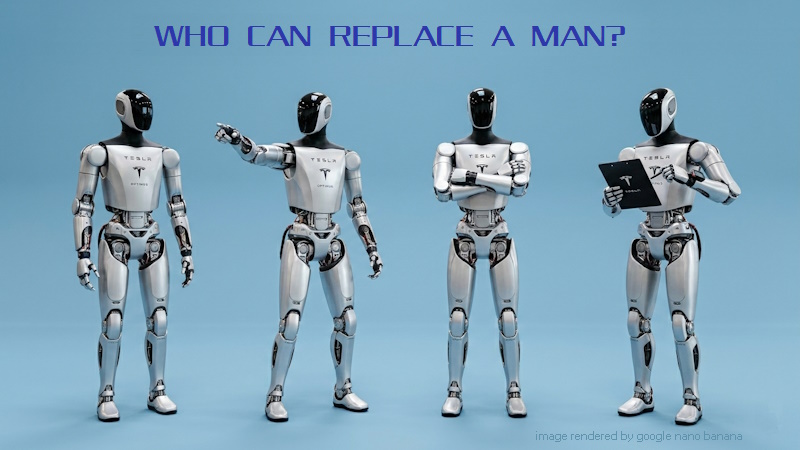
Human hands are elaborate, with about 17,000 specialized touch receptors, which would be very difficult to duplicate in a machine. Worse, although AI is good at speech recognition and image processing, those AIs were able to learn from vast streams of data. Where are the streams of touch data?
Tesla and others have tried to teach humanoid robots how to perform manual tasks by showing them videos of humans performing those tasks -- but that leaves out the data of how much pressure to apply and so on. Robots, Brooks says, are "coordination-challenged", and calls the video training approach "pure fantasy thinking". On top of that, a humanoid robot has to walk upright, and when they fall, they can be very dangerous.
Brooks is all for robots, he just thinks that the humanoid configuration is a dead end. He believes that in 15 years, robots will have wheels and multiple arms, though they may have five-fingered hands -- one good reason is that they would then be able to handle human tools. By that time, Brooks says: "A lot of money will have disappeared, spent on trying to squeeze performance, any performance, from today's humanoid robots. But those robots will be long gone and mostly conveniently forgotten."
A recent video showed Chinese robot dogs being used to help bring in vegetable crops from harvest. It's not a complicated job, it just requires the ability to reliably navigate and negotiate terrain too difficult for a purely wheeled vehicle. They are certain to get smarter in the future, but they don't need to that much smarter for the job they do.
The military is also interested in robot dogs for hauling cargo, scouting, and other missions. Giving them weapons and then letting them open fire autonomously does seem like a big step too far -- but robot dogs do suggest the robot path of the future.
We're unfortunately hooked, thanks to long tradition in sci-fi, on the idea of robots as artificial humans. In reality, a robot that could convincingly emulate a human is impossible at present, and pointless as well. Mechanical men? Mechanical dogs are a better idea.
DAYLOG WED 04 MAR 26 / ORBITING DATA CENTERS? Billionaire techlord Elon Musk has a lot of ideas, one being to put data centers in space. An article from FUTURISM ("Data Centers in Space Are Even More Cursed Than Previously Believed" by Victor Tangermann, 01 mar 26) poured cold water on the concept. The idea of the "orbital data center (ODC)" does have its attractions: data centers on Earth are power and water hogs -- so why not put them in orbit, where they can get solar power, and radiate their heat into space?

Musk envisions up to a million satellites in orbit, in near-polar "sun-synchronous orbits (SSO)" that would maximize their solar exposure. Since they would only send results back to Earth, they wouldn't need massive communications bandwidth. They would also, not incidentally, sidestep regulations that make siting data centers on Earth troublesome.
The first obstacle is the cost of building and launching such a massive cluster of satellites. Musk believes it is financially realistic; others are not so sure. There are some unarguable technical problems as well.
Rebekah Reed -- previously a NASA associate director, now a Harvard University science policy wonk -- wrote in FINANCIAL TIMES that, citing OpenAI boss Sam Altman, that thinking space was a solution to the data center controversy was "ridiculous". Reed added: "Orbital data centers are many years, perhaps decades, away." She pointed out that costs of setting up ODCs would have to fall below $200 USD per kilogram -- a "sevenfold reduction from current levels."
Space solar power has been a dream for decades, but we're not much closer to it than we ever were. There was a time when Elon Musk was seen as a brilliant visionary; now we see Cybertrucks on our streets, and have our doubts.
DAYLOG THU 05 MAR 26 / DECLINE & FALL? Today it was announced by the Trump White House that Homeland Security Secretary Kristy Noem is resigning, to be replaced by Oklahoma Republican Senator Markwayne Mullin. Noem was making too many enemies, so it appears.

Noem had been under intensive criticism, primarily over the Trump Regime's lunatic mass deportation drive and all the outrages accompanying it. Only a few days ago, she was getting raked over the coals in Congress and not holding up at all well under fire.
The White House says that Noem will become a "Special Envoy for The Shield of the Americas", a new security initiative of some sort -- what it amounts to, if anything, is not clear. We can assume Trump will grant her a blanket pardon to keep her out of jail. Mullin is much like Noem in most ways, so expectations are low. Yes, he would have to be extremely clueless to take on a job that had made Noem's life a well-deserved "living hell", and not be aware that he's walking into a minefield -- but maybe he is that clueless.
* Noem's resignation was something of a surprise, since Trump's cabinet is likely the worst ever -- and he's never seemed to care much how bad they are, as long as they kiss up to him. Has something changed? Maybe so.
Nine days ago, Trump's DOJ announced that they will no longer pursue their case against the 6 Democrats who told members of the military not to comply with unlawful orders. Defense Secretary Pete Hegseth is talking about appealing to the courts, but good luck with that: Trump's efforts to find pretexts to legally persecute his critics have been total failures, and the courts are very likely to shut Hegseth down. Again, however, Trump drives forward regardless, so why give up now?
Just recently, the Trump Regime announced it would no longer fight against court injunctions on the White House efforts to suppress DEI initiatives in schools and universities, and also gave up on its efforts to go after defiant law firms. That's the same puzzle: why give up now?
Maybe because Trump is fading out? Trump's health has been obviously failing, and his continued decline is no surprise. What happens when he can no longer even convincingly pretend to be in control? Bryan Tyler Cohen suggests that Noem's real sin was trying to steal the spotlight from Trump, but it still seems like he's on his last legs. When Trump's Iran War jumped off, JD Vance was in charge in the White House situation room; Trump was in Florida.
I was thinking at the start of Trump's second term that 2025 would be the worst year: come 2026, the Trump Regime would be running out of steam, and resistance would be strengthening. Things are still very bad -- but Trump is clearly on the way out.
DAYLOG FRI 06 MAR 26 / THINGS CHANGING PART 2: Last Friday I wrote here about finding Pinterest as a good place to post imagery. When I started with it, however, I realized that, though it was good for showing off pictures, it was not so good for selling my ebooks. The problem was that, unlike Tumblr, Pinterest is, essentially, ONLY based on images, not text -- it doesn't really support chats.
I needed something chattier; investigation led me to Threads. I'd tried Threads a few years back, and thought that Bluesky was the better deal. However, Threads has an order of magnitude more users than BlueSky, and that seemed like it presented an opportunity. I decided to sign up ... and then got into a big hassle. Threads is an offshoot of Instagram, and so an account has to be set up on Instagram first. Threads is working on a better scheme, but the situation is confused, and getting on board proved far more difficult than it needed to be.
After I did get on board, Threads did prove better than I thought it was: the level of discourse is a lot more like BlueSky than Xitter. It also seemed to be comparable to BlueSky in its features, though I had to puzzle out how to use them.
One big difference is that it ignores hashtags: users can select one, and only one, "topic" for a post. On consideration, that made sense. There's been sort of an "arms race" with hashtags, with users piling them on to get more reach. It makes better sense to restrict to one label, since it means more users were following that label. Threads helpfully checks the posting and suggests the most effective label.
I made good use of Google Gemini in puzzling out how Threads worked; I could ask specific questions, and Gemini would usually tell me what I needed to do. However, my Threads adventure came to an abrupt halt when Threads told me I was permanently suspended.
I didn't have a good idea of why. I asked Gemini if Threads was noted for capricious suspensions, and the answer was: YES IT IS. Social media is under pressure to clean up its act, but moderation is expensive, so Threads accordingly got a mindless robot to do the job. Threads -- which is, BTW, part of Zuckerberg's Meta conglomerate -- doesn't take chances: WHEN IN DOUBT, THROW THEM OUT. There are plenty more users out there signing up, they lose nothing: IT'S NOT FAIR? WE DON'T CARE. They didn't need me.
I wasn't upset, I didn't need them either. I was still trying to get up to speed when I got the boot, and was starting to wonder if Threads really offered me any more than BlueSky did. I've got too much on my plate, and it was good to take Threads off of it.
BACK_TO_TOPDAYLOG MON 09 MAR 26 / CHOCOLATE FROM CULTURES: Americans are worried about inflation -- which is puzzling, because it's not all that painful on the average, less than 3%. However, shopping at the supermarket suggests it's a lot worse than that.

It turns out that prices of some significant categories of food products have been rising much faster than 3%, the biggest things being beef, coffee, and chocolate. These foods have been afflicted by global supply issues, partly related to climate change.
Chocolate has been problematic because cocoa plants, from which chocolate is derived, is mostly grown in a near-equatorial regions -- particularly West Africa, which has been afflicted by bad weather and poor crops, among other problems.
Some start-up companies have a big idea to deal with the shortage: culture cocoa in tanks. According to an article in FUTURISM ("Chocolate Company Announces Plans to Produce Lab-Grown Cocoa" by Joe Wilkins, 07 mar 26), two food companies are working on the process. One is a foodtech startup named California Cultured (CC), out of Sacramento. CC has joined with Belgian ingredients giant Puratos to have commercially viable chocolate by the end of 2026.
CC starts by selecting cell samples from cocoa plants with the most flavorable beans. The cells are then grown in nutrient tanks to get the cocoa, which takes "days instead of months", according to the CC website. However, getting a production line running is not quick or cheap; it can take several years to get to production.
There are three hurdles beyond the technical challenges: regulation, consumer acceptance, and cost. CC is working to get regulatory approval from the US Food & Drug Administration, in the form of a "Generally Recognized As Safe (GRAS)" certification.
That's time-consuming, but doesn't seem like a big obstacle. Consumer acceptance is an issue, of course, but people trying samples of CC chocolate say it is good, even very good. The biggest problem is that production costs are high.
Making the chocolate is not inherently expensive, it just demands investing in the production facilities and bringing them up to scale -- and until it gets up to scale, CC's chocolate is not going to be cheap. There's still cause for optimism, and cultured cocoa is a good idea.
Puratos describes cultured cocoa as a "climate-independent and sustainable complement to traditional cocoa farming." Those of us hooked on chocolate would certainly like to see more of it.
DAYLOG TUE 10 MAR 26 / DRINKING FROM A FIRE HOSE: There's a lot of disgust with artificial intelligence, with continuous reports of AI failing, with bogus legal briefs, people thinking they can do their taxes with it, and generating code that works poorly or not at all. AI chatbots actually work well for highly specific questions with unambiguous answers, or for broad general questions with broad general answers -- as long as the user knows what the technology can and cannot do, and has the background to sort out good from bad answers.
However, even when AI does good work, it presents challenges. As discussed in an article from FUTURISM ("AI Use at Work Is Causing *Brain Fry* Researchers Find, Especially Among High Performers" by Frank Landymore, 06 mar 26), it can lead to overload.
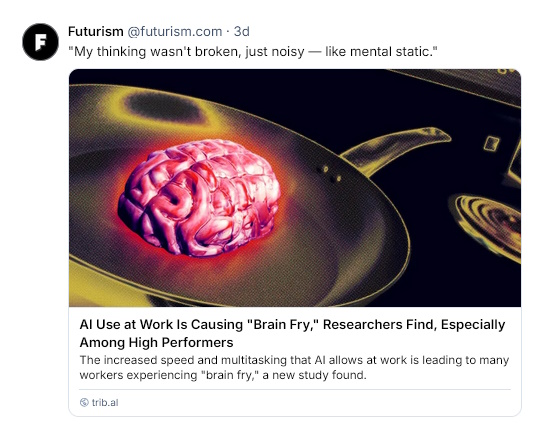
A survey of 1,500 employees showed that 14% of them who used AI to boost their productivity suffer from fatigue, a sort of "brain fry", with the burnout highest in marketing software development, HR, finance, and IT roles. The afflicted employees described feeling "buzzed", or in a mental fog; other symptoms could include headaches and slower decision-making. AI's ability to amp up their activity didn't necessarily allow them to get more done.
The study described information overload and rapid task switching as much of the problem. One senior engineering manager having to jump back and forth between several different AI tools, to find that his brain was becoming "cluttered", "crowded", saying: "It was like I had a dozen browser tabs open in my head, all fighting for attention. My thinking wasn't broken, just noisy -- like mental static."
He finally realized he was spending more time playing with the tools than solving the problem at hand. Myself, even though I don't have deadlines at home, using Google Gemini to get answers turns up the mental RPM. I realized that every day, all day I have little questions to answer, but I had to take time & effort to answer them. With my smartphone always at hand, Gemini gives me immediate answers.
I'm talking about little questions that would have been troublesome to answer before Gemini -- this morning, I was evaluating chicken V beef hot dogs. I also wanted to know if I could post images with clickable links on BlueSky, with Gemini telling me about "deck.blue (DB)". DB is a service that augments BlueSky. Great stuff, but now I have to figure DB out -- more on my plate. This sort of thing keeps happening, it's like drinking from a fire hose. Gemini is revolutionary, but it can feel like caffeine overload. I'll hoping I will settle out.
PS: I did check out deck.blue. I thought it provided augmentations to BlueSky, but actually provides an entirely different multi-column interface to BlueSky. It was interesting, but not what I was after; I kept a link to it, since I might come back to it later. This was another demonstration of how AI chatbots can end up spinning the wheels.
DAYLOG WED 11 MAR 26 / BEWARE THE TROLLS: I've long suspected that BlueSky is targeted by Russian trolls, but I got to wondering if there was any basis for that. I asked Google Gemini for evidence, and what I got back told me I wasn't fooling myself.
In early 2025, security firms and news agencies -- such as AFP -- confirmed that pro-Russian disinformation campaigns, such as the "Matryoshka" campaign, were active on BlueSky, often making use of AI, with tactics such as:
On BlueSky, Russian troll farms -- such as the Internet Research Agency -- don't pretend to be Rightjobs, since such are generally blocked; they instead pretend to be "hard Left" activists, working at "demoralization and division". The trolls target Democratic politicians, attempting to show that the party is too weak and "corrupt", using "rage baiting" to make trouble. Another trick is playing up Trump as unstoppable in hopes of intimidating the resistance. Trolls targeting Ukraine try to spread division between Ukraine and its allies.
Troll accounts have a set of distinct signatures:
To disguise themselves, trolls may set up "sleeper" accounts, operating as normal BlueSky users for an extended period of time, pivoting towards divisive political narratives as elections approach.
According to the Institute for Strategic Dialogue (ISD), a London-based democratic research organization, BlueSky has been conscientious in dealing with the trolls, reputedly filtering out over 90% of identified Russian troll posts in specific cases. BlueSky also makes effective use of 3rd-party "Labeler" groups to which users can subscribe, with Labelers that check for accounts with suspicious profiles, post at automated speeds, or fail fact checks. Some Labelers support specific BlueSky communities, such as transfolk or POC.
DAYLOG THU 12 MAR 26 / INTEL HERACLES: The digital age and the problems of internet security have led to the widespread use of cryptological systems to keep users safe. Intel has now demonstrated a new processor chip, the "Heracles", designed with data security in mind.

As discussed in an article from IEEE SPECTRUM ("Intel Demos Chip to Compute With Encrypted Data" by Samuel K. Moore, 10 mar 26), Heracles is designed to support "Fully Homomorphic Encryption (FHE)" -- encryption that allows operations on encrypted data. Amazingly, it can locate values in the encrypted data stream and perform math operations on them to get a valid result, without ever actually decrypting the values.
Exactly how FHE works is not easy to say, but suffice it's a big deal -- permitting, for example, tabulation of votes without anyone getting private data on voters, and useful in any other case where data analysis tends to step on privacy rights.
The problem with FHE is that, running on a normal computer, it slows down computations by thousands of times, and the encryption massively increases the size of the data. There's been a lot of work on specialized FHE hardware, but Heracles is the current leader of the pack.
The Heracles chip is only designed to run FHE; it can't run Windows. It is an order of magnitude bigger than an ordinary processor chip, with 8,192 computing processors, arranged in 64 "tile pairs" in an 8 x 8 grid, performing computations on multiple data streams in parallel. It has 48 gigabytes of memory onboard. It is, or will be, available as a plug-in card, with liquid cooling. A company demo involved getting stats on a supposed voter database; Heracles was thousands of times faster than a Xeon workstation -- taking half an hour, versus 17 days.
ROBOT PHONE: In other tech news more interesting to ordinary consumers, the Chinese company Honor has introduced a "robot phone", with a pop-up drone-style pro-level gimbal camera. It has AI "supersmarts", capable of automatically detecting or tracking different classes of subjects. The AI allows it to interpret what it sees and give evaluations. Honor is not planning on selling it outside the China just yet.

DAYLOG FRI 13 MAR 26 / THINGS CHANGING PART 3: Having got the boot from Threads -- and good with it -- I've been focusing on building up my Pinterest account. I'm slowly transferring the best from my personal photo collection there.

It's a very slow process, since I only have time to upload two images a day, and I've got thousands of pictures. Along with my own pictures, I've been enhancing images using Google Nano Banana (GNB), with an emphasis on glamour and pulp-cover pictures.
With the glamour pictures and the like, I'm doing "image-to-image (I2I)" conversion, uploading photos or artwork to GNB and enhancing them. Incidentally, more normal usage, in which prompts generate images from scratch, is called "text-to-image (T2I)".
Anyway, it can be frustrating to get good results with I2I, but sometimes those results are impressive. I had a photo of a young bride of India, dressed in Indian finery and bedecked with jewelry. It was a nice photo, but I thought the woman was too pale. I told GNB to give me somewhat darker skintone, but what I got back was a much darker skintone. I tried to go back to a lighter skintone, but tinkerings showed me that I liked the dark look the best.
However, I checked online and found the photo was protected, listed on Shutterstock, and I couldn't post it on Pinterest as it was. Fortunately, further tinkerings ended up turning the subject away from facing forward to facing off to one side -- and between the dark skin and the different pose, it seemed unlikely anyone would try to make a copyright case out of me posting that image.
Getting such impressive results takes time, however. Trying to devise prompts to get the desired results can be difficult. Sometimes GNB can be overly literal-minded, or doesn't deal with ambiguity well; sometimes it's just obtuse, misunderstanding seemingly clear directions.
I wanted to create images that appeared realistic on first glance, but on second glance were clearly too pretty to be for real. Trial and error gave me this prompt: "Reconstruct image as high-fidelity, but highly-polished, very smooth, unblemished and warm digital rendering." The prompts end up being verbose, and care has to be taken that the requirements don't contradict each other.
I also had the reverse problem of figuring out how to convert from overly-artificial images to more realistic one, attempts often generating gray lifeless zombies. I came up with the prompt: "Reconstruct image to look more photorealistic -- but retaining the smooth, polished, appealing computer generated-image appearance, as well as retaining the colors and tones of the original."
Another trick, when updating old Civil War photos, was to tell it to convert the old photo to a modern color digital camera photo, removing defects in the old photo. Civil War photos in color don't look authentic, but it's easy to convert them to monochrome, and reduce contrast to make them more convincing.
None of these tricks work perfectly, it's an evolutionary exercise, and I keep coming up with new tricks. A persistent difficulty was that GNB tends to clip the tops of the heads of subjects. One of the tricks that I learned was to tell GNB to zoom out to a bigger view, staying centered on the current canvas, trimming the resulting image to get the view I wanted, then feeding it back to GNB. What finally seems to have solved the problem was to take an image, add margins to the image in pure red or yellow, and tell GNB to fill the margins out. That gave me exactly the view that I wanted.
One big breakthrough was when I found out that I could upload two images, and tell GNB to, say: "Redraw the subject in the right image in the dress of the subject in the left image." It's no harder to swap the face of a subject in one image with the face of a subject in another image; it shows how easy deepfakes are. Anyway, I2I is still laborious, but I'm gradually getting up to speed.
BACK_TO_TOPDAYLOG MON 16 MAR 26 / TINY AI: I've been hearing about AI-enabled kids' toys and the controversy over them, and got to wondering if there was anything to it. I got to chatting with Google Gemini to see what I could learn.

I had to think that AI running on a cheap kids' toy was not the same sort of thing as, say, Google Gemini, and wondered how hazardous such a simple-minded AI could be. Gemini told me that this low-end field was known as "Tiny ML (Machine Learning)", running on low-cost "systems on a chip (SOC)", typically built around a standard "Cortex M" ARM processor ("M" for microcontroller) or, less commonly, the Arduino processor.
There's a range of these SOCs, but the Nuvoton M55M1 series can be used as representative. Nuvoton is a Taiwanese company, not much known to the public, but a big player in the "microcontrollers" market. The M55M1 series is built around the ARM Cortex M and can have up to 1.5 megabytes of RAM plus 2 MB of flash memory, along with extensive input-output capabilities.
The M55M1 has a power-management system to help it preserve battery life; it has a number of other subsystems, the most significant in this context being a "micro Neural Processing Unit (NPU)" to perform the matrix math driving AI systems.
A low-cost SOC with an NPU can add considerable smarts to kids' toys, allowing them to, say, hold simple conversations with the kids. Fitting an ZZ model into such a limited system is not easy, but it can be done by optimizing the "neural net" driving the model and using 8-bit instead of 32-bit math. It's also possible to use a macroscale AI system to give focused training to a tiny-ML system.
All that said, do Tiny ML systems really pose a lot of risk? It might seem not, first because their behavior is simple-minded and, it would seem, readily tested. However, in practice their behavior is complicated enough so that unfortunate corner cases can show up and have -- with the toys not having enough smarts to implement safeguards.
Tiny ML systems are not directly wired into the internet; parents can configure them or install updates via bluetooth with a smartphone, but nobody can hack into them. Unfortunately, some vendors have (it would seem unwisely) hooked up toys to online systems. Third, there are concerns that children, who are inclined to read personalities into their toys, could form unhealthy attachments to their intelligent toys.
Tiny ML systems do have the advantage that they don't need giant data centers to run. For all the problems with AI, a lot of things can be usefully done with it, and it's not going away. If we're stuck with it, we have a regulatory challenge to get it to work right.
DAYLOG TUE 17 MAR 26 / ROBOT DOGS: Sci-fi writer Isaac Asimov wrote a series of stories about "positronic robots", of humanoid configuration and intelligence similar to that of humans. Now we're in the era of the emergence of robots -- but look like dogs.

Robot dogs have been around for decades, but until recently they were mostly just expensive toys. The leader in developing robot dogs for practical use was Boston Dynamics (BD), founded in the 1990s by Massachusetts Institute of Technology researchers.
BD has developed a series of dog robots, assisted by military funding -- leading to the introduction in 2019 of the BD "Spot" dog robot for commercial use. Since then, more companies joined in, such as Ghost Robotics (GR) of Philadelphia, which focuses on military applications. The Chinese have more recently jumped in, with offerings by Unitree and Xiaomi; Chinese dog robots have brought prices down to the thousands of dollars, from tens of thousand to more than a hundred thousand dollars.
To be sure, a dog robot intended for rugged commercial or military use is not going to be cheap, with the GR "Vision 60" at the high end of the price range. The Vision 60 can be fitted with a variety of sensors and a manipulator arm; GR does not seem keen on weapons payloads.
For the military, the Vision 60 is useful for scouting; checking out areas contaminated by chemical or radiological agents; and explosive ordnance disposal (EOD). The military is also interested in large quadruped robots to work as intelligent "pack mules" for frontline forces.
In commercial and civil use, dog robots are useful for pipeline or other infrastructure inspection; search and rescue; and security patrolling. Dog robots don't have "human level" intelligence, but they can understand spoken commands, and then perform their missions autonomously.
The biggest problem with current dog robots is limited battery life; there's a screaming need in general for batteries with much more storage capacity at low cost, but it's hard to bank on "over the horizon" technological breakthroughs.
Public perception of dog robots is colored by widespread distrust of artificial intelligence technology, with many finding the robots "creepy". There are strong concerns, particularly in the European Union, over arming dog robots. Nonetheless, dog robots are now here, and we'll see more of them. Looking back on Asimov's positronic robots, the fixation on humanoid robots seems naive. A robot dog turns out to be more generally useful than a robot human, and humanlike level of intelligence turns out to be not all that needed.
DAYLOG WED 18 MAR 26 / TRUMP'S IRAN FIASCO: I was hesitant to say much on Trump's Iran War -- because of "fog of war" and all that, I wanted to get a better idea of what's going on. Three weeks into the war, however, one thing is obvious: the war's a fail for Trump.

There's been talk that Trump went into the war because of the Epstein files -- but I would think YES & NO, it was his bad poll numbers, to which the Epstein files have admittedly been a big contributor. True to his TV background, he wanted a military victory to boost his ratings.
The Iran War isn't exactly Trump's war; obviously, Bibi Netanyahu talked him into it, but it is unlikely it took much talking. Anyway, although the Israeli-US assault on Iran was devastating, with much of the Iranian leadership killed, it didn't lead to the expected regime change there. The Iranians then began attacks on oil tankers in the chokepoint straits of Hormuz, relying on a range of weapons -- missiles, drones, and drone boats, with the boats dispersing mines or attacking directly. Fuel prices have soared.
Trump, it seems, did not understand that George W. Bush got a massive boost for invading Afghanistan because Americans were outraged by the 9-11 attacks. Trump had no similar provocation from Iran. Yes, the regime is unpleasant, but so is Trump in his own way. Even hard-core Trump voters are dismayed by the war. Trump has been calling for assistance from the EU in opening the Straits of Hormuz, but that's a hard sell because Trump has been so nasty to the EU in the past. NOW he wants help?
It seems some European leaders are thinking of providing assistance, if Trump agrees to provide more Ukraine support. Not all that incidentally, the Iran War has been diverting missiles that Ukraine needs to defend itself. Trump even asked China for help, and was ignored.
In any case, Trump now has a set of poor choices: backing down and seeking a cease-fire, continuing the fight as it is now, or escalating. Since there's no visible prospect of success for Trump in the war, seeking an out would seem like the wisest choice. However, Trump lacks wisdom and doesn't want to back down. Since continuing with things as they are isn't working for him, he seems inclined to escalate -- but expanding the war is almost certain to make things worse in all respects.
Trump has been claiming the win in the fight, but nobody believes him. In the end, it would seem the only choice he has is to get out of the war -- but given the deterioration of his mind, which was not very keen to begin with, it's hard to say what he will do.
DAYLOG THU 19 MAR 26 / WINNING IN LOWER COURT: I like to read essays by law blogger Jay Kuo, in good part because he shows that the vision of an all-powerful Trump -- which Trump does all he can to create -- doesn't really square with the facts. Yes, when Trump is in the driver's seat, nothing can stop him, but he's not always in control. In particular, except for SCOTUS, the US judiciary has been making life difficult for Trump, and even SCOTUS seems increasingly less agreeable.

Anyway, JK pointed out on 16 March alone, Trump was handed defeats in Federal district courts in Colorado, Massachusetts, and Vermont. The Colorado court case involved a suit against the Trump Regime's efforts to weaponize SNAP -- food stamp -- funding against Blue states.
In December, Agriculture Secretary Brooke Rollins demanded that the state of Minnesota recertify within 30 days about 100,000 households receiving SNAP benefits, obviously to kick people off SNAP rolls. Minnesota sued and won, the court saying that the review was unjustified.
The same sort of farce took place in Colorado, it appears because Colorado won't let election fraudster Tina Peters out of prison. On 16 March, US District Court Senior Judge R. Brooke Jackson slapped the USDA with a preliminary injunction, saying the demand was not only unconstitutional, but broke "the bounds of reasoned decision-making."
Or, in simpler terms, it was stupid. On the same day, in Boston, Judge Brian E. Murphy blocked HHS Secretary RFK JR's efforts to reduce the number of recommended child vaccines. Judge Murphy said the proposed regulations were not supported by scientific evidence. More impressively, Judge Murphy also suspended appointments of 13 members of the CDC's vaccine advisory committee, who were appointed by RFK JR after he fired all the former members -- with Murphy pointing out the majority of the new appointees had no qualifications for the job.
Finally, last week ICE agents in pursuit of a Mexican national they claimed was here illegally. They ended up besieging a house all day, being blocked by hundreds of protesters, to end up forcing their way in and dragging off three people.
The Mexican national they were after wasn't one of them. One of them was Jisella Johana Patin Patin, a 31-year-old asylum-seeker from Ecuador, with two little girls. US District Judge Geoffrey Crawford ordered her release, saying the case "was not really contestable."
Yes, these decisions can be reversed by SCOTUS, but again, even SCOTUS is getting fed up with Trump's authoritarian and flatly idiotic actions. Those paying attention notice that Trump is running out of steam, and his decline is ongoing.
DAYLOG FRI 20 MAR 26 / THINGS CHANGING PART 4: I'm still getting up to speed on building up my Pinterest account with more imagery; every day I try to get two images uploaded. One thing that was troublesome was that Pinterest will crop images if they are too high and narrow, except if they're in an image carousel. Now I've got to fix a number of items I've posted.
More positively, I get to set up a link from every image I post, and have been using that to promote sales of my Kindle ebooks. As for images that don't have any connection to my ebooks, I decided the best thing to do was to link to the page with all my ebooks. Updating the links should be easy.
Underlying that effort is my use of Google Nano Banana to clean up images for posting. One problem with that is that I only got a few GNB "generations" a day for free, but I didn't like the idea of spending $20 USD a month for a Google Pro account, which would get me 100 generations a day.
I was, however, willing to spring for a $10-a-month subscription -- and then I found out that Google offers an "AI Plus" subscription for $8 USD a month, with 50 generations a day. Today I signed up for it; I also get proofreading for my documents, which will be welcome. Sigh, drinking through a firehose, another thing to figure out -- a thorough proofreader will also make releasing and updating documents more time-consuming.
Along with the limits, I also had difficulties with GNB refusing to do I2I conversions that it judged to be controversial, and was reluctant to accept some of the glamour shots and such I wanted to clean up. None were very rude, and GNB was very inconsistent in what it accepted or not: some things it would accept early in the morning, but not later, as if the threshold for rejection was dependent on server load. Ironically, I actually wanted to sanitize some of the images; Pinterest does sleaze bigtime, but still has limits.
Adding to the complication was that the balking was heavily influenced by Google's caution about invasions of privacy, generation of offensive images of public figures, and so on. For example, that image of a dark-skinned bride of India from last week caused me some trouble with GNB, it seems on the basis that it might come across as racist content. I did the image with ChatGPT, which wasn't as fussy. Cleaning up old Kamala Harris family pictures for the biography I wrote was also troublesome.
Incidentally, because of such laws and liability, Google searches are also much more restrictive these days. That's a good thing -- but anyway, I got to looking around for image generators that weren't so fussy. The search did not go well, with sites pushing weapons-grade sleaze, and featuring deliberately confusing user interfaces to try to cheat visitors. I almost got bit, getting my charge card locked out and nearly being ripped off, but I got straight with some effort and a user-friendly bank account interface.
Those sites were bad news. Finally, I found out about a generator called "Easy Diffusion" -- which I could install and run on a PC, no data center involved. That meant I could do anything I wanted with it, no worries about being cut off. I was intrigued and investigated. [TBC]
BACK_TO_TOPDAYLOG MON 23 MAR 26 / PUSHING BACK: On Saturday, a BlueSky blogger named Adam Serwer posted: "I'm not a political consultant, but I feel like Dems could probably get a lot of leverage out of pushing for green technologies that would wean the us off being dependent on oil."
True, but haven't they already done that? One "jtunes6 (JT6)" posted:
QUOTE:
The Dems' Inflation Reduction Act had the largest ever investment in clean energy. But of course the Dems get no credit for it from the media. And this is the core problem: when the Dems talk up green technology, does anyone hear it above the din of RW propaganda and feckless mainstream media? Dems don't have a message problem, they have a bandwidth problem.
The RW propaganda machine dominates the info wars, and drags mainstream media halfway along. That's the problem to be solved, not the mean "consultants" who allegedly tell Dems to use the wrong message that no one hears anyway.
END_QUOTE
I replied: "100% -- you totally nailed it. We still have people dissing Joe Biden here. If they're not working for Trump, they might as well be." One "Boulder Voter Rob" replied in turn:
QUOTE:
Yep. I'm blocking them. Republicans have all three branches, a corrupt court, media, local and national, gerrymandering, an anti-democratic Senate, the police, military and veterans, the church. Anyone who blames Democrats can f### right off.
END_QUOTE
Me:
QUOTE:
OH yeah. I actually like to post comments like that in hopes that they'll complain, so I can block them. A lot of them are Kremlin trolls, trying to get the Dems fighting among themselves. Some are not Kremlin trolls, but end up being hard to tell from them.
END_QUOTE
JT6:
QUOTE:
That's exactly right. So many people are unaware that there are trolls (foreign and domestic) posing as Leftist voices who are here to try to divide the Dem party. And then some organic voices as well but those voices are prone to getting radicalized by the trolls. These campaigns work, sadly. So we need to call it out as much as possible to raise awareness. That will weaken their effect.
END_QUOTE
Me:
QUOTE:
Right, that's why I help call out the trolling -- both to alert BlueSky users that they're being trolled, and (with less confidence) to suggest to those who just sound like trolls to dial it down a bit. BlueSky users ARE getting wise, and pushing back.
END_QUOTE
A BlueSky group is emerging to do the pushback, and we need to work together.
DAYLOG TUE 24 MAR 26 / ANTHROPIC AI POLL: As discussed in an article from EURONEWS ("Light and shade" by Pascale Davies, 20 mar 26), AI company Anthropic conducted a poll of 81,000 users over 159 countries to see what they thought of AI technology.

The response was, to no surprise, profoundly mixed. While many AI users used AI chatbots for emotional support, three times more users said they feared becoming dependent on it -- professionals saying as much, even as they said AI was very useful to them. The top five global concerns included:
Users in Western Europe and North America tend toward the skeptical on these counts, while users in Sub-Saharan Africa, Latin America, and South Asia overwhelmingly (67%) see AI empowering them with access to information and providing opportunities. One user in Cameroon replied: "I'm in a tech-disadvantaged country, and I can't afford many failures. With AI, I've reached professional level in cybersecurity, UX design, marketing, and project management simultaneously. It's an equalizer."
In East Asia, users were not all that worried about keeping AI under control, so much as they were worried about cognitive atrophy. According to the survey, lawyers all over were particularly worried about losing their edge; they find AI valuable, but are also very aware of its unreliability.
* Myself, I'm puzzled as to why so many people use a chatbot for emotional support. I've become dependent on Google Gemini for information of all sorts, but I never forget there's nobody really there: all my chats are technical or practical. I get annoyed when Gemini lays the chumminess on too thick; it's the "uncanny valley" of creepy human impersonation at work. Eh, it appears the emotional support is partly due to AI's utility.
As for cognitive atrophy, my problem with AI is that it boosts my mind activity too much. Unreliability isn't much of a problem to me either. Gemini is always getting things wrong, but I expect it as inevitable in exploratory thinking. I'm far better off than I would be trying to chase down information on my own, and determining whether the answers I get make sense keeps me on my toes.
DAYLOG WED 25 MAR 26 / DATA CENTER POWER HOGS: I'm finding AI to be a fascinating technology -- but it's not without its problems, and the public resistance to AI data centers is by no means misguided.

That was underlined by an article from IEEE SPECTRUM, titled: "Data Centers Are Transitioning From AC to DC" (Drew Robb, 24 mar 26). It turns out that the computer racks in traditional data centers draw about 10 kilowatts (kW) of power. With AI data centers, a rack will draw two orders of magnitude more power than that, more like a megawatt.
Traditional data centers can use medium-voltage AC electricity with no difficulty, but AC doesn't work well for AI data centers. One reason is that the losses involved in downconverting medium-voltage AC and converting it to DC become significant. Worse, the need for copper busbars escalates; a 1 GW AI data center could require 200 metric tons of copper, at a cost of several million USD.
AI data centers do have a trick that helps: high-voltage DC (HVDC), with grid power converted to 800-volt HVDC and fed to a data center. Electricity can be distributed through the data center at higher voltages, reducing current and the need for bigger conductors. Conversions are also simplified; efficiency is improved by 5% and copper requirements are cut almost in half.
For those unsympathetic to the AI industry, it should be noted that HVDC is a significant enabling technology for renewable energy. One of the issues with renewable energy is that it tends to be generated at sites remote from end users, and a renewable energy grid has to be able to shift between sources that don't necessarily operate on a constant basis -- wind power, of course, depends on wind.
HVAC suffers from losses over long transmission lines, becoming impractical at very long distances. HVDC has lower losses and is much more practical over long distances. In addition, HVDC only needs two lines, while triple-phase AC requires three. Getting rid of the third line means significant cost savings.
Finally, while it's tricky to get separate HVAC grids to link up, in particular in meshing 50 Hz and 60 Hz grids, it's not much of a problem for HVDC. We'll be seeing more of HVDC as renewables continue to take off.
DAYLOG THU 26 MAR 26 / AI BUBBLE WAITING TO POP: There's a lot of concern over the massive funds companies are pumping into AI; AI isn't bringing in nearly enough money to cover the investment, and the fear is that the "AI bubble" is going to pop sooner or later.

As it turns out, there are people of influence in the AI field who actually think the AI bubble is a good thing -- a viewpoint promoted in the book BOOM: BUBBLES & THE END OF STAGNATION by Tobias Humber and Byrne Hobart. The AI bubble itself, the authors claim, represents a massive investment in leading-edge technologies, leading to accelerated innovation. And when the bubble bursts? There will be industry consolidation, with the weak players dropping out. The consolidation will leave a few major players, who will be able to leverage off the data-center infrastructure built up before the bubble burst.
In this view, the bursting of the AI bubble will be like that of the "Dot-Com Bubble", a blip that led to normalization of the industry. That's not the only outcome; in the worst case, when the AI bubble pops, it might drag the entire economy down with it, leading to a massive financial collapse like the Great Recession from 2007. Given the Trump Regime's economic recklessness, that is an unfortunately plausible outcome.
Even in the optimistic view, the big winners will be Big Tech. Few but themselves would be happy with the idea of the tech oligarchy obtaining even more power -- with comments by the oligarchs that AI will put everyone out of jobs not being at all reassuring.
Back in November, Google CEO Sundar Pichai indicated the ambivalence of the economic situation, speaking of "over-investment" in AI, along with "some irrationality". He claimed that no company, not even Google, would be immune from the crash. He later clarified that "underinvestment" was a bigger threat than overinvestment, and also stated that Google was well-positioned to survive the shakeout, having the "full stack" of AI resources -- making their own hardware and models, with an extensive cloud infrastructure.
In addition, Pichai says they are seeing growing economic activity in their AI services, suggesting long-term health. Pichai, who is responsible as tech CEOs go, says that despite the massive power requirements of AI, the company still plans to reach carbon "net zero" by 2030.
DAYLOG FRI 27 MAR 26 / THINGS CHANGING PART 5: Last week, I mentioned hearing about Easy Diffusion, an AI image generator (AI2G) that could run on a PC. It's actually an implementation of the "Stable Diffusion" image generator, which is partly open-source.

Of course, having had experience with AI2Gs, I wondered if it could generate anything but AI junk, but investigation showed that ED could generate clean imagery. However, it was obviously going to be slow, with online commentaries confirming that notion. Some commenters said it could take 15 minutes to generate an image, or much longer than that. I got to wondering: Why not run Easy Diffusion on another PC, and network to my desktop?
I could start an image generation, then come back later. Further thought led me to look to my Acer ROG Ally handheld game box, which I hadn't got much use out of; it would seem that it would have more computing horsepower than my PC. I had no plans to use my PC for Easy Diffusion, but I still wanted to know if the ROG Ally was better. I also had a cheap Chinese-made CHUWI "brick" PC, that I used with my TV in the living room to run Steam games; I didn't think it had much computing horsepower, but I wanted to check.
It turned out that the CPU in the ROG Ally had a faster clock rate than either PC. More to the point, the ROG Ally had an AMD Ryzen Z1 chip, which has an GPU system much more tuned to AI than the GPU system of the Intel chips in the two PCs; the ROG Ally was clearly way ahead of them both. Good news.
The next question was how to remote-control the ROG Ally from my PC. After some fumbling around, I discovered the Google Chrome Remote Desktop (GCRD) system, which was available for free. I downloaded it to both my Windows PC and the ROG Ally. The GCRD includes two parts: host software to be installed on a computer, plus a plugin for the Chrome browser that provides a user interface. Ignoring a little bit of further fumbling, I got everything set up and working.
It was straightforward: all I had to do was set up a name and PIN on the ROG Ally, then run the GCRD on my PC and log in to the ROG Ally, using the PIN. It was completely transparent operation -- I'd heard comments that mouse click-&-drag didn't work, but it seems that was a bug that got fixed. The only "hands-on" I then needed with the ROG Ally was to turn it on. The biggest problem was getting confused as to which computer I was talking to, but I set the ROG Ally to "dark mode" to keep it distinct.
GCRD turned out to be as clean a solution as I could have imagined. That done, I went to work with Easy Diffusion -- which wasn't quite so "easy". [TBC]
BACK_TO_TOP
