
* This is an archive of my own blog and online notes, with weekly entries collected by month. The last week in stand-alone format is available here. Feel free to CONTACT ME if so inclined.
DAYLOG MON 30 MAR 26 / NO KINGS AGAIN: There was third national NO KINGS rally on Saturday, with an estimated 3,100 events inside (and outside) the USA, and a turnout estimated at over 8 million. The turnout here in Loveland CO was comparable to previous such events.

I planned to spend two hours at the event and leave at 2 PM, but it didn't start thinning out until almost 3 PM, so I toughed it out to then. I was tired and hungry when I got back home -- and feeling a bit discouraged, the end of our Trump problem not yet in sight. However, blogger Jay Kuo cited four reasons as to why NO KINGS 3 is relevant.
ONE: it makes Trump look like he's not really in control in a way that his dismal popularity polls don't quite match. While many leading institutions have caved in to Trump, the people haven't. Kuo says the event "shows the world that most Americans now oppose Trump, and that the actions he is taking that harm other nations and their people do not reflect the will of most of us."
One big clue for me was that, although Loveland isn't truly a Left town, the great majority of drive-bys honking were supportive. Those that weren't posed the question: So where are YOUR mass demonstrations? Trump enthusiasm is not deep, and is dissipating.
TWO: The inspiring resistance of the people of Minneapolis against Trump's ICE goons made him back down. NO KINGS 3 suggested there is no shortage of other Americans who will push back directly when they need to.
THREE: The mass demonstrations translate directly into electoral power: get a lot of people on the streets, that means a lot of people voting in elections.
FOUR: The NO KINGS demonstrations are building up steam, with greater turnout on each iteration. Get enough mass, it not only translates to electoral power, but may even convince many in the opposition that they're on the losing side.
Kuo suggests that the mass demonstrations now may be a necessary step towards mass resistance should Trump attempt to subvert the 2026 midterm elections. Myself, I'm doubting that Trump will do much more than make a nuisance of himself as he has before, but it pays to be prepared.
DAYLOG TUE 31 MAR 26 / METAVERSE GONE: As discussed in an article by Jason Koebler of 404MEDIA ("RIP Metaverse, an $80 Billion Dumpster Fire Nobody Wanted", 19 mar 26), back in 2014 Facebook's Mark Zuckerberg decided that virtual reality (VR) was the way of the future. He bought up the VR company Oculus, added VR offerings, and in 2021 went so far as to rename the company as "Meta", declaring as a corporate vision a vaguely-defined "Metaverse". Investors were skeptical, Meta's VR offerings lost money, and Meta began mass layoffs. Now Meta has largely discarded VR, with the company to focus on mobile gaming and AI. Meta's Reality Labs, which had been driving the VR effort, has been gutted, having racked up losses of $80 billion USD.
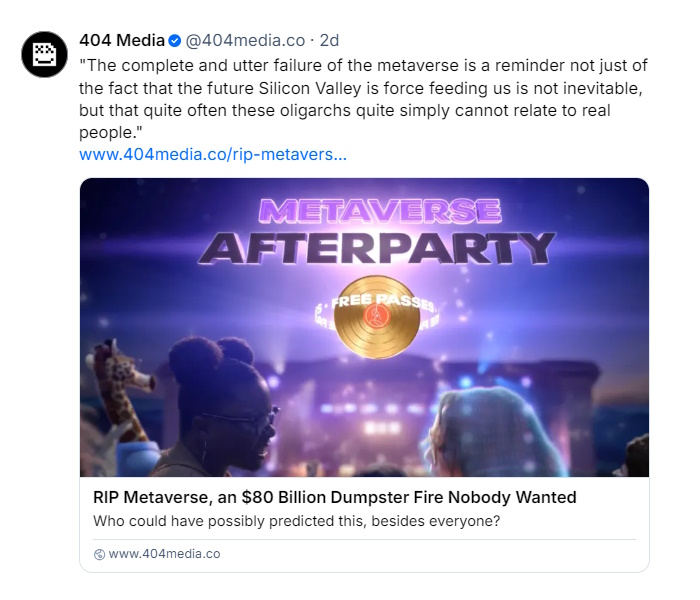
Back in 2021, Koebler wrote an article titled: "Zuckerberg Announces Fantasy World Where Facebook Is Not a Horrible Company." Zuckerberg announced that Meta would give users "the future [they] want". Sadly, they didn't; it was more about Zuckerberg rebranding his shaky company. Koebler then added that the future Zuckerberg pitched "was a delusional fever dream cribbed most obviously from dystopian science fiction and misleading or outright fabricated virtual reality product pitches from the last decade." Virtual worlds were not going to trump the real world. Now, according to Koebler:
QUOTE [EXCERPTS]:
Zuckerberg has found another thing he can ruin via his trademark process of pouring kerosene on huge piles of money and throwing matches at it. "Zuckerberg's current bold vision for the future is one in which social media is not social media at all but is instead a bunch of highly customized AI-generated ads delivered to you via an increasingly creepy algorithm.
Alongside this, it is a future in which Reality Labs ... makes AI camera glasses whose main use appears to be harassing women [and, in general, doing no one any good]. The complete and utter failure of the metaverse is a reminder not just of the fact that the future Silicon Valley is force feeding us is not inevitable, but that quite often these oligarchs quite simply cannot relate to real people, don't know how or why people use their products, and very often have no idea what they're doing.
END_QUOTE
The Trump Era has been something of an era of social media, and not in a good sort of way. It is not clear what the future of social media is, but it will not, cannot survive as it is now.
DAYLOG WED 01 APR 26 / BIRTHRIGHT CITIZENSHIP? Donald Trump has decided to crush "birthright citizenship", the Constitutional idea that anyone born in the USA is an American citizen. The case has gone up to SCOTUS.

The relevant clause of the Constitution specifically reads: "All persons born or naturalized in the United States, and subject to the jurisdiction thereof, are citizens of the United States and of the State wherein they reside."
Why, exactly, was birthright citizenship established? The main driver was the end of slavery and the desire of the Radical Republicans in Congress to make sure that states could not decide to deprive freed slaves of their rights by declaring they weren't citizens.
The alternatives to birthright citizenship -- following the principle of "jus soli (right of the soil)" -- were criteria based on ethnicity or national origin -- "jus sanguinis (right of blood)" -- which would have opened the door to arbitrary discrimination.
In 1898, in the case of US V WONG KIM ARK, SCOTUS judged that birthright citizenship also applied to immigrants, saying that that a child born in San Francisco to Chinese parents -- who at the time could not become citizens -- was a US citizen, the parents being under US jurisdiction.
Birthright citizenship is nearly universal in the New World, because all of these nations were defined by immigration. In Latin America, there was the threat that only those of European descent could be citizens, meaning those of even partial native descent could not. In the Old World, only a few countries have full birthright citizenship; others that had some form of it have tended, in this age of immigration, to dilute it -- saying that at least one parent must typically be a citizen or a legal permanent resident.
There's really no argument over birthright citizenship, at least in terms of a discussion: people either buy it or they don't, it's diversity versus ethnic nationalism. Neither side can persuade the other. [8/more]
Today, SCOTUS had hearings on the case, with the justices clearly being skeptical of the Trump Regime's arguments. Trump attended the hearing but left after 13 minutes. Disgusted? Or maybe that was just 12 minutes longer than his attention span?
DAYLOG THU 02 APR 26 / SCAMMER'S PARADISE: As discussed by Matt Ford in an essay in THE NEW REPUBLIC ("How to Reclaim America From the Scammers and Frauds" 01 apr 26), the Age of Trump has, inevitably been the age of scams and frauds, with Trump as the chief fraudster.
Ford writes:
QUOTE [EXCERPTS]:
Perhaps no scam in modern American life is more Trumpian than cryptocurrency. The digital tokens, of which bitcoin is the most popular, are supposed to fulfill some kind of economic role depending on the owner's wishes: as a medium of exchange, as a store of value, as an investment vehicle, and so on. At best, cryptocurrency was a cynical response to widespread disillusionment with the banking and financial sectors after the 2008 crash.
It has now been 17 years since bitcoin's launch it is safe to describe cryptocurrency as a failure. The tokens provide no legitimate social or economic value. They do not offer a fixed rate of return like bonds. They do not represent an ownership stake in a company or pay dividends like stocks. They are not a feasible medium of exchange even after nearly two decades of attempts to build the infrastructure for it. You can't buy groceries with them.
END_QUOTE
They are, however, excellent for taking suckers to the cleaners, with the Trump family raking in vast sums with them. The Trump Regime has, to no surprise, softened the already-minimal regulation of cryptocoin to encourage the scams. The Obama and Biden Administrations didn't really know what to do about cryptocoin; the next administration needs to go "scorched earth" on it and shut it down.
Next is sports betting and "prediction markets". Sports betting used to be generally illegal in the USA, but a SCOTUS ruling in 2018 opened the floodgates, creating a multibillion-dollar online industry in which users who win too often are banned from the apps.
The industry preys off gambling addicts. Prediction markets are somewhat different, with people betting on the outcomes of general events. While that means much the same ills as gambling in general, prediction markets also mean guaranteed windfalls for those with insider information. In the next administration, Congress needs to step hard on these scams.
Next, the Trump Regime elevated Robert F. Kennedy JR to run America's health system. It seems this was done in part because Trump wanted to exploit the "Kennedy mystique" -- but the end result is that America's health system is now being subverted by antivaxxer dogma and quack medicine. The new doctrine focuses on "wellness", a vague term that translates in practice to selling dubious cures, while denouncing mainstream medicine.
Trump's enthusiasm for "alternative medicine" appears to be in large part driven by a dislike of providing public support for legitimate medicine. Although alternative medicine has long been tolerated, the era of toleration needs to come to an end.
Finally, there is Trump's abuse of the pardon power, granting pardons indiscriminately to the biggest scammers, after they've given him generous donations. In sum, the Era of Trump is a scammer's paradise, and cleaning it up is going to be a massive job -- but it will happen.
DAYLOG FRI 03 APR 26 / THINGS CHANGING PART 6: Having figured out how to use my Asus ROG Ally gamebox as a remote AI processor for my PC via Chrome Remote Desktop, I then downloaded and installed Easy Diffusion on the gamebox. Installation proved a laborious process.
I was hoping things would be simple after that, but that was a faint hope. First time I tried to run ED on the gamebox, it went nuts, going in a noisy loop. I rebooted the gamebox and cleaned out some apps that might be competing, and then ED came up. However, trying to get images out of it gave me wildly distorted figures. It turned out that ED does that if it doesn't have enough memory.
I was able to compensate by setting ED to lower memory requirements for VRAM, and then telling it to use CPU instead of GPU. I then got output that was coherent, but wildly different from the image I was trying to copy. It turns out that ED is very complicated to use, requiring an understanding of things like number of steps, calibration of strength of prompts, and in particular highly detailed prompts, both to declare what it should draw and what it should NOT draw.
It's not easy to get good results with Google Nano Banana, and it's much easier to use than ED. I was faced with a steep and time-consuming learning curve, and it wasn't clear there would be a payoff. ED was clearly a dead end.
However, there are other options for download of image generators based on Stable Diffusion, notably Fooocus and Krita, that aren't so hard to use. Krita looks like the best option, because it would work more easily on the ROG Ally than Fooocus. Krita is really a paint program, but it can use a plugin named "Krita AI Diffusion" for image-to-image generation.
For the moment, I'm stalled on local image generation; it'll be a longer-term project; in between the difficulties of getting AI image generation to work on a PC and the challenges of using it, it may not work out.
* In the meantime, I failed to realize that the term on my website was running out and got caught badly short at the end of March, spending about three days in a mad scramble to get my websites working again. It was an exercise in resilience; I'd start to despair, then catch myself and plug on. I ended up having to revise my website formatting to handle altered URLs, but I was pleased to find out that I'd thought it out well, and only had to make minimal changes.
Ironically, I had been wondering if I really wanted to run a website any more -- but on facing the prospect of losing it, I realized that it gave me options, even if my website traffic is minimal. It's worth the money. However, I will also add that I do not recommend Network Solutions as a website service provider; they tried to renew my account at a higher level than the one I already had, and I had to struggle to get a more reasonable deal. I went with them because it was too much of a nightmare to change abruptly -- but when renewal time comes up in five years, I'll be looking for other options.
BACK_TO_TOPDAYLOG MON 06 APR 26 / UKRAINE & AFRICA: On 3 March, the Russian liquefied natural gas tanker ARCTIC METAGAZ -- part of Russia's "shadow fleet" of tankers -- was cruising east in the Mediterranean, south of Malta, on a trip from Murmansk to Egypt.

The vessel suffered at least one major explosion that left it drifting. Libyan authorities tried to take it under tow, but rough seas frustrated the effort; they've called for help from other nations, before the ship becomes a major ecological disaster.
Investigations showed that more than 200 Ukrainian military officers and specialists are stationed in Libya. The Ukrainians operate a base at the port city of Ezzawiya, north of Tripoli, deploying air and sea drones. It appears the ARCTIC METAGAZ was hit by at least one Magura V5 sea drone.
Ukraine isn't the only country providing military assistance to the Libyan government; Turkey and Italy also have a presence there, and in fact the Turks are Libya's biggest military backers. Libya is getting the help to deal with a rebel movement in the south and east of the country, with the rebels being assisted by the Russian Africa Corps -- which includes many former Wagner mercenaries in its ranks.
The attack on the ARCTIC METAGAZ shined a light on Ukraine's shadowy far-abroad campaign against Russia, with operations largely conducted by the Ukrainian HUR military intelligence service. Ukrainians have been operating against the Russians in Sudan since 2023, and against the Russians in Mali & the Sahel since at least 2024. Ukraine has also provided military support for Syria -- President Volodymyr Zelenskyy recently visited Damascus to solidify the relationship -- and is said to be engaged in operations against Iran.
Ukraine engages in these operations to degrade the Russians militarily, diplomatically, and economically. The relationship with the USA being so uncertain under Trump, Ukraine needs all the friends it can get -- notably providing anti-drone defenses to the Gulf States.
In the meantime, Ukraine appears to be ascendant on the battlefields closer to home, with wide-ranging and highly effective airstrikes against Russian infrastructure and military targets. Kill rates of Russian drones have improved, and the Russian Army is suffering more casualties. Russian social media has reported that Russian front-line forces are running out of air defense missiles. Are they falling apart? Maybe so -- but Putin hates bad news, and so the generals have to lie to him.
DAYLOG TUE 07 APR 26 / UKRAINE IS WINNING: The news from the Ukraine War seems to be hinting that the Russians are failing. That notion was reinforced in a CBS News interview with David Petraeus, previously a US Army general and CIA director, who says Russia "no longer has the upper hand."

Speaking in Kyiv, Petraeus said: "Over the last two months, the Ukrainians have actually made greater incremental gains than have the Russians." Given the imbalance in size and power between the two countries, that might have seemed unlikely. However, Ukrainian ingenuity has shifted the balance. Everyone knows about Ukraine's air, sea, and ground drones, but there is also the Ukrainian "Delta" battle-networking system.
Delta started out as a scheme to collect drone video feeds, then gradually expanded into consolidating a wide range of intelligence feeds, giving Ukrainian warfighters a high-level "Google maps" view of the war fronts. Delta is a decentralized system that can run on laptops, tablets, or smartphones. It has been incorporating an increasing number of AI capabilities, including target recognition and tracking; target prioritization on the hundreds of current data streams; mission direction of drones; and predictive analysis of likely Russian actions.
Delta has notably helped direct air defense against Russian drone swarms. Petraeus says he observed a combat engagement in which a Russian soldier was tracked continuously by a series of surveillance drones before attack drones were deployed, adding: "Once you're observed on this battlefield and you can't get into a deeply buried position really quickly, it's not going to end well."
Sheer numbers of drones help as well, Petraeus saying he visited a Ukrainian drone manufacturer that will build 3 million drones in 2026. Down the road, Petraeus sees the drones as increasingly autonomous using "tiny ML" AI technology, able to conduct missions on their own and shrug off jamming. He believes Western militaries are not quick enough to adopt these new technologies:
QUOTE:
In some Western countries right now, they think that innovativeness is giving 50 drones to an armored battalion. No. What we should do is scrap the armored battalions and replace them with a drone battalion.
END_QUOTE
In relevant news, Ukraine launched another drone attack against the Ust-Luga oil terminal in the Leningrad region. It's the sixth strike in three weeks, all of which inflicted severe damage. It appears Russian air defenses are ineffective against the strikes.
DAYLOG WED 08 APR 26 / ALTERNATIVE FLAGS: According to an article in THE IDAHO STATESMAN ("Boise took its Pride flag down. But new art has popped up at City Hall. What it cost" by Carolyn Komatsoulis, 07 apr 26), there's been a long-running feud between the government of the State of Idaho and the City of Boise, over city government flying a gay pride flag. Last year, the state legislature banned "unofficial" flags on state government property -- so the city of Boise declared the pride flag "official".

The legislature then effectively banned the city's right to declare an "official" flag, and then imposed a fine of $2,000 USD a day for flying an illegal flag, with the state attorney general empowered to sue. The city accordingly took the flag down -- but then struck back by painting flagpoles in front of city hall in rainbow stripes, with a large pride-themed sign in one of the windows, proclaiming: "Creating a city for everyone!" The exercise cost about $6,000 USD, taken out of the city budget.
Republican state legislators say they had been expecting such a prank, and were considering options for further action. The incident demonstrates how the far Right spends too much time being outraged over trivia, and can be easily foiled.
* I grew up in Spokane, Washington, which is linked to Coeur d'Alene, Idaho, just across the border, so Idaho is almost home. Boise is in Southern Idaho -- which is sometimes called "Northern Utah", being a stronghold for conservative Mormons. It is good to see Boise standing up.
I couldn't have imagined 20 years ago getting fired up about gay rights, but here I am now. It's the bullying, particularly of transfolk, that really flames me off. I'm thinking I'm not alone in my sympathy either, saying on BlueSky the other day that attitudes are shifting.
I was indignantly challenged for saying that, and replied with a poll that over 70% of Americans support transgender rights -- adding a qualification that the approval tended to flip-flop when it came to specifics, like transfolk on sports team and bathroom access.
My challenger threw exactly the same qualifications I'd stated back at me; since we were clearly not communicating, I blocked him. In any case, the war over transfolk is absurd, there being so few of them, and they represent no threat to anyone.
The EU Parliament has endorsed transgender rights. I think the solution in the USA will be to guarantee transgender rights in the law, and then let challenges over specifics go through the courts. Americans accept transfolk in principle -- which is halfway towards doing so in practice.
DAYLOG THU 09 APR 26 / US BATTERY BOOM: As discussed in an article from WIRED earlier this year ("The US Had A Big Battery Boom Last Year" by Molly Taft, 23 feb 26), even though the Trump Regime is bitterly opposed to renewable energy, it's not being stopped.
According to a report by the Solar Energy Industries Association (SEIA), the US added a record-breaking amount of energy storage in 2025 -- 57 gigawatt-hours, enough to power 5 million homes, which was about 30% more than in 2024. Bloomberg New Energy Finance similarly reports the boom in battery growth.
Although the Trump Regime cut tax credits for wind and solar last year, battery tax credits were generally spared. Renewable tech has continued to grow in the USA, even in deep-red states. In Texas, for the prime example, solar met more than 15% of demand throughout the summer, topping coal for the first time. The SEIA report predicts that Texas will overtake California in 2026 to become the US state with the most gigawatt hours of storage deployed.
Jigar Shah -- a managing partner at the advisory firm Multiplier and the former director of the Department of Energy's Loan Programs Office -- says that the success of renewables in Texas owes much to Texas' independent and largely deregulated power grid. The Texas grid operates much closer to a true free-market system than other grids in the country, which has proven a big boost to solar and batteries. Renewables are even starting to gain approval from the far Right. Shah comments:
QUOTE:
Texas basically says: "I don't care about your cultural bias. These are the market signals. You guys do what you want to do. If you want to build new coal plants, great. If you want to build batteries, great." And it happened to be that batteries were most incentivized by their financial incentives.
END_QUOTE
While solar and batteries are closely connected, the SEIA report says most of the battery installations in 2025, were stand-alone installations not linked to specific solar projects. Battery growth is a good sign for grids being stressed by skyrocketing demand. On the average, US grids only provide about half the energy available to them, ensuring they have the capacity to handle days with peak demand. Batteries help level the load, Shah saying: "When the grid is underutilized, we use it more by charging batteries. And then we use those batteries to reduce those peaks that happen two to three hundred hours a year."
Incidentally, the battery installations are now beginning to use "iron-air" batteries, with the iron "rusting" to release electricity and "unrusting" to store it. Iron-air batteries are bigger and heavier than lithium ion, but are very cheap, and well-suited for grid backup.
DAYLOG FRI 10 APR 26 / THINGS CHANGING PART 7: In parallel in going through tech upgrades I recently discussed, I was also moving along two other tech upgrade paths: Google Drive / Docs, and internet radio. I'd been tinkering with them before, but have been making more use of them.
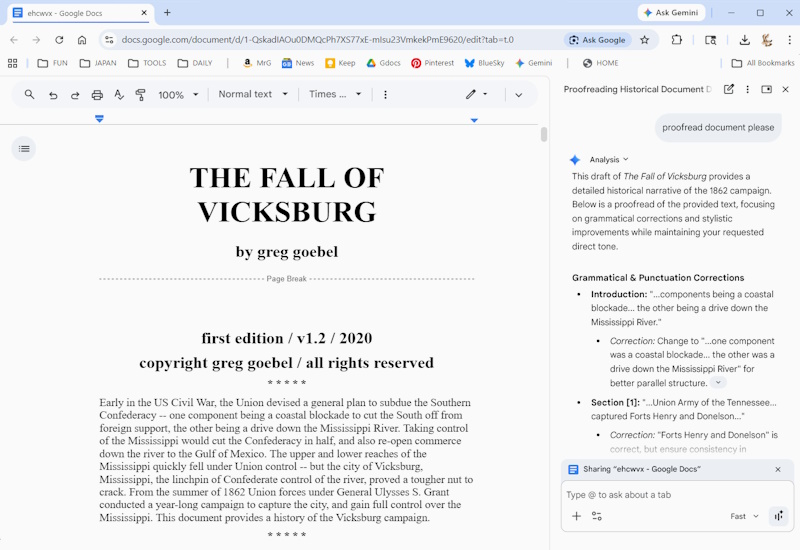
I knew about Google Drive some time back, but never paid it much mind -- since I had Microsoft Onedrive, and that seemed to handle all my online storage needs. It was Google Docs that tilted me more towards Google Drive.
I'd been using OpenOffice and then LibreOffice to write my ebooks, but they were both a little buggy. When I found out I got Google Docs for free, it seemed a promising alternative for writing my documents, and on initial use it did prove much cleaner.
One challenge at first was that I can't close a Google Docs document; I just exit, and it remains "as is" on Google Drive. It turns out that Google Docs is specifically designed for collaboration, allowing multiple people to modify the same document at the same time. In other words, if Alice and Bob are updating the same document at the same time, any changes Alice makes in the document immediately show up in Bob's text -- and the reverse.
This took a little getting used to, but it comes in handy, even though I'm writing by myself. Suppose, for example, I want to ensure I've got all the illustrations in a document properly credited at the end of the document. I can bring up two windows on the same document, then check the images in the first window while updating the credits at the end in the second window.
The biggest problem is converting my old LibreOffice files for use under Google Docs; even using standard MS-Word .DOCX files, there can be weird variations in formatting between the editors. This is apparently a long-running problem with different word processors. Sometimes the documents port OK, but in the worst case I end up simply storing the old document as raw text, importing it into Google Docs, and then reformat it. It's a pain, but it's easier than chasing after subtle formatting bugs.
I've had to become more consistent and structured in my formatting. I still get into discrepancies between the formatting of the .DOCX files generated by Google Docs and, after uploading them, the formatting of my Amazon Kindle ebooks -- but again, that appears to be a normal thing. I was using LibreOffice as a reader to check my .DOCX files before upload to Kindle, but LibreOffice sometimes did glitchy things. Google Gemini pointed me to the answer: download the Amazon Kindle previewer to my PC -- which of course proved much better for checking. I don't touch LibreOffice any more if I can help it.
With Google Docs, I got to thinking I could use Gemini for proofreading, but as it turned out, I needed to get a baseline Google AI contract for that. I did, and now the proofreading is proving handy. It works very well -- not perfectly, but AI is like that.
* While writing this item, I got to remembering the origins of word processing in the 1980s. Hard to imagine now that before digital writing, authors couldn't make instant changes in text, or run spellchecks and the like; documents were all "hard-coded". On thinking of that, I recall a few people complaining at the time about authors using word processors. What? Instead of a typewriter? Seems silly now. It was something of a foretaste of the current concerns over AI -- though AI honestly does pose big problems.
BACK_TO_TOPDAYLOG MON 13 APR 26 / ORBAN IS OUT: On Sunday, Hungarians went to the polls to elect a new parliament, with Peter Magyar's Tisza party winning a supermajority -- 138 out of 199 seats, the result being a staggering defeat for Viktor Orban and his Fidesz party.

Orban had been prime minister for 16 years, pursuing an ever more authoritarian, pro-Putin, anti-NATO line of action. Somewhat surprisingly, Orban readily conceded defeat -- one reason being that the vote was so overwhelmingly against him. It also appears that sources of support have been very much drying up. In any case, on winning the election, Magyar publicly recommended that all the Orban loyalists in government resign immediately, or be evicted -- and also spoke of working towards an 8-year term limit for the PM.
Magyar similarly made it clear that Orban's hostility towards the EU and NATO was a thing of the past: "Hungary will again be a strong ally in the European Union and NATO. ... The EU doesn't have to worry anymore."
Magyar said his first trip as prime minister will be to Warsaw, then to Vienna, and then to Brussels. He promises that Hungary will join the European Public Prosecutor's Office (EPPO), an anti-corruption operation, and work to deal with climate change. Orban had been blocking a 90-billion euro EU loan to Ukraine; the block will now be lifted. Slovakian Prime Minister Robert Fico collaborated on the block, but is likely to concede defeat without Hungarian support.
Magyar has made it clear that he regards Russia as the illegitimate aggressor in Ukraine, but also says that Hungary will not contribute to the defense of Ukraine. He wants to maintain a balance with Russia, it seems in large part to keep getting Russian gas. In this, Magyar seems conflicted -- one big issue being the fact that Ukraine is busily wrecking the Russian energy system, making any reliance on it problematic.
Magyar is walking a tightrope; thanks to Russian disinformation, many Hungarians distrust Ukraine. However, anti-Russian sentiment seems to be growing rapidly in Hungary, with a video showing Hungarians in a metro station chanting: "Russians go home! Russians go home!"
Americans, suffering under the Trump Regime, are envious of Hungary. In one silver lining, Trump dispatched Vice President JD Vance to Hungary to shore up Orban's campaign. That raised the question of what good Vance could do Orban, with the obvious answer in the end: "None."
DAYLOG TUE 14 APR 26 / UNHAPPY MILITARY: As discussed in an article from NPR ("There's growing disquiet in the military. The Iran war made it worse" by Kat Lonsdorf & Tom Bowman, 10 apr 26), in his second presidential term, Donald Trump became militarily assertive, the latest example being a widely unpopular personal war on Iran. Bill Galvin -- counseling director at the Center on Conscience and War, which helps run a 24-hour GI Rights Hotline -- says he's been "very, very busy" handling calls from disaffected troops.
Most of the callers want to know how to become a conscientious objector -- an unusual and difficult process -- but they also air their grievances. In March, Galvin's center obtained more than 80 new clients, which is about twice as many as normally come in a year.
Military recruitment slumped after the COVID-19 pandemic, finally bouncing back in 2024. Now more troops are seeking to end their service, mostly due to low morale or ethical concerns. An Army career counselor told NPR: "Retention is the only thing holding the Army up, from a metrics standpoint. And it is crumbling fast."
The counselor said that the climate and cultural shifts within the military under the Trump Regime are driving people out: "It has been a mess, and many individuals feel frustration throughout the ranks."
Military members are choosing to retire early or to not reenlist when their contracts are up, while some are applying for medical separation or are breaking their enlistment contracts. It's not just the Trump Regime's enthusiasm for war that is making the troops unhappy -- it's also the "white supremacy" regime set up by Defense Secretary Pete Hegseth, in which DEI efforts are eliminated, while women and persons of color in leadership positions are sidelined. It's not just women and people of color who are unhappy with the new order either; it makes many others uncertain of a military career.
The Trump Regime's lack of restraint in warfare has greatly added to the discomfort. Hegseth is widely regarded as unqualified to be secretary of defense, being called the "Secretary of War Crimes"; his enthusiasm for brute force and violence is not widely shared. Galvin says troops tell him: "I can't be a part of something that's doing that." [9/more]
NPR queried the White House on the troop retention issue, a spokesperson replied: "President Trump has restored readiness, lethality and a focus on warfighters at the Department of War." Bad news is not welcome in the Trump Regime.
DAYLOG WED 15 APR 26 / UKRAINE'S F-16S: I knew the old F-16 fighters being supplied by European nations to Ukraine had been updated, but I got curious as to the specifics -- particularly for the radar system. Early F-16s had the AN/APG-66 radar series; second-generation F-16s had the APG-68 series; and modern F-16s have the APG-83 SABR radar, which uses an array system instead of a moving antenna, and is much smarter.

I was thinking that Ukraine's F-16s had been updated to the APG-68(V)9 radar variant -- the most advanced radar with a mechanical antenna available to the F-16. However, Gemini said that was not so, because older airframes had to be modified to accommodate it. It would be much more practical to update Ukrainian F-16s with the SABR radar, which was designed with upgrades to older F-16s in mind, but that hasn't been done (yet). Ukrainian F-16s all were run through a "mid-life update (MLU)" by their original users which means they have the APG-66(V)2a radar variant, the last in that series, with a better processor system.
MLU F-16s also obtained an improved "Modular Mission Computer (MMC)" to coordinate their subsystems. The MMC is substantially more powerful than the radar's computer, but still isn't much better than a 1990s personal computer. Disappointing? Not so much, since both the radar and MMC are plenty capable, and have been given continuous software updates.
The "M-Tape" updates have provided support for new munitions and new systems. Ukraine's F-16s carry the Sniper targeting pod -- with TV / infrared imagers and resident "smarts" for things like target tracking -- and the Danish Terma "PIDS+" and "ECIPS+", which are underwing stores pylons with countermeasures systems, also with resident smarts. The MMC controls them, but only at a high level.
Most significantly, however, a relatively recent M-Tape upgrade provided support for the "Link-16" datalink system. Link-16 allows the F-16 to be hooked up the modern Ukrainian Delta combat networking system. Delta allows other users on the network to "see" what an F-16's radar or Sniper pod "sees"; a Ukrainian MiG-29 can then leverage off F-16 inputs for defense or targeting. Delta also provides features such as target identification and allocation, identification friend or foe, safety restrictions, and a growing list of AI-driven capabilities. Ukraine's F-16s have old technology, but are leveraging off the latest tech.
DAYLOG THU 16 APR 26 / GREAT GREEN WALL: An editorial from NATURE ("What China's Great Green Wall Can Teach The World", 16 apr 26) praised the "Great Green Wall of China (GGWC)" -- an effort to combat desertification with a network of forests and planted areas across northern China.

The GGWC was initiated in 1978, and now encompasses almost half the country; it is expected to be complete in 2050. It didn't get off to a great start, being initially focused on fast-growing plant species that weren't always a good fit to locales. The Chinese learned and improved. Forest cover in the regions affected by the GGWC has almost tripled -- from about 5% in 1978, to almost 14% in 2023. The frequency and intensity of dust storms have fallen, improving air quality in downwind cities, particularly Beijing.
Key to the success of the effort has been long-term government commitment and funding, along with flexible management -- notably acquiring better metrics for progress, for example focusing on measurable benefits of the GGWC, and not just, say, the total area of tree-planting. [4/more]
The GGWC also factors into the sprawling solar arrays being built in China's deserts, with vegetation being planted around them. The arrays work well alongside the plants, providing shade, trapping moisture, and helping to reduce evaporation.
The GGWC is not the only project of its type; there's also the "Great Green Wall of Africa (GGWA)". Forests once covered about half of Ethiopia, until land was cleared for agriculture in the late twentieth century. Ethiopia has managed to reclaim over a million hectares of land. Unfortunately, the GGWA project is not close to achieving its target of restoring 100 million hectares in 11 participating countries by 2030. Senegal, for example, has accomplished little in the program.
One big problem is that the GGWA is highly dependent on foreign donors, and the donor governments aren't all that good about following through. NATURE's editors said that African governments needed to take ownership themselves:
QUOTE:
Governments need to view nature restoration not as a cost, but as an investment. Restoring degraded land and planting and protecting forests is as important as building other kinds of infrastructure, such as housing and railways. Human life cannot thrive without clean air, water, healthy soil and abundant biodiversity.
END_QUOTE
There's a deep irony to the GGWC, in that it shows a nondemocratic and authoritarian government being far-sighted and prudent, while the USA is saddled with a government that is inept and corrupt. The USA will be back in a few years -- with a long list of things to fix.
DAYLOG FRI 17 APR 26 / THINGS CHANGING PART 8: Using Google Gemini to proofread Google Docs is handy -- but it turned out to have a limitation, in that Gemini wasn't so good at spell-checking. No worries, Google Docs has a spellchecker. The Google Docs spellchecker offers suggestions for corrections and will make corrections itself if told to do so, but I preferred to make the corrections myself instead of trusting the spellchecker to do it for me. No problem, I just ignored the suggestions.
I did have trouble when I tried to use Gemini to proofread documents in Docs, since Google changed how Gemini interacts with Docs. I got it to work -- it turned out part of the problem was my own, I was accidentally using Firefox or Edge instead of Chrome. I changed Chrome's color scheme so I could recognize it.
Although I could use Gemini to proofread text documents I'd converted to HTML and uploaded to the internet, spell-checking was a bit of a challenge -- until I realized I could load the text files into Windows Notepad and skim through them for spelling issues.
* Another nice thing I found out about Gemini is that I could send transcripts of chat sessions to Google Drive, with the files formatted in PDF. Roughly in parallel, I was trying to figure out how to send quick notes and reminders to myself, and finally learned about Google Keep. Keep is a notes facility; I could make notes on my smartphone, using voice input if I wanted, and they would all then be accessible under Keep. I could even use voice to tell Google Assistant to send notes: "Hey Google, note to self: remember to get milk."
Along with archiving Gemini chats on Google Drive, I finally realized that it was best to archive .DOCX files for my ebooks on Google Drive. I still download them for archiving to my PC, but no more need to upload again then when it comes time to update them. I've had to set up an elaborate directory hierarchy to keep everything orderly on Google Drive.
Incidentally, I tried to hook up Google Drive to my PC file system, the same way I do with OneDrive -- but it's not possible to simply transfer files between Google Docs and Windows. The files have to be uploaded and downloaded, making the integration pointless. OneDrive handles all my other online storage needs, so there's no need to integrate Google Drive with my PC. In any case, I've obtained a substantial increase in capability. [TBC]
BACK_TO_TOPDAYLOG MON 20 APR 26 / SANCHEZ SPEAKS: On Saturday, Spanish Prime Minister Pedro Sanchez addressed the Global Progressive Mobilization meeting in Barcelona, delivering speeches in defense of democracy, and rejecting fascism. Translated from Spanish, excerpts of the rejection include:

QUOTE:
The far-Right international and some right-wing puppets, lacking any inspiring ideas that get people moving, make a lot of noise; they shout so loud and so much that sometimes it feels like there's nothing else. But I'm asking you not to be fooled, not to let them fool us, because the far-Right and the conservatives aren't shouting because they're winning -- they're shouting because they know their time is running out.
They know their neoliberal orthodoxy, which is not only ineffective but also cruel, died back in 2008 with the big financial crisis and has been surpassed by progressive policies. They know their view of the international order is being dismantled because of tariffs and illegal wars. Their surrender to climate change denial, xenophobia, and the macho attitude of the far-Right international has been their biggest mistake, and it'll take them a long time to recover from it. The right isn't leading; they're fading away.
It doesn't matter how much they shout or how many lies they spread. People are realizing they have no plan, no solutions; Just hate, empty slogans, and messed-up policies that have only brought four things to the world: war, inflation, inequality, and division. That's all they've given the world.
That's why I'm convinced the time for the far-Right international and the Right wing that's given in to those reactionary ideas is over, and that we, are going to bring a new era of progress to the world and to all our countries. They've tried again and again to make us feel ashamed of our ideas and our history, but you know what? That ends now. Shame on those who exploit workers, who criminalize those who are different, who turn rights into commodities, who defend the privileges of the elites.
Our dreams are on every street, in every city, in every country, all across the planet. Let's come together and work side by side [applause], and let's do it with the spirit of victory so that in a few years people can look back and say: IT ALL STARTED IN BARCELONA.
END_QUOTE
The USA was not left out of the meeting, Minnesota Governor Tim Walz also in attendance, speaking to call Trump "feeble minded" and "trigger-happy" -- and, referring to JD Vance, Walz saying he wasn't there to "host a rally for any local wannabe authoritarians." All I can say is: keep up the good work.
DAYLOG TUE 21 APR 26 / PUTIN FAILING: As discussed in an article from EURONEWS ("Russia faked economic data to appear more resilient to its war and sanctions, intel report says" by Emma De Ruiter & Dimitri Kavalerov, 21 apr 26), in the course of the war in Ukraine, the Russian government has been issuing generally positive reports on the state of the Russian economy. Now the Swedish Military Intelligence and Security Service (MUST) says that while the latest Russian government report did admit to economic weaknesses, the numbers presented in the report made Russia "appear more resilient than it really is", saying that Russia is likely suffering from "higher inflation and a larger budget deficit" than stated.
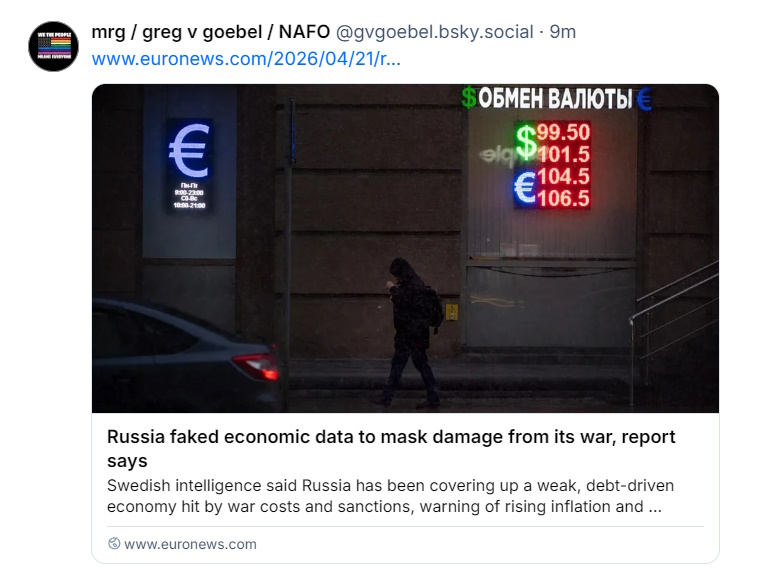
MUST stated: "Despite the recent period of high oil prices, which has provided Russia with increased revenues, it would take a price of over $100 per barrel for an entire year to remedy the Russian budget deficit."
Thomas Nilsson, head of MUST, cautioned that "the weak economy does not affect the strategic objectives" of Russia's continuing assault on Ukraine, that the war is a "political decision, not an economic one." Putin's goal is destroy independent Ukraine regardless of the cost. Nonetheless, Nilsson points to the obvious reality that "the economic constraints and sanctions do affect what kind of military capabilities Russia can muster, and how quickly this can be done."
Nilsson says that Russia is "living in debt" -- and that the Russian Central Bank's claim of 5.86% inflation is implausible, with inflation actually more like 15%. There is a prospect of a banking crisis, Nilsson warning:
QUOTE:
The Russian economy can only go on one of two scenarios: long-term recession or shock. In either case, it will continue on a downward trajectory towards financial disaster.
END_QUOTE
Vladimir Putin unsurprisingly takes a more relaxed view, saying the economic report reflects "generally expected trends", that the reported softness only reflects "calendar, weather, so-called seasonal factors" of the winter period. He's lying.
Commenting in KYIV INDEPENDENT on the same report, one Andreas Koehler suggested that Russia's current situation looks like that of Germany in 1917, everything running out of steam. Koehler said: "We will see if Putin is facing his 1918 -- maybe he's in Chinese exile next year."
DAYLOG WED 22 APR 26 / KASH PATEL SINKING: Last week, THE ATLANTIC published an expose on FBI Director Kash Patel, saying that he spent much of his time drinking, with meetings having to be rescheduled because of hangovers and such. In at least one case, door breaching gear had to be obtained, Patel having locked himself in a room and then, it seems, passed out. There were also tales of "frequent job absences", misuse of the FBI's executive jet, and so on.

Patel responded by threatening THE ATLANTIC with a $250 million USD defamation lawsuit, to which the publication's officials replied, in so many words: "Bring it on." In the first place, it is very difficult for a government official to sue a publication. Add to that the fact that THE ATLANTIC article was well-documented; unsurprisingly, FBI personnel seem eager to take shots at Patel. It's just a nuisance lawsuit anyway, unlikely to go anywhere, intended to discourage others from taking shots as well.
Patel has become the target of jokes -- one of the best being a photo of Patel, and of Defense Secretary Pete Hegseth, as members of Trump's "Liquor Cabinet". The Iranians, whose propaganda has been adept, skewered Patel with a Lego-style animation as a falling-down drunk. There have been home-grown videos as well.
The thing about yet another scandal from the Trump Regime is that the instinct is to say: "So what?" It's normal for them. However, this case does show that government agencies are not happy with the inept and corrupt leadership. The Trump Regime is a thin layer on top of organizations that generally despise the leadership, being willing to inform on misconduct, and maybe more importantly willing to deceive and undercut the bosses. People in the agency mislead Patel as much as they can; his control is very weak. Much the same is presumably true in most other US government agencies.
Anyway, it appears plausible, if not certain, that Patel is on his way out -- though again, the inclination is to say: "So what?" Patel will be replaced by somebody much like him, right? Yes, but that's for the good too, since the turnover weakens the authority of the bogus leaders.
A related question: what happens to the bogus leadership when Trump checks out and JD Vance becomes POTUS? That's not easy to say -- but Vance, at least, is not demented, and unlike Trump will be aware that he could be held accountable after he leaves office. Vance spins with the wind; maybe we'll see some normalization? Yeah, maybe. We'll see.
Oh, and one last question in the matter: What kind of fool would want a position of authority that he has no competence to be in? Who would want that kind of trouble? In Patel's case, it appears he's simply too soused to have ever asked such questions.
DAYLOG THU 23 APR 26 / THINKING WITH AI: As discussed in an article from SCIENCENEWS ("Is AI bad for critical thinking? It depends on when you use it" by Aaron Brooks, 14 apr 26), there's a general perception that use of AI chatbots means lazy thinking.

Not necessarily. Computer scientist Mina Lee of the University of Chicago and colleagues presented a study at a recent conference on "human factors in computing" in Barcelona that suggested people using an AI chatbot who thought about a problem before consulting the chatbot performed better on a critical thinking task than those who jumped in immediately to use the chatbot.
The study involved 393 test subjects, divided into eight categories. Participants were first divided into two main groups, one being given 30 minutes to work on a given problem, the other given 10 minutes. Each group was then divided into four groups, depending on when they used the OpenAI GPT-4o chatbot: continuous, early, late, or not at all.
The task the participants were given was to play as a city council member to decide, on the basis of seven documents, to accept or reject a company's proposal to mitigate a water contamination problem. Each participant had to write an essay explaining their decision.
The researchers scored the essays, in part, on the number of valid arguments and text references they contained. Not surprisingly, those given 30 minutes scored better than those given 10 minutes. The best scores were from participants who used the chatbot later in the process.
The researchers also unsurprisingly found that participants who had 30 minutes and no chatbot had the best memory of information in the provided documents. However, when it came to assessing "myside" bias -- that is, the willingness or lack thereof -- to consider alternate points of view, the group with 30 minutes and late access to the chatbot also scored high.
The results linked into other research that suggests "two kinds of learning": one based on slow and careful reasoning, the other on fast and reflexive learning. Among those who had 10 minutes, those who had early access to the chatbot scored highest. In the real world, we often have to make decisions under time pressure, but Lee suggests that delegating decision-making to the chatbot is risky. She says that anyone who does so should be "at least be aware of what you're signing up [for]."
DAYLOG FRI 24 APR 26 / THINGS CHANGING PART 9: I talked about getting into internet radio here in the fall, mentioning that I'd got radio apps for NPR, Soma FM, and other radio stations, and set up a Samsung tablet in the kitchen to play the stations while I was eating. I decided that I should hook up a little USB keyboard I had sitting around, gathering dust, to the tablet to make control of it easier -- most importantly, to make use of the "tape player" keys on the keyboard.

Easy, right? Not as easy as I thought, since trying to get the keyboard to work proved tricky; I couldn't get it to be consistently recognized. On consulting with Google Gemini, I finally discovered that the tablet had a subtle bug: if I plugged the keyboard into the USB slot on the tablet while the tablet was asleep, it wouldn't be recognized. If I plugged the keyboard in while it was off and then turned the tablet on, or if I plugged in while the tablet was active, then no problems with recognition.
Roughly in parallel with this misadventure, my Fire TV Cube started acting up. I ended up having to do a "hard reset" on the Cube, then re-install everything on it. Troubles come in clusters.
Anyway, I did get the tablet to work right, but over time I realized that having different apps for different internet radio stations was troublesome, since they tended to work differently. After some investigation, I finally found a "master" internet radio app named "Audials Play (AP)".
AP is made by a German outfit; it is available on Android, IOS, and Windows. It has a free option, with some limitations. I downloaded it to my various platforms, installed it, and it worked fine. I then had a uniform environment for all the stations I wanted.
It's a rich environment, which means it can be a bit tricky to use. One radio channel I liked simply disappeared and I couldn't get it back; it turned out I had unintentionally "banned" it. Another issue is that AP doesn't give me discographies for a channel. That was easy to fix, however, since I can bring up websites for individual channels via AP. AP also allows me to record channels, even breaking up a stream into separate tunes. Recording really needs the paid option for AP, however. I'll think about that; more to explore.
In the meantime, to get internet radio in the bathroom, I bought an older 8" Samsung tablet and mounted it on a stand that I could stick on the bathroom mirror. This older tablet turned out to have a bug, too, in that when I left it on and plugged in, it drained the battery down to zero. Now I turn it off overnight, and no problem.
I ended up having two tablets and two smartphones scattered through different rooms in my house for internet radio. That led to another adventure in configuring bluetooth keyboards for them, since no two bluetooth keyboards seem to work alike, and it's not necessarily easy to figure out how to get them to talk. I did get them to work, and they're OK now.
[<]
