
* Kamala Harris' parents -- Shyamala and Donald Harris -- were both academics. They divorced in 1971, with Shyamala obtaining custody of Kamala and her younger sister Maya. The two girls grew up mostly in Oakland, but the family did spend a number of years in Montreal. After high school, Kamala went on to college, to end up at Howard University in Washington DC -- to then obtain a JD degree from University of California Law San Francisco. With her law degree, she became a public prosecutor in California's Alameda County, to then move up to become the district attorney of San Francisco.
* Gopalan Shyamala was born in 1938 in the city of Madras in the Indian state of Madras -- the city now being known as Chennai and the state as Tamil Nadu. Her parents were P.V. Gopalan and his wife, Rajam, both of the Brahmin caste. Gopalan was a career civil servant, originally in the service of the British Raj; after independence, he directed the resettlement of refugees from what is now Bangladesh. It should be noted that Tamil names do not follow Western conventions; they do not have family names, instead the first name of offspring and wife being the father's name.
Shyamala was the eldest of four children of Gopalan and Rajam. She was closest to her brother Gopalan Balachandran, nicknamed "Balu", who was about two years younger; they were childhood "partners in crime". There were also two younger sisters, Sarala and -- the baby of the family -- Mahalakshmi. Shyamala was an accomplished singer, in classical Indian style, winning a competition once and singing on the radio.
Shyamala eventually attended Lady Irwin College, a prominent women's institution in New Delhi, studying "home science", basically home economics. Her parents thought she should set her sights higher, Balachandran recalling that Gopalan asked her: "What is home science? Are you learning how to invite guests?" Rajam, on her part, thought her children should aspire to be doctors, engineers, lawyers.
Shyamala took the hint, and in 1958, aged 19, she decided to apply for a masters program at the University of California in Berkeley. Gopalan told her: "Go ahead." She was accepted and went to California. It was a big jump, she'd never left India before. At Berkeley, she ended up working towards a doctorate in nutrition and endocrinology; her goal was to do defeat breast cancer.
She was known as "Shyamala Gopalan", reversing the name order to fit Western convention. At the time, Indians in the USA were unusual, something of a curiosity, and Shyamala -- though hardly unassertive -- felt out of place. She soon discovered a new identity. Civil rights activism had been gaining strength in the USA since the 1950s, which would lead to the end of racial segregation laws in the mid-1960s.
Early in that decade, counter-culture activism was starting to take hold at UC Berkeley, with Shyamala gravitating toward the black activist community, joining up with a group of black students who discussed the works of black writers such as W.E.B. Dubois and Ralph Ellison. The "Afro American Association" was an "incubator" for black consciousness; its members would help create the discipline of Black studies, introduce the holiday of Kwanzaa, and establish the Black Panther Party. Shyamala was the only non-black member of the AAA.
In the fall of 1962, her involvement with black culture led her to attend a talk by Donald Harris, a Berkeley grad student from Jamaica working towards a doctorate in economics. After the talk, Shyamala introduced herself to Harris, and they struck up a friendship.
Donald Jasper Harris had been born in 1938, same year as Shyamala, in Saint Ann's Bay, Jamaica. He was of Afro-Irish descent, his parents being Oscar Joseph Harris and Beryl Christie Harris. He obtained a Bachelor of Arts degree from the University College of the West Indies in 1960, to then go to Berkeley for a doctorate in 1961.
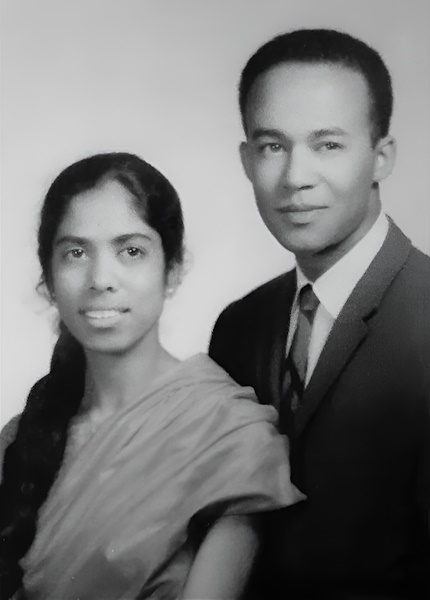
One thing led to another, and the couple married in 1963, simply going to the courthouse at lunch hour. Shyamala was defying tradition in many ways by marrying Harris -- one reason being that arranged marriages were the norm for Indian women, another one being that Indians are inclined to be more sensitive about skintone than they like to let on. However, although Balachandran said Gopalan and Rajam were upset, skin color wasn't the issue, Shyamala later saying: "They had not met the bridegroom before the wedding. I don't think they had any issues that he was Jamaican or anything like that."
Shyamala got her doctorate in 1964. The couple's first child, a daughter, was born in Oakland, California, on 20 October 1964, and was named "Kamala Devi Harris". "Kamala" means "lotus" in Sanskrit, and also is an alternate name for the "Lakshmi", the Hindu goddess of wealth and prosperity; "Devi" means "goddess", and is the name of the Hindu mother goddess. Much later, Shyamala provided a specific reason for the name: "A culture that worships goddesses produces strong women."
Donald Harris got his doctorate in economics in 1966. The family then moved to Champaign, Illinois, with the couple taking positions at the University of Illinois. Their second child and last child, another daughter, was born on 30 January 1967, to be named "Maya Lakshmi Harris". "Maya" can mean "dream", but it is also another alternate name for Lakshmi.
BACK_TO_TOP* When Kamala was about five and Maya was still a baby, Shyamala took the two girls to present them to their grandparents. Gopalan and Rajam were not living in India at the time, Gopalan having been dispatched to Zambia in Africa to help with a refugee crisis; the neighboring state of Rhodesia, now Zimbabwe, had declared independence from Britain in 1965, with people fleeing the country.
Shyamala may have found a visit to Africa with the girls less problematic than a trip to India, having expressed fears to friends that the girls might be abused for their skintone in India. Again, there was no evidence of any such bigotry in Gopalan and Rajam -- instead they doted on their granddaughters. There would be further visits to the grandparents, it appears all the later visits being to India. Kamala became very attached to Gopalan, later describing him as "my favorite person in the whole world."
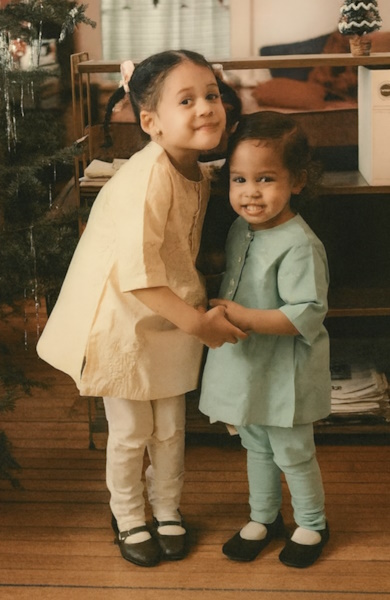
Back in the Midwest, Shyamala and Donald took a series of positions at various universities. They had gradually fallen into quarreling, the two strong-willed people finding out they could not get along. In 1970, Shyamala took the girls back to California, with Donald remaining in the Midwest. Shyamala sued for divorce in 1971; a bitter custody battle followed, with Shyamala winning the case the next year. American courts were biased towards the mother in custody cases. She never reconciled with Donald Harris -- they couldn't stand the sight of each other. Donald Harris became a professor of economics at Stanford University in 1972, being noted as a critic of mainstream economics from the Left.
If the marriage had caused distress among Shyamala's family, the divorce caused more, since divorce was strongly discouraged and stigmatized in India. Gopalan and Rajam were unhappy, but forgiving; however, Shyamala could not really look back to India any more, having burned all her bridges. It is not, however, apparent that she ever became an American citizen.
The two girls retained contact with their father, but he was peripheral to their lives. Much later, Kamala would tell an interviewer: "My father is a good guy, but we're not close." The girls were raised by their mother, with Kamala writing in her 2019 memoirs that Shyamala was "extraordinary":
QUOTE:
My mother was barely five foot one, but I felt like she was six foot two. She was smart and tough and fierce and protective. She was generous, loyal, and funny. She had only two goals in life: to raise her two daughters and to end breast cancer. She pushed us hard and with high expectations as she nurtured us. And all the while, she made me and Maya feel special, like we could do anything we wanted if we put in the work.
END_QUOTE
Incidentally, Gopalan Balanchandran got a doctorate in economics and computer science from the University of Wisconsin in Madison in 1978; from that time, he had a prominent career in India in academia and as a government advisor. Sarala became an obstetrician, remaining in India, while Mahalakshmi got a degree in information science -- to ultimately become a Canadian citizen, living there as "Chinni Subash", with her husband Shankar Subash.
Shyamala was apparently working in UC Berkeley's Department of Zoology & Cancer Research Lab at the time. She and the two girls lived in South Berkeley; when they started going to school, they were bussed to a school in North Berkeley. School busing to redress racial imbalance was common at the time, though it was politically controversial. However, it worked well enough in Left-leaning Berkeley, which had established the busing program in 1968.
There were South Asian communities in the area, but Shyamala had become Americanized -- from the perspective of black American culture, which she infused into the two girls. Late in her life, in a 2007 interview Shyamala said:
QUOTE:
I raised them in an African-American community, for a very special reason. It doesn't make a damn bit of difference if your color comes from India or African Americans, because this country is racist based on color.
END_QUOTE
In the interview, Shyamala came across as driven -- opinionated, uncompromising, determined to pass her drive onto her daughters, telling them to take ownership, not indulging them. That was, it seems, not exactly the same face those who knew Shyamala saw. She had an uninhibited laugh, and colleagues who worked with her found her pleasant and witty to deal with. If the girls were gloomy, she'd throw an "unbirthday party" with cake and "unbirthday presents", possibly as a nod to Lewis Carroll.
She raised the girls in a lively multi-ethnic environment, the effort being supported by friends and neighbors -- Kamala saying much later:
QUOTE:
Mrs. Shelton, who ran the daycare below us and became a second mother. Uncle Sherman. Aunt Mary. Uncle Freddy. And Auntie Chris. None of them, family by blood; and all of them, family, by love. Family who taught us how to make gumbo; how to play chess; and sometimes even let us win.
END_QUOTE
Lateefah Simon -- discussed more later, as a friend of the adult Kamala -- commented that Mrs. Shelton was particularly significant:
QUOTE:
Ms. Shyamala relied on the safety net of the African American community to help raise those babies. A young woman of color, single mom, academic, lived in a Black neighborhood and had a community around her to support the growth and the cultural development of these children. Her mother sent her to Ms. Shelton's day care. That tells you a lot. The Shelton family has been a neighborhood day care oasis for single moms for decades.
END_QUOTE
One of the favorite hangouts of the family was Rainbow Sign -- a facility that had once been a mortuary, but ironically became a lively black cultural center during its existence from 1971 to 1977. Kamala wrote:
QUOTE:
Rainbow Sign was a performance space, cinema, art gallery, dance studio, and more. It had a restaurant with a big kitchen, and somebody was always cooking up something delicious -- another chicken, meatballs in gravy, candied yams, corn bread, peach cobbler. By day, you could take classes in dance and foreign languages, or workshops in theater and art. At night, there were screenings, lectures, and performances from some of the most prominent thinkers and leaders of the day -- musicians, painters, poets, writers, filmmakers, scholars, dancers, and politicians.
END_QUOTE
Shyamala pushed the girls to excel, immersing them in varied interests. Kamala played chess, took piano and ballet lessons as a child, and later participated in a high-school band, playing the French Horn, xylophone, vibraphone, and kettledrums.
BACK_TO_TOP* In 1976, Shyamala got a job with McGill University in Montreal, Quebec, Canada -- teaching at the university and doing breast cancer research at the university's Jewish General Hospital. Shyamala tried to tell the girls it would be a great adventure, but Kamala never really signed on; she was at heart a California girl, and generally went back there on holidays and during the summers, staying with her father or friends. Kamala particularly hated the cold winters.
The threesome spent five years in Montreal. Kamala was originally enrolled in a French-language school, but she didn't adapt to the language well. She finally transferred to Westmount, an English-language high school. She became good friends with one Wanda Kagan -- mixed-ethnic as well, with a white mother and a black father. When Kagan said her stepfather was molesting her Shyamala, always inclined to take charge, had Kagan move in with the family.
* Kamala graduated from Westmount in 1981. She invited both her parents to her high-school graduation, even though putting them in the same room -- no matter how big -- was asking for trouble. Donald Harris showed up, but Kamala couldn't find Shyamala in the audience. She eventually strode in wearing a bright red dress and high heels. Shyamala usually wore jeans and tennies to work, but that night she wanted to make a statement.
Kamala attended Vanier College in Montreal for a year. She wasn't satisfied to remain at Vanier, however, and so decided to go to Howard University in Washington DC, focusing on a law degree. She wanted to work towards social change, and saw becoming a lawyer as the best route.
Howard University is the most prominent of the "historically black colleges & universities" of the USA, which number over a hundred, being rooted in the days of segregation. It was named after Oliver Otis Howard, a one-armed Civil War general who ran the government Freedmen's Bureau after the conflict, the bureau providing assistance to freed slaves. He was instrumental in establishing Howard, which opened its doors in 1867, and was one of its first presidents. One of its most famous graduates was Thurgood Marshall, the first black justice of the US Supreme Court -- and in the modern day, its alumni are common among America's black cultural and political leadership.
When Kamala arrived in the fall of 1982, she thought she'd gone to heaven, soaking up the energy and diversity of the place. Yes, it was a black experience, but it covered the range of it. Kamala wrote:
QUOTE:
Some came from cities, some from rural communities, and some from African countries, the Caribbean, and throughout the African diaspora. ... I chaired the economics society and competed on the debate team. I pledged a sorority, my beloved Alpha Kappa Alpha [AKA], founded by nine women at Howard more than a century ago. On Fridays, my friends and I would dress up in our best clothes and peacock around the Yard [Howard's equivalent of a college quad]. On weekends, we went down to the National Mall to protest apartheid in South Africa.
END_QUOTE
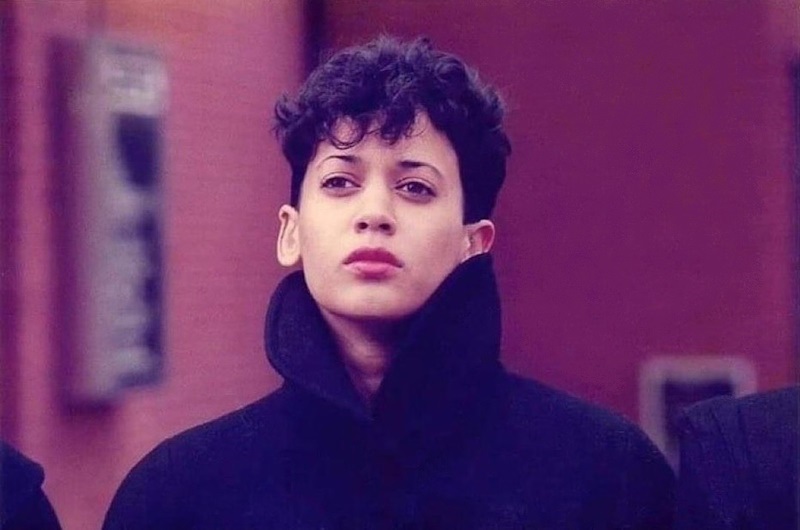
In any case, living in Washington DC, Kamala got her first tastes of working in government:
QUOTE:
I interned at the Federal Trade Commission, where I was responsible for "clips", which meant combing all the morning newspapers, cutting out any articles that mentioned the agency, and pasting them onto sheets of paper to copy and distribute to senior staff. I also did research at the National Archives, and was a tour guide at the US Bureau of Engraving & Printing. My fellow tour guides and I were all given walkie-talkies [cellphones were not a thing in those days] and ID numbers; I was "TG-10", a code name that made me feel like a Secret Service agent.
Once, I emerged from my shift to find [Hollywood actors] Ruby Dee and Ossie Davis [wife and husband] in the main area, waiting for a VIP tour after hours. They projected an aura like the luminaries they were, yet they made a special point of engaging me in conversation and telling me that it made them proud to see me as a young black woman working in public service.
END_QUOTE
The couple had grown up before World War II and, to them, the days of segregation were not such a distant memory. In the summer of her sophomore year, Kamala worked as an intern for Senator Alan Cranston, Democrat from California. Working in the Capitol Building was an experience, but she was also in awe of the presence of the nearby Supreme Court Building, with its legend engraved in marble: EQUAL JUSTICE UNDER LAW. Incidentally, Kamala worked at a McDonald's in Alameda during the summer of 1983, between her freshman and sophomore years, "making fries and ice cream." Maya worked at a McDonald's for a time as well.
* Kamala graduated from Howard in 1986, with a BA in political science / economics. She then went to the University of California, Hastings College of the Law in San Francisco -- now simply known as "UC Law San Francisco" -- which is how it's referred to here for simplicity. Richard Sakai, one of her first-year professors, described her as "very polite" and having "reserved" demeanor, sitting in the rear and listening, but not saying much. Sakai said: "She was very intense. ... It was almost like still waters. You could tell she was absorbing and taking everything in."
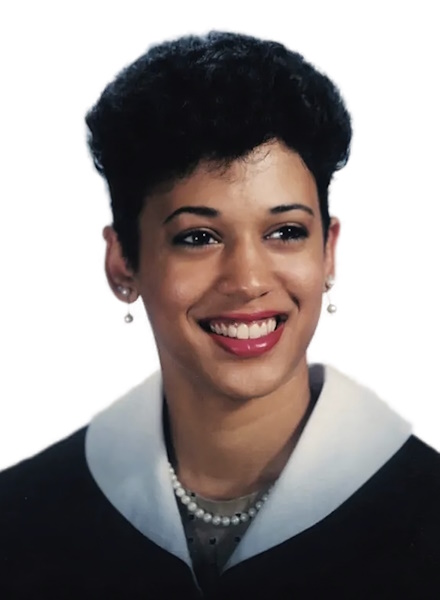
At UC Law SF, Kamala engaged in student activism with an emphasis on black civil rights, but she was not a "bomb-thrower"; she always wanted to work within the system. That was the seed of tensions between Kamala and the hard Left that would persist, with the edge cutting both ways. Veronica Eady, one of her classmates, said: "I never thought of [Kamala] as a moderate ... she often talked about civil rights." Presciently, Eady added: "She was somebody that people wanted to know -- it was clear that she was an important person or going to be an important person."
In her second year at UC Law, Kamala became much more involved in the college's chapter of the Black Law Student's Association (BLSA), which had been founded in 1968 to "increase the number of culturally responsible Black and minority attorneys" -- and became its president.
Those who knew her saw that she wanted to sign up with law enforcement. During the summer of 1988, Kamala worked as an intern at the Alameda County District Attorney's office during the summer of 1988, between her second and third years of law school. She recalled in her biography how she was handed a case that involved a young woman who had been arrested in a drug bust, though she was clearly an innocent bystander. The woman had kids at home, and nobody to care for them while she was locked up for the weekend. Kamala wrote: "I rushed to the clerk of the court and asked to have the case called that very day. I begged. I pleaded."
BACK_TO_TOP* In 1989, on graduating from UC Law and passing the bar exam, Kamala got a job offer to work as a prosecutor in Alameda County, in the East Bay Area. Kamala got some resistance against taking the job, it appears primarily from Shyamala; prosecutors were often seen as "The Man", out to put people in jail, with the public defender role seen as more appealing. Journalist Jamilah King commented:
QUOTE:
She's becoming a prosecutor at a time when Black communities are literally under siege. Specifically in Oakland and Alameda County in the 1980s, it is literally ground zero for the crack cocaine epidemic. You have tremendous amounts of violence in Black communities. You have overpolicing. So it was a controversial decision in her family and her community.
END_QUOTE
However, Keith Wingate, one of Kamala's professors at Hastings, noted: "There were a lot of people who thought that one way to make the system fair was to have some people of color in those positions." He added that black students often got jobs at the public defender's office or the district attorney's office, in both San Francisco and Alameda Counties. Jamilah King realized that Kamala wanted reform, power only being a means to that end:
QUOTE:
Ultimately I think her argument was that: "Look, in order for us to change the system, we have to have people within it who are willing to open the doors, who are willing to listen, who are willing to sit at the table." And that's what she did.
END_QUOTE
Kamala started work as a deputy district attorney in Alameda County after graduating from UC Law SF with a Juris Doctor in 1989. Awkwardly, she had failed the California bar exam. Shyamala had raised the girls to be achievers, telling them: "Don't do anything half-assed." -- and Kamala was appropriately humiliated. She was hired on anyway, the bar exam being seen as only a formality. She passed the exam when she took it again in early 1990.
* During this time, Shyamala had continued her work in Montreal -- but she came back to the USA in the early 1990s, getting a research position at Lawrence Berkeley Labs. Maya had returned to the USA earlier, living in Oakland -- when, at age 17, she gave birth to a daughter, Meena Ashley Harris, on 20 October 1984. The father's name was never revealed.
It can be assumed that if Maya contemplated giving up the baby, Shyamala emphatically discouraged it; Shyamala was insistent on people taking ownership of their actions, and she helped raise the baby. Kamala, who had actually been accepted by Georgetown law school, came back to the Bay Area to study at UC Law instead so she could help out as well, while Maya went to college. Maya graduated from UC Berkeley with a Bachelor of Arts degree in 1989, going on to Stanford Law School.
* Kamala took great pride when she was sworn in as an officer of the court, from then on introducing herself in trial with the prosecutor's declaration: "Kamala Harris, for the people." As she would much later say: "My entire career, I have only had one client: the People." She wasn't on a joyride, writing:
QUOTE:
The daily work was intense. At any given time, an individual prosecutor might be juggling more than one hundred cases. We started with lower-level work: arguing preliminary hearings, doing misdemeanor trial that covered things like DUIs and petty thefts. As the years passed, I got more and more trials under my belt and moved my way up the hierarchy of the office. In time, I would start prosecuting violent felonies, which took the work to a whole new level.
END_QUOTE
* Kamala's entry into the justice system played out against the backdrop of the Reagan Presidency. Ronald Reagan, a likeable and charismatic Hollywood actor who had previously been governor of California, was elected president in 1980 on a program to oppose communism, cut government regulation, reduce government spending, and cut taxes. He represented a shift to the Right, a reaction to the popularly-perceived excesses of the 1960s.
Reagan was genial, non-confrontational, and willing to compromise -- as well he might be, since he didn't have a full Congressional majority all the time he was in office, and Congress could block legislation he wanted. However, Reagan was able to turn the dial down on Federal regulation, and substantially cut taxes on the rich. He sincerely believed in "trickle-down" or "supply-side economics", in which big tax cuts would lead to an economic boom that would increase government revenues, and everyone would benefit. The actual result was to run up deficits; more cynical GOP didn't care about "supply-side", instead seeing deficits as a weapon to throttle government.
The Reagan era meant a fundamental shift in how America operated, notably with businesses taking an increasingly single-minded focus on profits to the exclusion of other factors, with an underlying mantra of "greed is good". Major corporations more visibly proclaimed that their primary goal was to "increase shareholder value". Unsurprisingly, increasing shareholder value led to surging executive compensation, with boards of directors rubber-stamping grand pay packages -- on the assumption of those on the boards that they would get their turns later.
With deregulation, the government became less interested in restraining mergers and the emergence of monopoly power. In the meantime, while executives were increasingly shielded from the whims of the market, employees were confronted with its full fury, with cutbacks and layoffs becoming more common and brutal.
There was another effect of the Reagan era. Following national desegregation in the 1960s, Southern Democrats, the "Dixiecrats", had defected from the Democratic Party to the Republicans. By the 1980s, the Dixiecrats had become a pillar of the GOP, exerting growing influence over it -- pushing it towards white nationalism, though it wasn't overt at the time.
* Again, at the time, national politics were in the background for Kamala. Like any other serious job, being a prosecutor meant a lot of grunt work -- in her case reading police reports; interviewing witnesses; talking to coroners and inspecting the results of autopsies; observing police interrogations of suspects through a two-way mirror; then dealing with the mountain of labor to prepare, present, and argue a solid case to the court.
It was not always pleasant work. Going through the autopsies of victims was difficult, but not as hard as, say, getting children who were victims of sexual abuse to testify in court -- all the more so because children are not necessarily reliable witnesses, are impressionable and easily pressured, and their testimony can often be demolished by the defense. Some of the kids she dealt with, who had a long history of being abused, were hard cases who were unlikely to win the sympathy of a jury. After the court proceedings, sometimes the kids would simply disappear off.
Kamala, as a prosecutor, lived in a continuous balance of judgement of the lives of the victims and perpetrators of the crimes she prosecuted. The victims were not always perfectly innocent; the perpetrators ranged from decent people who had made bad mistakes, to hardened criminals who were capable of anything and did care what damage they did. She wanted to help abused kids, but she also wanted to take down those who abused them. One of her colleagues, Nathan Ballard, said of her: "She was somebody who wanted to prosecute criminals."
Her work demanded a certain toughness and inevitably a certain hardening of the heart -- which had to be balanced against a bedrock of principles, of EQUAL JUSTICE UNDER LAW, of doing what could be done to improve the system. The conflicts in her mind had the inevitable effect of driving her upward.
Just how far up she wanted to go was an open question. As Kamala wrote:
QUOTE:
I'll always remember how I felt in November 1992, as a twenty-eight-year-old prosecutor, driving across the bridge from my home in Oakland into San Francisco to celebrate the victory of newly elected US Senators Barbara Boxer and Diane Feinstein. They were the first female senators from California, and the first two women to represent any state [in the Senate] at the same time. Their election was a highlight of the so-called Year of the Woman, and an inspiration to girls and women everywhere, including me.
END_QUOTE
* The American national political scene had, by that time, moved on from Ronald Reagan. His vice president, George Herbert Walker Bush, won the 1988 election. Bush was a Boston patrician who had been transplanted to Texas, working in the oil industry; he was by temperament a moderate, but he believed that the voters who put him in the White House wanted him to continue the "Reagan Revolution". He accordingly leaned to the Right.
George H.W. Bush got his presidency off with a literal bang when Iraqi dictator Saddam Hussein invaded Kuwait in 1990. When Saddam Hussein refused to withdraw from Kuwait, Bush assembled a coalition and drove him out in early 1991 in a lightning offensive. The First Gulf War was a grand triumph of American arms, but left a lot of issues hanging -- the most significant being that Saddam Hussein remained in power in Iraq, squirming under sanctions and seeking ways to defeat them.
One of the aspects of the Republican tilt to the Right was an effort -- pushed by the Federalist Society, an association of conservative judges and legal minds -- to stack the Supreme Court to the Right, with SCOTUS to then throw out laws passed by liberal administrations.
In 1992, Justice Thurgood Marshall retired, with the Bush I Administration nominating Clarence Thomas, previously chairman of the Equal Employment Opportunity Commission (EEOC). Thomas, being a black conservative, was seen by the White House as the ideal replacement for Marshall.
Delaware Senator Joe Biden, chair of the Senate Judiciary Committee, didn't think highly of Thomas, believing him unqualified to be a SCOTUS justice. During the Judiciary hearings for the nomination, Thomas all but bluntly refused to describe his judicial philosophy. When asked what he thought of ROE V WADE, the 1973 SCOTUS decision that guaranteed the right to abortion, Thomas blandly claimed he'd never thought about it at all -- an assertion that did not go over well with the committee.
Since the Democrats controlled the Senate at the time, it seemed unlikely that Thomas would be confirmed -- but then accusations of sexual harassment emerged. Thomas, to no surprise, indignantly denied everything, claiming he was being subjected to a "high-tech lynching for uppity blacks". It worked; to Joe Biden's exasperation, Thomas was narrowly confirmed, with Democrat senators voting to push him over the top. The implication was that, in the male-dominated Senate, the accusations had created sympathy for Thomas. As a SCOTUS justice, Thomas's decisions would invariably fall well to the Right.
Kamala paid close attention to what was going on in Washington DC -- but for the time being, she remained focused on her work as a prosecutor. However, she was clearly thinking of wider horizons.
BACK_TO_TOP* In 1998, Kamala got a new job working for San Francisco district attorney Terence Hallinan. She was put in charge of the "career criminal" unit, dealing with hardened lawbreakers. It was a promotion, putting her in a supervisory role, but she had heard ugly rumors about the SF DA's office, painting it as a toxic mess. After she arrived she gradually found out the rumors were true, the staff suffering from layoffs and a backstabbing work environment, as well disorganization and a lack of tools. There were few computers, no email, no database; the case backlog was bottomless, and the operation was seen as a joke by the police and other players in the system.
It would be inspiring to say that Kamala charged in and put everything right, but that isn't what happened. The operation had problems at a higher level; the experience was, as she put it, "incredibly frustrating." She spent 18 months spinning her wheels there -- but then she got a call from Louise Renne, the San Francisco city attorney, the first woman in that job. Renne had an opening in her office to head a group that handled child and family services. After discussion, Kamala signed up, glad to get out of the DA's office.
She started out setting up a task force to deal with sexually exploited youth, leveraging off expert help:
QUOTE:
Norma Hotaling was my partner in that effort. She had firsthand experience with the challenges we were tackling. She had been abused as a girl, and ended up homeless and addicted to heroin. She was arrested for prostitution more than thirty times. But hers was one of the few such stories with a happy ending. Norma got clean. She went to college. She got a degree in health education. And as soon as she graduated, she put that degree to use, creating a program to rescue women from prostitution that is still widely used today.
END_QUOTE
Kamala bristled at the label of "teen prostitutes", insisting they be called "sexually exploited youth", saying that they were actually "young people who were being exploited and preyed upon by adults." The kids were not the criminals; they were the victims, they weren't the people who needed to go to jail. One of the difficulties with trying to rescue such youths was that, once the justice system let go of them, they quickly gravitated back to their old ways -- for the simple reason that they didn't have anywhere else to go, many of them having escaped from dysfunctional households. The task force accordingly promoted the creation of a "safe house" where they could get consistent support and assistance -- as well as a crackdown on "massage parlors" that were hubs for prostitution.
The task force's recommendations were accepted by the authorities. The safe house was accordingly set up, with an advertising campaign generated to make sure kids on the street knew where to go for help if they wanted it. In the meantime, law enforcement shut down dozens of brothels.
* The national political landscape shifted somewhat back to Left of center in the meantime. Although George H.W. Bush's popularity had been sky-high after the First Gulf War, there had long been doubts among the GOP faithful of his commitment to the Reagan Revolution. When he ran for re-election in 1992, an economic recession, which would prove short-lived, was in progress -- and so Bush was voted out, being replaced by Democrat Bill Clinton, previously governor of Arkansas.
Clinton, having taken to heart the overwhelming popularity of Ronald Reagan, had campaigned strictly from the center Left -- deliberately snubbing the hard Left, much to their lasting fury. He took ambitious actions after going into office, most significantly attempting to promote a national health care plan. That was a nonstarter; there wasn't enough support for it. He tried to delegate leadership of the effort to his wife Hillary. She had been his chief aide when he was governor of Arkansas, but the idea of the First Lady having substantial power in the White House did not go over well with the public.
In reality, first ladies had often enjoyed considerable political power, but it was always behind the scenes. The public cry went up: "We never voted for her!" -- oblivious to the fact that, as a rule, they had never voted for Bill Clinton's cabinet officers and other senior White House officials either. In any case, the national health care plan went nowhere, and on top of that the media developed an unrelenting contempt for Hillary Clinton.
That was consistent with a general deterioration in the tone of public discourse as the far Right grew in power, their voice being that of malevolent radio "talk jocks" like Rush Limbaugh, with advocacy organizations like the Heritage Foundation spreading the message more quietly. The message was unyielding hostility to diversity, gay and reproductive rights, gun-control laws, environmental action -- working to undo every bit of progressive action going back to the 1930s and before. It was distilled into a list, the "Contract With America (CWA)", as a Republican platform for the 1994 mid-term elections.
The message was strong enough to allow the Republicans to take back the House of Representatives in the mid-terms for the first time in decades, with Newt Gingrich of Georgia, one of the architects of the CWA, becoming House Speaker. Gingrich represented the new wave of Republican politician, echoing the radio talk jocks -- with little sense of principles, a con-man's awareness of the ignorance of Republican voters, and willing to do anything to win. The Senate also came under Republican control, furthering America's shift to the Right.
However, trying to implement the Contract With America with Bill Clinton in the White House was an uphill fight, since the Republicans didn't have enough of a majority to override his vetoes. They resorted to government shutdowns -- one for 5 days in 1995, one for 21 days around New Year's 1996. There had been government shutdowns before, going back to 1980, but they were typically weekend things; a three-week shutdown was something new. The public blamed the GOP for the shutdowns more than they did Clinton, and they accomplished nothing for the Republicans. Nobody would ever manage to accomplish anything with government shutdowns.
One element of the CWA that did have bipartisan support was a push to "Get Tough On Crime (CTOC)". It had been brewing for years, to culminate in the "1994 Crime Bill", Joe Biden having been one of its major backers. It was a comprehensive package of measures, some of which were sensible -- including a limited assault-weapons ban, and a "Violence Against Women Act" pushed through by Biden, in which he took great pride. On the other hand, the crime bill led to surging imprisonments, many on petty drug charges, with minorities being hit the hardest. On the entirely positive side, Bill Clinton installed two new and significant SCOTUS justices: Ruth Bader Ginsburg in 1993, Stephen Breyer in 1994.
* Bill Clinton won re-election to the White House in 1996, much to the frustration of Newt Gingrich and the Republicans. They despised the Clintons, along with "liberals" in general. The consequent gridlock fed popular distrust of both parties, though Clinton had the advantage of a booming economy. He was even able to enjoy balanced budgets from 1997.
Things went badly south for Clinton in early 1998, when it came to light that, in an appalling display of bad judgement, he had been having an affair with an eager young White House intern named Monica Lewinsky. The scandal would cast a shadow over the remainder of his term of office. However, it didn't do the Republicans much good either; they attempted to impeach Clinton, but he handily survived the vote, and the Republicans' rabid focus on taking down Clinton disgusted the voters. The GOP did poorly in the 1998 mid-terms, with Gingrich deposed as House Speaker as a result.
* During this time, Kamala was becoming more socially prominent. She long had men in her life, but she never said much about them, and they were clearly not very important -- with one exception: Willie Brown, the Speaker of the California State Assembly. It seems they met in 1994, when Kamala was 29 and Brown was 59. He was technically married, but had been separated from his wife for a decade; the two remained on familial terms, simply wanting to lead separate lives. He was known to date younger women, it seems usually somewhat younger than Kamala.
They dated for a year or two, with the San Francisco gossip columnists playing it up. One of them, Herb Caen, was at Brown's surprise 60th birthday party in March 1994, when actor Clint Eastwood "spilled champagne on the Speaker's new steady, Kamala Harris." Not much else is known about the relationship, except that Speaker Brown allegedly got her positions on two state regulatory boards: the Unemployment Insurance Appeals Board and the California Medical Assistance Commission.
Tales would also circulate that Brown bought her a BMW, but nothing confirms that story. In any case, Kamala's relationship with Willie Brown would only be an issue to people who wanted to make it one. Much later, when a belated fuss was made about Kamala's association with Brown, he wrote an essay that put the fuss into perspective, titled: "Sure, I Dated Kamala Harris. So What?"
By that time, Kamala had acquired a brother-in-law, Maya having married a Stanford Law classmate, Tony West (born 1965). Maya and Tony had known each other while at Stanford Law, but didn't start dating until after they both graduated in 1992. Tony was from San Francisco and had gone to Harvard before attending Stanford Law. Both would have legal careers in commercial, government, and academic roles, along with close involvement with Democratic Party politics.
BACK_TO_TOP
