
* After having worked in the Alameda County, San Francisco DA, and the San Francisco City Attorney offices, Kamala decided it was time to move up, running for the San Francisco DA office herself in 2004, to win the election after a tough campaign. Once in office, she worked hard to set up criminal rehabilitation programs and otherwise seek reforms, though constrained by the unavoidable need to work within the system.
* Kamala liked what she was doing in the city attorney's office, and spent two years in that position. However, she hadn't forgotten her wasted time in the district attorney's office, and her failure to accomplish anything there. Kamala did not easily accept defeat, recalling in any challenging situation what Shyamala had always asked her girls: "Well, what did you do?"
On consideration, it was obvious what to do: run for San Francisco DA. It was a big step to take, since she hadn't ever conducted a serious election campaign before. She was inspired by the words of James Baldwin, one of her favorite authors: "There is never a time in the future when we will work out our salvation. The challenge is in the moment; the time is always now."
The challenge was framed by being a biracial woman in San Francisco, which at the time was effectively controlled by white males. Her opponent in the race was her previous boss, Terence Hallinan, with a reputation for leaning strongly to the Left, a big asset in San Francisco. Another candidate, Bill Fazio, was to the Right of Kamala, but he dropped out in a run-off election, with the other two left to fight it out.
Kamala's campaign was home-grown; she cooked up her own campaign fliers, and went to Kinko's to have copies made. Shyamala was involved as well, Kamala writing:
QUOTE:
"Kamala, let's go. Come on, we're going to be late." My mother was losing patience. "Just a second, Mommy," I called back. (Yes, my mother was and always will be "Mommy" to me.) We were on our way to campaign headquarters, where volunteers were gathering. My mother often took charge of the volunteer operation, and she didn't dillydally. Everyone knew that when Shyamala spoke, you listened.
END_QUOTE
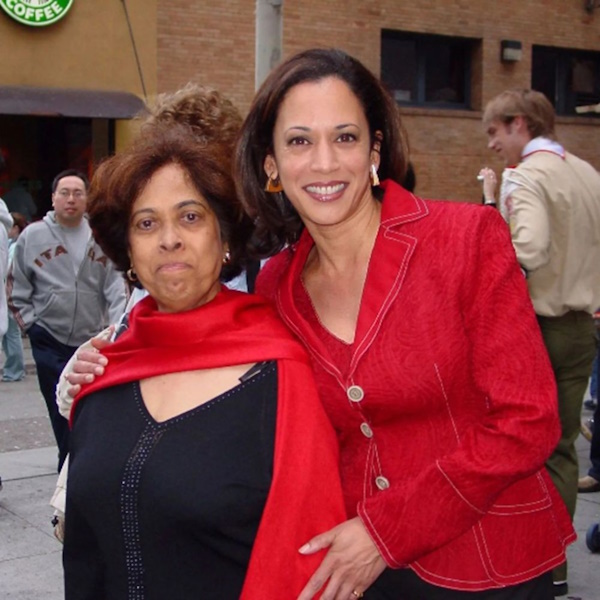
When Shyamala gave orders, people obeyed. Maya assisted, less forcefully, as well. The campaign headquarters was in Bayview, a slum section of San Francisco, Kamala wanting to focus on the "underserved" parts of the city. She had no shortage of volunteers, of all backgrounds, show up to help.
Kamala would set up in front of, say, a supermarket, accosting people with: "Hi! I'm Kamala Harris. I'm running for district attorney, and I hope to have your support." As assertive as she always was, being that forward took some getting used to, but she started to gain on Hallinan. San Francisco journalist Joe Garofoli commented:
QUOTE:
The coalition she put together is a very rare one in San Francisco. She had the rich people in Pacific Heights, with folks in the Bay View, the Black neighborhood, and then the Castro, the LGBTQ neighborhood. It's a very unusual triangle of power there. Because of who she is, how she grew up, the diversity of experiences she had, she does feel comfortable walking into any room.
END_QUOTE
* The election contest was nasty, Tony West once commenting: "San Francisco is the bluest of blue. All political wars there are civil wars. And so it's like a family fight. And those are often the worst."
Kamala attacked Hallinan for his managerial inefficiency, pointing to a conviction rate of a bit over 50% for serious crimes, which was 30% lower than the California state average. She said Hallinan wasn't doing enough to deal with the city's gun violence, and was too quick to take plea bargains from domestic violence offenders.
On her own side, she presented the "Tough Cop Kamala" persona, which would become her trademark -- though tried to moderate it. On one hand, she blasted Hallinan for being too soft; on the other, she pledged she wouldn't seek the death penalty. She also took a moderate approach to "three-strike" offenders. The tough anti-crime laws meant stiff mandatory sentences for those convicted of three crimes in a row, even if the third crime was trivial; Kamala said she wouldn't prosecute in such cases.
The moderate mindset had its risks: As the saying goes, people standing in the middle of the road can be hit by traffic going both ways. Her campaign advisors were nervous, but Kamala was relaxed about it, telling them: "No good public policy ends with an exclamation point."
Willie Brown, however, was a clear liability for Kamala. He had become mayor of San Francisco in 1994, a position he would retain for eight years. There were allegations of corruption; nothing was ever proven, but Hallinan still felt Kamala was vulnerable on that score. In a debate not long before the election, Hallinan said that Brown "has an interest in having a friend in the district attorney's office."
Kamala hit back hard, saying: "I will set up a public integrity desk, dedicated to dealing with investigating and prosecuting cases involving corruption by any public official -- be it Terence Hallinan or anyone else." The comeback scored a visible hit on Hallinan. On election day -- 4 November 2003 -- Kamala won with a handy 56% of the vote, becoming the first "person of color (POC)" in the role of San Francisco DA. Her inauguration was on 3 January 2004, Kamala writing:
QUOTE:
My mother stood between me and Ronald George, chief justice of the California Supreme Court, who I chose to swear me in. My strongest memory is of looking at her and seeing the pure pride on her face.
The room was packed to overflowing, hundreds of people from all corners of the city. Drummers drummed. A youth choir sang. One of my pastors gave a beautiful invocation. Chinese dragon dancers roamed the aisles. The San Francisco Gay Men's Chorus serenaded us all.
END_QUOTE
This was San Francisco, after all. Along with the festivities, Kamala chatted with Jerry Brown, then the mayor of Oakland; that same day, Gavin Newsom was sworn in as San Francisco's mayor. Jerry Brown had once been governor of California, and would be again, to then be followed by Gavin Newsom. She had come up into the company of the California elite, and they were not the end of her contacts among them either.
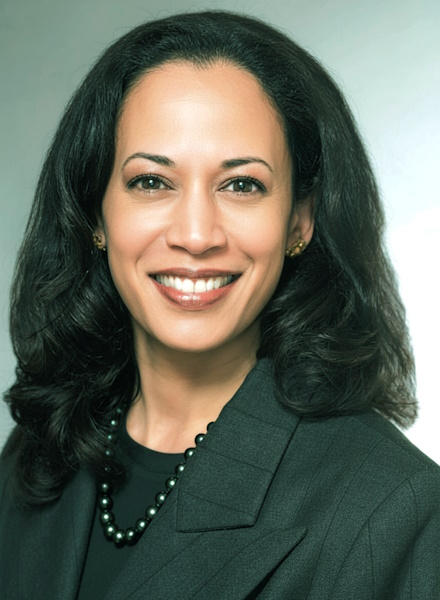
Of course there was Willie Brown, though Kamala did not emphasize that connection. In any case, Kamala was at least acquainted with top California Democrats such as Brown, Senator Diane Feinstein, and prominent House Representative Nancy Pelosi. They all would have some effect, positive or negative, on Kamala's career -- but her interactions with them were generally private, details occasionally leaking out, sometimes garbled when they did. All that can be said is that Kamala had acquired a network of influential backers for her political ambitions.
BACK_TO_TOP* As Kamala began her ascent in California, America's national politics were continuing to shift. In the 2000 election Al Gore, Bill Clinton's vice president, opposed George W. Bush, then governor of Texas and George H.W. Bush's son. It was a painfully close election, with George W. Bush winning the electoral vote but losing the popular vote.
Once in office, Bush's first priority was a big tax cut, with the effect of taking Clinton's budget surplus and replacing it with growing budget deficits. However, domestic concerns were derailed on 11 September 2001, when four jetliners were hijacked by members of the al-Qaeda terrorist group, with two of the jetliners striking and toppling the dual World Trade Center Towers in New York City. The third jetliner flew into the Pentagon; the fourth was apparently supposed to attack the White House -- but the passengers took on the hijackers, with the plane crashing into the Pennsylvania countryside. Almost 3,000 people were killed, including everyone on board the jetliners.
There had been a war of sorts against Islamic terrorism before "9-11", as the day of the attack was commemorated, but it was mostly in Europe, particularly France. The 9-11 attacks meant a dramatic escalation in the "Global War On Terror (GWOT)", as it was called. The first order of business was to deal with al-Qaeda, whose home base was in Afghanistan -- then being led by the extremist Islamic Taliban group.
The Bush II Administration demanded that the Taliban hand over the al-Qaeda terrorists; the Taliban refused, and in October the US leading a coalition to invade Afghanistan and overthrow the Taliban government. The Taliban quickly fled to the countryside, with the US and its allies working to create a new and, hopefully, more democratic government.
The apparent success in Afghanistan emboldened the Bush II Administration to engage in further adventures. The foreign policy group in the White House, with the ultra-hawkish Vice President Dick Cheney as their most visible member, felt that the USA had the power to impose its will on the planet, and that power should be exercised. If America's allies didn't want to go along, whatever, they weren't needed. To that end, the administration began to push for action against Saddam Hussein's Iraq.
Saddam Hussein had been doing everything to spite the efforts to contain him, and in particular to spite the UN inspection team attempting to monitor Iraqi efforts to develop weapons of mass destruction (WMD). Saddam Hussein had been engaging in such provocations through the Clinton Administration, with conservatives fuming that something needed to be done about him. Now they had the opportunity and, taking a generous read of intelligence analyses, they built up a case for military intervention -- a case with some basis in fact, but with substantial exaggerations, for example implausibly linking Saddam Hussein to Islamic terrorism. The French warned that invading Iraq would a big mistake, but their counsel was irritably rejected.
The invasion of Iraq went ahead in March 2003, with Iraq overrun within a month; Saddam Hussein was captured and later hanged by the new Iraqi government. It seemed like a second triumph of American arms, but problems began to emerge, the most embarrassing one being that the WMDs that were made into the basis for the intervention didn't really exist. Bush would be accused of lying in his case for war, but he had been misled by his intelligence people -- who had been misled in turn by Saddam Hussein, who had been playing a game of bluff to make himself look more fearsome than he was.
However it happened, it was a blunder. Overturning the established order in Iraq meant chaos, with Sunni and Shia Muslims at each other's throats, and Islamic terrorists attempting to exploit the situation: the French were right after all. Some conservatives had spoken of America bringing democracy to the Middle East -- an idea that was derided, even by some other conservatives, and which proved as unrealistic as it sounded. Senator Joe Biden, by that time chair of the Senate Foreign Relations Committee, took a particular interest in the occupations of Afghanistan and Iraq, expressing concerns that the Bush II Administration hadn't really thought out how the occupations were supposed to work.
The Bush II Administration found itself, through events beyond their control, entangled in international politics. Joe Biden once observed that presidents who had been governors tended to not do all that well on the international stage, and it was becoming apparent that George W. Bush was out of his depth.
* For Kamala, as San Francisco District Attorney, international politics were remote. One of the first things she did as SFDA was work on the backlog of homicide cases. She was in touch with a group named "Mothers of Homicide Victims" who were seeking justice for their slain offspring, and was sympathetic to their distress. She called all the homicide inspectors in for a meeting and grilled each of them, asking what homicide cases were on their lists and what actions were being taken. It was not something they were used to, but the push started to get results.
Kamala also worked to establish order in the office environment. Early on she sent out a staff survey, asking what needed improvement; the old and defective photocopiers were a clear problem, so she ordered new ones. She also set up a meeting on Monday afternoons where her lawyers working on felony cases got up to describe the current progress of their cases to the group. It was not intended as a critical session, instead being to communicate everyone what was going on, and making them feel involved.
Difficulties inevitably arose. Only a few months into her time in office as the SF DA, one of her campaign promises -- that she would not seek the death penalty for any offenders -- came back to haunt her.
On 10 April 2004, an SFPD officer named Isaac Espinoza, age 29, and his partner Barry Parker, both in plainclothes, were in the SF Bayview-Hunter's Point district. Bayview-Hunter's Point had once had thriving shipyards, but after WWII the district gradually declined, becoming run-down, isolated from the rest of the city, and largely black. By the turn of the century, it was starting to revive, but it was still not a very safe neighborhood. The two police officers approached a "suspicious person" who they thought was carrying a concealed weapon under a long coat. When they accosted him, he pulled out an AK-47 assault rifle and started spraying them down. Espinoza was hit twice and killed, Parker was hit in the leg.
The shooter, 21-year-old David Hill, was arrested; he was a local gang member with a long history of trouble with the law. The cops wanted the death penalty for Hill, but Kamala stuck to her campaign promise and asked for life without parole, which is what he eventually got. San Francisco's police chief, police unions, and police officers were furious with Kamala's decision, cops turning their back on her when they could get away with it. Even Senator Diane Feinstein was critical, saying that the death penalty was warranted.
Kamala became more cautious about crossing law enforcement. She went out of her way to forge alliances with the police, and increased her office's conviction rate; she decided that if California was to abolish the death penalty, that needed to be done at a higher level of authority.
BACK_TO_TOP* Despite the flap over the death penalty, Kamala was never really a softy; she often ran into hard criminal cases, and worked to make sure they were given the punishment they deserved. For one example, she helped push through longer sentences for "johns" who had sex with juveniles, saying the johns were guilty of child sexual assault. However, many of the criminals she dealt with were not hard cases:
QUOTE:
I remember the first time I visited the county jail. So many young men, and they were mostly black or brown or poor. Too many of them were there because of addiction and desperation and poverty. They were fathers who missed their kids. They were young adults, many of them who had been pulled into gangs with no real choice in the matter. The majority weren't there for violent offenses, and yet they had become drops in the sea of those swept up in a wave of mass incarceration.
END_QUOTE
She saw these young men as a "living monument to lost potential", and wanted to tear down the structures that had made them into such a monument. One of the core elements of the problem was "recidivism" -- the inclination of convicts who had been released to commit new crimes that put themselves behind bars again, often for longer terms.
Kamala got to thinking about the problem of managing "re-entry" of discharged convicts so they didn't end up back behind bars. She assembled a group of core advisors -- including her chief of policy, Tim Silard -- and asked them: How can we put together a re-entry program that works?
The program was named "Back On Track (BOT)". It had several aspects:
BOT was a full-time job in itself, and Kamala needed to find somebody who could manage it under her direction -- which is where Lateefah Simon entered the picture.
* Lateefah Simon, mentioned earlier, had been born in 1977 in San Francisco's Western Addition, a neighborhood in the central city adjoining on Haight-Ashbury. It had once been a center for San Francisco's ethnic Japanese community -- but they had been removed by the internment of Japanese Americans during WW2, with a black population taking their place. While Lateefah had been growing up, Western Addition was suffering from the crack cocaine epidemic, with the associated decline of the neighborhood. She wasn't happy with what she saw and wanted to do something about it, but she was too caught up in the decay: she ended up on probation for shoplifting and dropped out of high school.
Lateefah was working full-time at a Taco Bell when she got a line on an opportunity. There was a social-service organization named the "Center for Young Women's Development" that took young women on the margins, provided them with support, and helped them get jobs. They needed more staff; was Lateefah interested?
She jumped at it. She was still a teenager, with a daughter of her own, but she threw herself into the job, politicking at local government meetings, getting out on the streets to get in touch with girls on the edge, working with them at the center. Kamala thought she was perfect to run BOT -- but when she called up to offer the job, Lateefah wasn't certain the SFDA's office was the place she should be, telling Kamala: "I never wanted to work for the Man."
Kamala laughed and shot back: "Well, don't worry! You won't be working for the Man -- you'll be working for ME!" After laughing hysterically, Lateefah signed up. Kamala had acquired a lively and sometimes prankish sense of humor, being quick to laugh enthusiastically: "Hahahahahaa!" Both Kamala and Maya got their laugh from their mother.
In any case, with diligent effort BOT was put into motion. A year down the road, the first graduates got their diplomas. It was an appropriately festive occasion, with Kamala describing it:
QUOTE:
Through the main door, a group of eighteen men and women walked down the aisle to take their seats. With a few exceptions, this was the first time in their lives they had ever worn graduation robes. Only a handful of them had ever had an occasion to which they could invite their family ... In the year since they started the program, each of them had, at a minimum, earned a GED and landed a steady job. They had all done community service -- more than two hundred hours of it. The fathers among them had paid all of their outstanding child support payments. And they were all drug free ...
After two years, only 10 percent of Back on Track graduates had re-offended, as compared with 50 percent for others convicted of similar crimes. ... Our program coat about $5,000 per participant. For comparison, it costs $10,000 to prosecute a felony case and another $40,000 or more to house someone in the county jail.
END_QUOTE
BOT graduation ceremonies would generally be officiated by California superior court judges; the state judiciary generally appreciated the program. It even got a nod from the Federal Department of Justice (DOJ), being designated a model program.
BACK_TO_TOP* Establishing BOT was something of a high point of Kamala's time as San Francisco District Attorney. Much else happened -- the cases she dealt with as a big-city DA could have been the basis for a long-running TV drama. She was re-elected to the office in 2007, suggesting the public had no problem with the way she did the job. Nonetheless, as SFDA Kamala had a limited ability to change the system. In a 2020 interview, Jamilah King -- a reporter for MOTHER JONES, who followed Kamala's career -- noted the ambiguity of Kamala's position, saying:
QUOTE:
I think it's incredibly hard to create change from within law enforcement. She was within the confines of a law enforcement system and a criminal justice system that has been very, very slow to change.
END_QUOTE
Nonetheless, as King pointed out, Kamala did what she could:
QUOTE:
I'm from San Francisco. I know folks who've been in the system, and they'll just say flat out: "Look, she's a cop. She put us in jail."
... On the other hand, it's always been really telling for me that there are a lot of organizers and community groups within California and San Francisco's criminal justice reform system that are pretty ride-or-die for her. They don't agree necessarily with all of the decisions she's made, but they recognize that she was one of the few people to even give them a seat at the table.
She's this complicated figure, but I think she's earned the respect of a lot of the people who are doing criminal justice work, who recognize what the confines are. They recognize what's possible, and they also recognize when she's wrong. That's not to say that everybody is in favor of her. But I think there's this long history in San Francisco ... of Black folks in elected office being a little bit more moderate than sort of the white [liberals] who end up getting the headlines.
END_QUOTE
* While Kamala was laboring as San Francisco District Attorney, the Bush II Administration was getting into trouble -- particularly in Iraq, where the USA found itself stuck in a festering civil war. Afghanistan wasn't nearly as troublesome at the time, but the situation there was far from settled as well.
In 2005, George W. Bush did score a success for his side by appointing two new SCOTUS justices, including John Roberts -- who would soon become Chief Justice -- and Samuel Alito. Roberts would, at least for a time, prove moderate, but Alito would tend towards the Right from the start.
In 2007, the Bush II Administration went into a crisis phase, in part because the situation in Iraq deteriorated into an all-out war with Islamic terrorists, but more because America's and the world's economic situation went into free fall. It had begun earlier in the decade, when mortgages were enthusiastically issued to borrowers with weak credit ratings. The housing market had collapsed in 2006, leading to a wave of foreclosures and, more importantly, to a financial crunch among those who had issued such "subprime" mortgages.
What greatly compounded that problem was that this was an era of imaginative financial gimmicks, one of them being "mortgage-backed securities (MBS)" that were traded on the open market, buyers being reassured that the MBS had good credit ratings. In reality, they were hollow, leaving the financial industry drowning in bad debt. That threatened the entire financial order, which had become dependent on "shadow banks", based on innovative and largely unregulated financial schemes, and under stress they fell apart.
The result was the global "Great Recession", the worst financial crash since the Great Depression of the 1930s. Economic stimulus, emergency business loans, and other actions by the Bush II Administration managed to stave off absolute disaster, but the economic crisis was not going away any time soon.
George W. Bush did manage to stabilize the situation in Iraq by sending in additional US forces, with Islamic terrorism defeated and a degree of peace following. However, that wasn't enough to restore public confidence in him and the GOP, with the Democrats ascendant. The presidential election of 2008 consequently resulted in a win for Democratic candidate Barack Obama, a freshman senator from Illinois, who defeated Arizona Senator John McCain. Obama was the first POC to become president.
Senator Joe Biden had run in the Democratic primary, but ended up dropping out. Soon after he had done so, the Obama campaign contacted him to see if he wanted to be Obama's vice-president; Obama and his people perceived that an older and much more experienced white politician, with deep roots in Congress, would be the ideal balance.
Biden was unenthusiastic, knowing that the vice-presidency was often a useless position. Obama made it clear that nobody in the administration would have greater access or influence than Biden; he didn't want Biden just to balance the ticket, he wanted Biden to help him govern. Joe Biden always talked over major career decisions with his extended family -- and when he did so on that occasion, his mother Jean asked: "Let me get this straight, honey. The first black man has a chance to be President, he says he needs you, and you told him NO?" That gave him pause; Biden agreed to sign up. In practice, Biden would in fact have extraordinary access and empowerment in the Obama Administration.
The Bush II Administration gave every courtesy and assistance to the incoming administration -- which, given that the USA was still in the grip of a financial crisis, was very helpful. George W. Bush felt that the measures his administration had taken would be enough to fix the Great Recession; Obama was not so sure.
BACK_TO_TOP* It was in 2008 that Kamala's world was turned upside down. The two Harris girls had generally not lived far from each other, but at that time Maya was living in New York, working for the Ford Foundation as vice president of democracy, rights, and justice. She came back for a visit, the two joining up in a restaurant, Shyamala having asked to meet them there. They were chatting when Shyamala arrived:
QUOTE:
Our mother had just walked in. Mommy -- the least vain person I knew -- looked like she was ready for a photo shoot. She was dressed in bright silk, clearly wearing makeup (which she never did), her hair professionally blown out. My sister and I exchanged a glance.
"What's going on?" I mouthed to Maya as our mother approached our table. [Maya] raised an eyebrow and shrugged. She was just as confused as I was. We hugged and greeted one another, and our mother sat down. A waiter brought us a basket of bread. We reviewed our menus and ordered our food, making lighthearted conversation.
And then my mother took a deep breath and reached out to us both across the table. "I've been diagnosed with colon cancer."
END_QUOTE
The two girls were floored. Kamala necessarily took ownership of Shyamala's treatment, getting her to the hospital for chemotherapy; getting her back home; keeping track of her medications, and seeing which of them caused Shyamala trouble. In the meantime, Kamala had to keep up with the workload at the district attorney's office, and was also beginning to line up a run at the California Attorney General's office in 2010.
As Shyamala's condition worsened, she became harder to care for. Kamala tried to get her into assisted living, but Shyamala wouldn't hear of it. Eventually, Shyamala was hospitalized, whether she liked it or not; she did go back home, but with a hospice nurse in attendance.
When the end was close Kamala, Maya, Tony, and Meena were there, along with family friends going back to the Afro-American Association. Kamala called her uncle Balachandran to come to the USA, but he didn't make it in time. Shyamala Gopalan Harris died on the morning of 11 February 2009; she was 70 years old. Kamala visited family in India afterward, taking Shyamala's ashes with her, which were scattered in the Bay of Bengal.
* During this sad period of time, Kamala's refusal to press for the death penalty was tested again. On 22 June 2008, 49-year-old Tony Bologna -- a night manager in a supermarket -- and his three sons were returning to their home in San Francisco's Excelsior district from a barbecue, when an assailant opened fire on them; Tony, along with sons Michael and Matthew, were killed.
On 25 June, San Francisco police arrested 21-year-old Edwin Ramos, an immigrant from El Salvador and a member of the notorious Latin MS-13 gang, on suspicion of the murders. As the story came out, MS-13 gang members were attacked earlier on 22 June by members of the rival Norteno gang; for some reason, Ramos thought the Bolognas were members of the Nortenos and decided to take them down.
Kamala refused to ask for the death penalty against Ramos, pushing for life imprisonment, with Mayor Newsom backing her up. Ramos accordingly got 183 years in prison in 2012. The surviving members of the Bologna family, incidentally, had to be relocated under a witness protection program. Kamala's refusal to ask for the death penalty was not as controversial as it had been in the case of Officer Espinoza; distaste for the death penalty was growing in California, leading to an extended back-&-forth on its legality, and the last execution in California was in 2006. Nonetheless, her critics would still throw the Ramos case at her.
* As an extension of her work as a prosecutor, in 2009 Kamala published her first book, SMART ON CRIME, put together with the assistance of Joan O'C. Hamilton, a professional writer. It focused on rationalized approaches to ensuring public safety, including BOT and comparable efforts across the USA -- while providing the political background on how crime control in America had gone off the rails.

It was rooted in the Nixon Administration's "War on Drugs" in the 1970s, which led to the emergence of the "Get Tough On Crime (GTOC)" political drive that became established during the Reagan Administration. GTOC focused on more aggressive policing, and particularly on tougher prison sentences. It was pushed by the Right, but many Democrat politicians went along with it rather than be seen as too "soft". Kamala's waffling on the death penalty reflected the political pressure GTOC exerted on public officials.
The end result of GTOC was an explosion in prison populations that did nothing to improve public safety -- in fact, made it worse. Nonviolent offenders who could have been rehabilitated were sent off to prison, with all its small and large brutalities, where little or nothing was done to mold them into constructive members of society for when they were released. When they got out they were likely more dangerous than when they went in, with high rates of recidivism.
By 2009, GTOC had widely been recognized as a failure, but the urge to paint Democrats as "soft on crime" remained a popular Republican talking point, with "smart on crime" efforts played up as boondoggles. Although Kamala didn't mention it in her book, GTOC presented white people as under siege from brown and black criminals, helping to feed growing white nationalist sentiment. Kamala also got criticism from the hard Left for saying in the book that low-income communities actually wanted stronger policing -- though she acknowledged that in practice, racial bias among police remained a problem.
BACK_TO_TOP
