
* In 2010, Kamala decided to reach up from her work as San Francisco's district attorney for the position of California's attorney general -- and won the election after a tough fight. Once in the new job, one of her first priorities was to deal with mortgage fraud that accompanied the Great Recession then in progress, finally helping to push through the "California Home-Owner's Bill of Rights" to help the state's citizens keep their homes.
* Although Kamala deeply grieved the loss of Shyamala, she had too much to do to dwell on it: not only did she have her hands full as SFDA, she also had the state attorney general election to focus on. By 2010, her election campaign was in high gear, with her Republican opponent -- the district attorney of Los Angeles County. In a time when Republican extremism was on the rise, Cooley was popular in liberal-leaning Los Angeles, being seen as even-handed, a corruption-buster, and had been elected as LADA three times. In short, it was a tough race, and the odds were not on Kamala.
The two candidates had one and only one debate, on 5 October 2010, and it was a turning point for Kamala. It was not a high profile event, being held at a practice courtroom at the law school of the University of California, Davis. Nothing much eventful happened, until the moderators asked about "double-dipping" -- that is, taking both a public salary and a public pension at the same time.
The moderators pointed out that the $150,000 USD salary of the California attorney general was half of the $292,300 salary that Cooley was earning as the LA district attorney. If Cooley were elected, he could in principle take a taxpayer-paid pension as a former district attorney and a taxpayer-paid salary as the state attorney general, which would give him an income of more than $400,000 USD. The moderators asked: "Do you plan to double-dip by taking both a pension and your salary as attorney general?"
Cooley, a direct person, replied without hesitation: "Yes, I do." He elaborated: "I earned it. I definitely earned whatever pension rights I have, and I will certainly rely upon that to supplement the very low, incredibly low salary that's paid to the attorney general." Cooley would later admit he should have dodged the question. Kamala stayed quiet for the moment. The moderators then asked Cooley: "Anything you'd like to add to that?" Kamala busted out with: "Go for it, Steve! Hahahahahaa! You earned it!"
Those present thought Cooley had been extraordinarily tone-deaf, though the incident might not have amounted to much -- except that Kamala's campaign seized on Cooley's remarks, finding they fit perfectly into a 30-second ad that ended with the screen fading to black marked by white text that read: "$150,000 a year isn't enough?" The average California household made less than $55,000 USD at the time.
Kamala's campaign was running low on money, so the decision was made to run the ad only in Los Angeles, to cut into Cooley's home-field support. It was effectively the only TV ad they had the money to run, but Kamala approved it. She was generally inclined to positive campaigning, but couldn't pass up the shot.
* In the course of the election campaign, growing political extremism on the Right made Steve Cooley's reputation as a "moderate Republican" an awkward tightrope act. Very much in response to the election of Obama, in early 2009 a national "Tea Party" movement had emerged that, reduced to fundamentals, was based on hostility to all things liberal, and to Republican politicians not seen as sufficiently zealous.
For a period of time in 2004, San Francisco Mayor Gavin Newsom had authorized city officials to issue gay marriage licenses, even though gay marriage was not legal at either the state or Federal level. Kamala was enthusiastic, even performing gay marriages herself. The California Supreme Court quickly ended Newsom's initiative -- but ironically, the same court overturned the state's gay marriage ban in 2008. 2008, however, was an election year, and California voters had passed "Proposition 8", which re-instituted the ban.
In 2010, Proposition 8 was being challenged in Federal court; Cooley said he would defend it, while Kamala made it clear that she would not. Public sympathy for gay rights was strongly increasing at the time, particularly in California; Cooley was fighting the tide as America shifted slowly to the Left, while the Republicans shifted strongly towards the far Right. The entire California GOP ticket was suffering accordingly.
Very late in the game, national Republicans correctly recognized that Kamala was a threat, a rising Democrat star who was going places. The GOP spent a million in Los Angeles to run an ad featuring the mother of the slain SFPD Officer Isaac Espinoza, talking about Kamala's refusal to seek the death penalty for the man who killed her son. Kamala, however, then got a boost when President Obama visited LA for a rally, with Obama telling a crowd of 37,000: "I want everybody to do right by her."
Election day was 2 November 2010, the vote being agonizingly close. That night, against advice, Cooley declared victory -- with the SAN FRANCISCO CHRONICLE following up with a COOLEY BEATS HARRIS headline, even though returns were still coming in. Kamala's campaign wasn't close to giving up hope. One Matt Haney, at the time a campaign volunteer, recalled: "People are falling asleep all around her, and she's still there. We stayed there until the Sun came out."
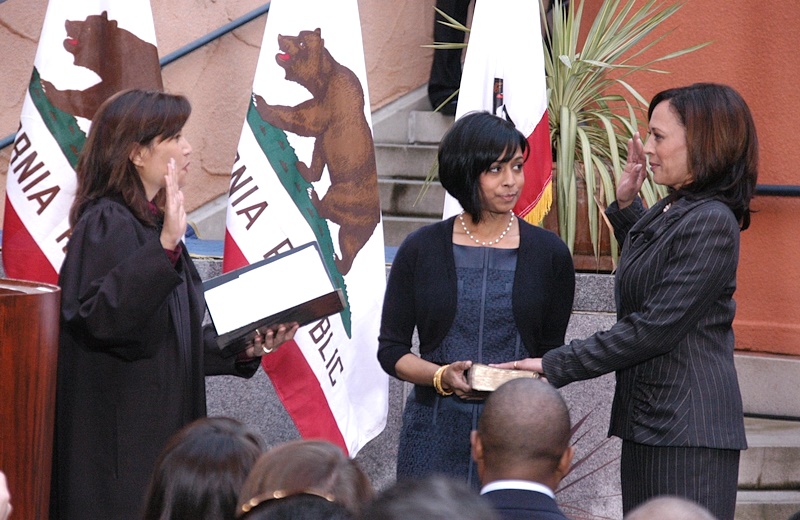
Of course, as close as the vote was, there were recounts, with the issue not settled for three weeks. Kamala had won by a razor-thin margin of less than 75,000 votes, with Cooley finally conceding. It was a near thing; if Kamala had lost, it would have cut the thrust from her political ascent. Kamala was sworn in on 3 January 2011 by California's chief justice, Tani Cantil-Sakauye, with Maya assisting. The win gave Kamala higher national prominence, since she was the first woman, the first Afro-Indo woman, to become California's AG.
It should be noted that one of the planks of her campaign for state AG was she was willing to argue for the death penalty, saying in effect that she was responsible to carry out California's laws as written. Kamala's about-face on the death penalty might well have been influenced by the growing public sentiment against it; there were no executions in California on her watch, or afterward for that matter. California had outgrown the practice, and in practice she wouldn't need to push for executions.
It should also be noted that the Federal court battle over Proposition 8 -- under the case of HOLLINGSWORTH V PERRY -- continued to 2013, when the measure was finally killed off, and gay marriage became legal in California for good. Kamala ordered the Los Angeles County Clerk's office to "start the marriages immediately" -- to then officiate at the wedding of the plaintiffs in the case, Kris Perry and Sandy Stier, at San Francisco City Hall. Gay marriage then became legal all over the USA in 2015.
* The 2010 election had a disastrous effect on the Obama Administration. When Obama took office in 2008, the Democrats were in the majority in both houses of Congress -- though not enough of a majority in the Senate, with 60 seats needed to overcome a filibuster. At the outset, his first priority was to stabilize the economy, with stimulus efforts and emergency business loans following. The Obama Administration also worked with Congress on a comprehensive overhaul of business regulations, which would be signed into law in the summer. In his memoirs, Obama wryly noted how bankers were glad to get government financial assistance, but not so glad to get new regulations as well.
In the meantime, Obama Administration was working on a national health-care bill, which had long been a goal of Democratic administrations. Initially, the effort was conducted in discussion with Republicans -- but then Mitch McConnell, the Republican Senate minority leader, sent down the word that all cooperation was to cease. The health-care program, called the "Affordable Care Act (ACA)" or "ObamaCare", managed to squeak through Congress. At the signing ceremony in the spring of 2010, Vice President Biden was picked up in a famous open-mike gaffe, telling Obama: "This is a big f###ing deal."
It was. The ACA envisioned national health care through commercial health-insurance exchanges set up by the government -- a "public option" insurer didn't make the cut. Everyone had an "individual mandate" to get health insurance or suffer tax penalties, with subsidies helping those who couldn't afford the insurance. The ACA left much to be desired, but it was still a huge step forward.
Later on in 2010, Obama signed into law the "Dodd-Frank Act" -- named after its two Democratic sponsors, Representative Barney Frank of Massachusetts and Senator Chris Dodd of Connecticut. It was introduced in response to the breakdown of the US financial system in the Great Recession, being the biggest financial regulatory reform since the Roosevelt Administration. It leashed in the worst excesses of the finance industry and gave consumers more rights.
Republicans were not very enthusiastic about Dodd-Frank, but it was the ACA that infuriated them. They blasted Obama as a "socialist" -- a meaningless snarl word, applied by the Right to any government action to help the American people. With the Tea Party becoming noisier, Republicans in Congress turned towards political obstructionism. As the 2010 election approached, McConnell announced: "The single most important thing we want to achieve is for President Obama to be a one-term president."
Obama wasn't up for re-election until 2012, but the intent was there. Some claimed the quote was taken out of context -- but in the days before the election, McConnell made himself perfectly clear:
QUOTE:
... if our primary legislative goals are to repeal and replace the health spending bill; to end the bailouts; cut spending; and shrink the size and scope of government, the only way to do all these things it is to put someone in the White House who won't veto any of these things. We can hope the President will start listening to the electorate after Tuesday's election. But we can't plan on it.
END_QUOTE
The election went badly for the Obama Administration, with the Republicans gaining a landslide 63 seats in the House of Representatives and taking control, along with a similar bloodbath in state governments. The Democrats held on to the Senate, but the Republicans took back six seats, narrowing the Democratic majority. Mid-term elections tend to have low voter turnout; in 2010, Democrats preferred to stay home, while the Republicans turned out in numbers -- showing their distaste for the POC in the White House, and demonstrating how deeply the GOP had been undermined by the white nationalism of the Dixiecrats.
Obama's work became much more difficult, and would stay that way to the end of his time in office. Before the election reversal, Obama had managed to place two liberal justices on the Supreme Court -- both women, including Sonia Sotomayor in 2009 and Elena Kagan in 2010. They were the last liberal SCOTUS justices to be appointed for over a decade.
BACK_TO_TOP* As California attorney general, one of the first issues Kamala had to address was the impact of the Great Recession, which meant a lot of Californians losing their homes. As Kamala wrote, this calamity ...
QUOTE:
... played out with particular force in Fresno and Stockton. Local leaders pleaded with the Federal government to declare the region a disaster area and send help. "Disaster area" was an apt description: entire neighborhoods were abandoned, and the area was suffering one of the highest foreclosure rates in the nation. Sometimes families were struggling so hard to pay their mortgages that they would abruptly pick up and leave. I heard stories of pets being abandoned because their owners could no longer afford to keep them -- a phenomenon the Humane society was reporting all across the country ...
When I visited Fresno, I was told that abandoned dogs had been seen roaming in packs. I felt like I was walking through the aftermath of a natural disaster. But this disaster was man-made.
END_QUOTE
In 2009, as SF DA, Kamala had set up a mortgage-fraud unit to take on mortgage scammers preying on veterans and the elderly. That was a small-scale effort; there were bigger things going on in the background.
In October 2010, before the election, news media investigating the wave of foreclosures following the Great Recession found out that large banks and other financial institutions had set up work groups to expedite foreclosures. The work groups were often staffed by people with few qualifications, who signed through the paperwork on foreclosures with no consideration of due process; the paperwork was sometimes fraudulent, signatures being forged. There was a tale of a man in Florida who whose house was foreclosed, even though he fully owned the house, and never had a mortgage. Those targeted with foreclosures were given no explanation and no avenue for protest. The people involved in the exercise were called "robo-signers" for their ability to churn out foreclosures in volume.
In response to the scandal, a number of major banks -- including Bank of America, JP Morgan, Wells Fargo, and Citigroup -- put foreclosure proceedings on hold for the time being. In one of the responses to the scandal, the attorneys general of all the US states joined into a "multistate investigation" into the "foreclosure scandal". After winning the election as state AG, Kamala was quick to get involved with the multistate investigation:
QUOTE:
On my first day in office, I gathered my senior team and told them that we needed to get involved right away in the multistate investigation into the banks. I had appointed Michael Troncoso, a longtime member of my team, as chief counsel in the attorney general's office, and Brian Nelson as special assistant attorney general. I asked them to dig in and get us up to speed.
END_QUOTE
She and members of her team attended a meeting of the National Association of Attorneys General (NAAG) in Washington DC in early March 2011 to get aligned with the effort. However, all was not right at NAAG. The discussion was focused on coming to a settlement, a bank payout -- but the settlement amount appeared arbitrary, no investigation having been completed to determine what the proper amount should be. Worse, if the states accepted the settlement, the lenders got immunity from further legal action, and were off the hook.
Kamala didn't argue the matter, she simply walked out of the NAAG meeting with her staff. She didn't need to protest, since California was a big player in the crisis -- and if California didn't play along, the banks were not going to get a settlement. Kamala and her people went over to the Justice Department; there they talked with Tom Pirelli, the associate attorney general.
Kamala told Pirelli that California had been hit harder by the foreclosure crisis than any other state -- and if NAAG couldn't perform a proper investigation of the lenders, then California would do it on its own. Pirelli replied that he didn't think California could really do the job, and such an investigation would take too long to be helpful to the people in need anyway.
Later in the day, Kamala spoke with Elizabeth Warren, a prominent Harvard law professor who had been on government financial-advisory committees, and at the time was working at the Treasury Department on the new "Consumer Financial Protection Bureau (CFPB)". Warren had proposed the CFPB and made sure it was included in the Dodd-Frank bill; it would go into operation in July. Kamala found Warren supportive -- but cautious, Warren being engaged in a tug-of-war with the Obama White House at the time over taking on the banks that she couldn't talk about. Nonetheless, Kamala was encouraged.
* Kamala and her people went back to California and quickly got to work. She knew that the banks were prepared to offer California from $2 billion to $4 billion USD. Some in her office thought that sounded good, but she was suspicious, replying: "Good? Compared to what?" When seeking redress for damages, it was important to know what the damages actually were.
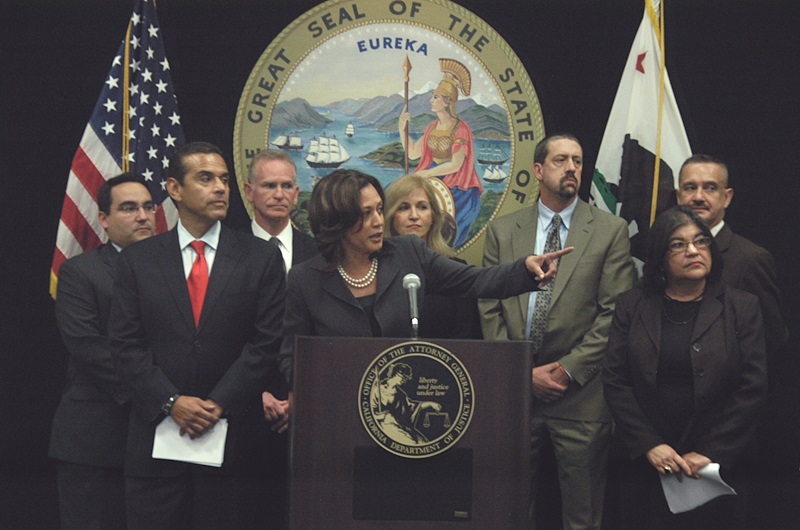
That was a job in economic statistics and her office didn't have that expertise, but it wasn't that hard to bring in people who did. The analysis was duly performed, to show that what the banks were offering was woefully inadequate. Kamala told her people: "There's no way I'm taking this offer." In May 2011, the establishment of the "California Attorney General's Mortgage Fraud Strike Force" was announced -- staffed by investigators and lawyers from the consumer fraud, corporate fraud, and criminal divisions.
The team was not only going after the banks, they were going after "Fannie Mae" and "Freddie Mac" as well. They were Federally-chartered home finance enterprises, Fannie Mae having been established during the New Deal as the "Federal National Mortgage Association (FNMA)", while Freddie Mac was established in 1970 as the "Federal Home Loan Mortgage Corportion (FHLMC)".
Both enterprises bought mortgage funds from lenders, and either kept them in their portfolios, or packaged them into MBS; at the time, they handled about 3/5ths of all US mortgages. They had got into trouble during the Great Recession along with the rest of the mortgage-finance industry, and since 2008 had been under oversight by the government's "Federal Housing Finance Agency (FHFA)".
The foreclosure crisis was ongoing, people were still losing their homes, so things had to happen quickly. The sudden emergence of the California strike force threw the NAAG discussions into confusion, as Kamala intended it would. The bankers were upset, perceiving that they were being treated roughly -- they were, but it was hard to say it was unjust. In August 2011, New York pulled out of the NAAG negotiations; would California be next?
The banks had a meeting in Washington DC in September 2011 and invited Kamala to attend. The meeting started out cordially, then got increasingly tense. The Bank of America counsel started out by saying California was putting the banks through "terrible pain"; that they were frustrated, traumatized, and exhausted. She asked, in so many words: What is California's problem?
Kamala went hot and replied: "You want to talk about pain? Do you have any understanding of the pain that you've caused? There are a million children in California who aren't going to be able to go to their school any more because their parents lost their home. If you want to talk about pain, I'll tell you about pain."
The lawyers there didn't take the hint, saying the homeowners were at fault; they had bought homes with mortgages they couldn't afford. Kamala wasn't buying that: she knew that banks were not always honest with home buyers about mortgages, and could treat them like marks to be conned.
The general counsel of JPMorgan then suggested to her that a quick settlement would go over well with California's voters -- to which Tough Cop Kamala replied: "Do I need to inform you that this is a law enforcement action?" The room went quiet, and that was the end of the discussion.
Kamala told them: "Look, your offer doesn't come near acknowledging the damage you have caused. And you should know I mean what I say: I'm going to investigate everything."
The general counsel of Wells Fargo asked: "Well, if you're going to keep investigating, why should we settle with you?"
She replied: "You'll have to make that decision for yourself." As she left the meeting, she decided that she'd have to pull out of the negotiations completely. Back in California, she wrote a letter announcing and explaining her decision -- releasing it late on Friday lest it disrupt markets.
After the letter was released, she started getting calls from friends, worried that she had taken on too big a fight; from political consultants, who warned that the banks would spend great sums to evict her from office; from the government of California, one caller saying: "I hope you know what you're doing." -- and even the White House, with cabinet secretaries making their concerns known. It was enormous pressure, but there was also the pressure of knowing families were being evicted every day. Kamala felt the pressure, but always ended up thinking of Mommy, still a presence in Kamala's mind, telling her to stand fast.
BACK_TO_TOP* In her fight with the banks, Kamala ended up with an ally: Beau Biden, the attorney general of Delaware. Beau was the older of Senator Joe Biden's two sons -- he was actually named "Joe III", his father being "Joe II", but the family called him "Beau".
Delaware was a small state, and the foreclosure crisis was accordingly much smaller in scope than it was in California -- but Beau didn't like the offer the banks were making to NAAG any more than she did, and for the same reasons: not enough money being offered, no investigation being performed. When the pressure was on, they'd talk to each other several times a day; a number of other state AGs were on her side as well.
Kamala and her team were putting in long hours and flying all over the USA. They didn't know if they were making much progress. In early 2012, Michael Troncoso came into Kamala's office and told her: "I just got off the phone with the general counsel of JPMorgan. I told him what the deal was, that we weren't budging off our position."
"What did he say?" she asked.
"He wouldn't stop screaming at me. He says it's over, that we pushed too far -- it was really intense. And then he hung up."
Kamala called her team together to discuss whether it made sense to continue the investigation. While they were talking, a light went on in her head, and she shouted out to her assistant in the neighboring room: "Get me Jamie Dimon on the line." -- Dimon being the chairman of JPMorgan Chase.
One of the team was startled: "You can't call him. He's represented by an attorney." She shot back: "I don't care. Get him on the phone."
A moment later, her assistant stuck her head into the room and said: "Mr. Dimon is on the phone." Kamala took off her earrings -- a prudent thing to do when preparing for a fight, "the Oakland in me" -- and picked up the phone. The fight started immediately, Dimon shouting at her: "You're trying to steal from my shareholders!"
Kamala shouted back: "Your shareholders? Your shareholders? My shareholders are the homeowners of California! You come and see them! Talk to them about who got robbed!" The shouting match went on, with a team member later saying that he was thinking: This is either a really good or colossally bad idea.
The two finally started to cool off, and tried to come to an understanding. Dimon, a sensible and decent person as CEOs went, told Kamala he would talk to his board and see what could be done. She had no idea what was said in the board meetings, but two weeks later the banks caved in -- Dimon had obviously been persuasive. California got a settlement of $18 billion USD, later rising to $20 billion USD, for homeowner relief. The Federal government assigned a monitor to keep an eye on the process; Kamala also assigned one of her own to make sure California's interests were attended to.
* The agreement also included a set of reforms to allow homeowners to fight foreclosures more effectively, but the reforms were only valid for three years. Something more permanent was required, in which predatory lending practices by the banks would be outlawed and individual homeowners would have the right to sue when the banks jerked them around.
Kamala wasn't the only person in the California government who was thinking along such lines; she hooked up with like-minded members of the state assembly to work for what became known as the "California Home-Owner's Bill of Rights". Trying to get the bill passed was a challenge, since the bank lobby had considerable influence over the state assembly. Kamala obtained a capable ally in the form of John Perez, at the time the speaker of the assembly. He worked the assembly and had Kamala do the same, pitching the bill to the legislators.
Sometimes the fight went well, but it was always an uphill slog. Kamala was particularly annoyed at one legislator who said foreclosures were good for the local economy, because a house that had been foreclosed needed painters and gardeners to get it back in salable condition. She wondered if the legislator also supported arson "because it keeps fire extinguisher companies in business?"
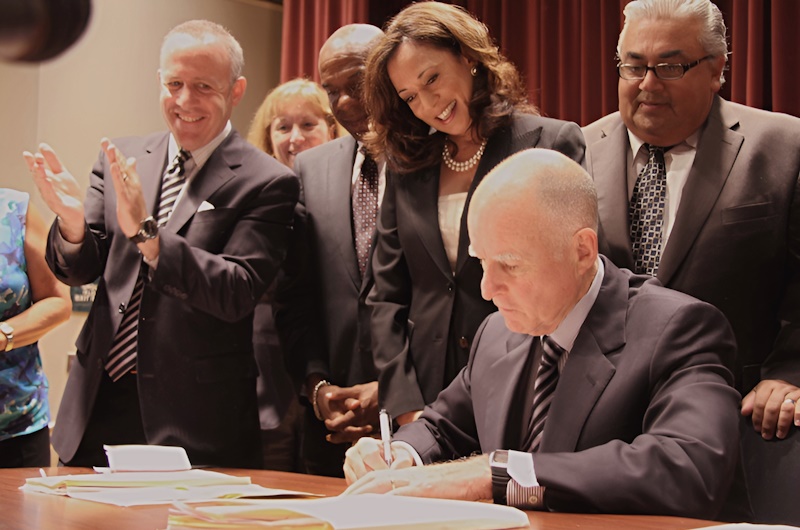
Kamala went on the road to pitch the bill to the voters, and have them contact the legislators. Organized labor proved a big help, helping to counterbalance the influence of the banks. When the bill finally came to a vote, Speaker Perez conducted an extended vote roll, while Kamala, her team, and others buttonholed legislators to persuade them to vote for the bill. The bill passed the assembly, then got through the state senate, thanks to the work of Senate President Darrell Steinberg. It was then signed into law by Governor Jerry Brown, becoming law on the first day of 2013.
The work didn't leave off there, Kamala writing:
QUOTE:
Meanwhile, the Mortgage Fraud Strike Force was pushing hard. The unit would go on to investigate and prosecute a number of major mortgage scams. The head of one of the largest scams was sentenced to twenty-four years in state prison. Because of the efforts of a truly extraordinary team, we were able to secure -- on top of the $18 billion -- $300 million from JPMorgan to reimburse the state pension system for losses on investments in mortgage-backed securities. We also secured $550 million from SunTrust Mortgage, $200 million from Citigroup, and another $500 million from Bank of America -- all in connection with the mortgage crisis.
END_QUOTE
The joke went around with Kamala's staff that her name meant: "Add another comma to that settlement."
All that was satisfying, but it was in the context of national and global economic disaster. By 2012, the economy had stabilized, and was poised for a return to growth -- but the Great Recession had left too much wreckage behind, and in the USA it was disproportionately cruel to people of color. To make things worse, many of the systemic failures that had led to the Great Recession had not been addressed. Dodd-Frank could only do so much.
BACK_TO_TOP
