
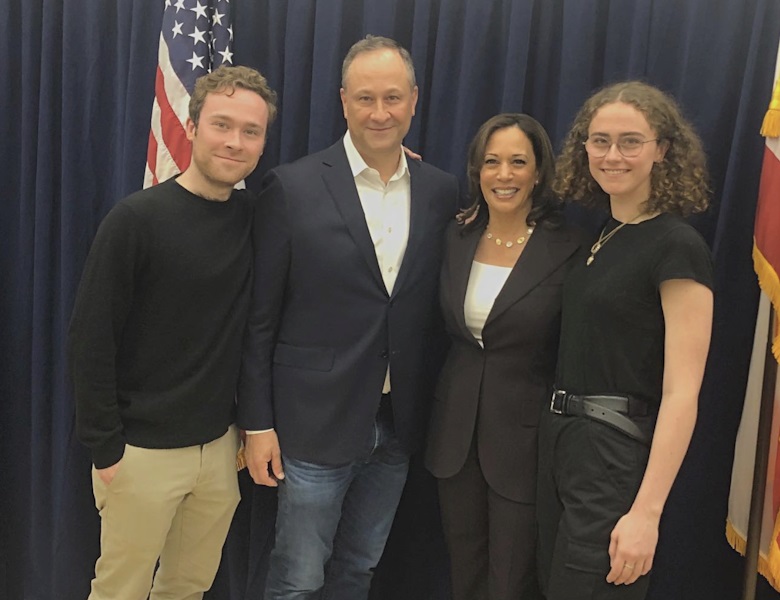
* Following her criminal rehabilitation effort, Kamala pushed a complementary truancy effort, operating on the basis that kids who stayed in school also tended to stay out of crime. During that time, she started dating a high-profile lawyer named Doug Emhoff; things clicked, and they got married in 2014, with Kamala becoming a stepmom to Doug's kids Cole and Ella.
During that period of time, Kamala got a call from Eric Holder, Barack Obama's attorney general; he was planning on stepping down, and asked Kamala if she was interested in the job. She thought it over, but turned down the offer, having too much on her plate as California's AG -- one of the issues at the time being a wave of illegal immigration.
* Along with criminal rehabilitation actions, Kamala worked on another major effort:
QUOTE:
When I first started as attorney general, I told my executive team that I wanted to make elementary school truancy a top priority for my office. Those who didn't know me must have thought I was joking. Why would the state's top law enforcement official want to focus on whether seven-year-olds are going to school or not? But those who had been with me for a while knew I wasn't messing around. Indeed, instituting a statewide plan on truancy was part of the reason I'd run for the office in the first place.
END_QUOTE
The effort was the flip side of the earlier Back on Track program. Crime statistics showed that young criminals were well more often than not high-school dropouts, and the dropouts had usually been truants in elementary school. Kids who didn't mesh up with school life early on almost inevitably fell behind until they finally gave up. If they were able to make it through their schooling, the chances were much smaller that they would commit crimes.
The SF-AG's office joined hands with the city and the school district to develop a truancy initiative. The exercise yielded interesting insights. A widely-held stereotype was that truancy was a symptom of shiftless parenting -- but the reality was more often of a single parent, working long hours and barely getting by, stretched too thin to be a good parent, with no extended family available to help.
There was another stereotype involved. When Kamala found out the school districts only contacted the mother in single-parent households, she asked: "What about the father?" The reply was that they usually didn't pay child support, and didn't care about the kids.
That was of course true in some cases -- but what if the father was just barely getting by himself, and didn't have the money to pay child support? Fathers could still could be interested in the welfare of their kids -- and when the school districts reached out to them, they often stepped up to do what they could. The stereotypes, often racially-tinged, that had been spread by Ronald Reagan and others had become pervasive to the point of being seen as common knowledge, but they actually reflected ignorance.
The effort to correct the problem paid off, with a significant reduction of truancy among San Francisco's elementary school children. Kamala also worked to spread awareness of the truancy issue and mobilize efforts to deal with the problem across the state.
There was actually nothing new about truancy laws; all US states had compulsory education laws by 1918, California having passed their version in 1874, with laws stipulating penalties for non-compliance. However, the truancy effort also helped drive passage, in 2011, of a California law that allowed parents of chronic truants to be charged with a misdemeanor for "contributing to the delinquency of a minor."
Some prosecutors took an overstressed view of that law. In 2013, a DA in Orange County busted one Cheree Peoples for the truancy of her daughter, who was afflicted with sickle-cell anemia; Peoples was put in handcuffs and dragged off in front of cameras. In reality, the 2011 law left criminal prosecution as a last resort, with the courts first providing assistance to parents, such as referral to health services, substance abuse treatment, plus child care and housing. Gene Demby, a journalist with National Public Radio, commented in 2020:
QUOTE:
Big picture, [Peoples's case] was one of the most extreme examples of how this law was used. More broadly, what the law did was create a more standardized way for local law enforcement officials to get involved with making sure kids go to school every day. And so very few parents were arrested and perp walked in this really punitive and splashy way. But what did happen to a lot of families is that they were ushered into a system that asked parents: Why can't why can't you get your act together? Why can't you send your kids to school?
I thought it was really interesting to look at [Harris's] involvement in this issue, because she didn't invent the idea of punishing parents when their kids miss school. California already had a law on its books. Her innovation was to build a really standardized way for local district attorneys to get involved in pressuring parents to make sure their kids go to school. And a lot of education advocates were happy that she brought attention to the issue, because they say attention is actually the number one way we solve truancy. They think it's really important to call people's attention to the fact that, Hey, it adds up when your kids miss school.
What Harris also intended to do was to build a system where the school district officials, teachers and parents could all sit down and talk through the problems: Why isn't your kid coming to school? What are the resources that we could give you to help make sure that your child goes to school every day?
END_QUOTE
The actual difficulty with the law, as Demby pointed out, was not that parents were being dragged off in handcuffs -- that was a distortion of the law -- but that they were subjected to a gradual spiral of pressure if, after being given assistance, the problem wasn't resolved: We're giving you everything, why can't you make this work? That wasn't an unreasonable question, but parents on the receiving end could well find it so when confronted by the authorities.
* 2012 was, of course, a presidential election year, with Barack Obama running for re-election, against Republican Senator Mitt Romney of Utah. Republican having control of Congress from the mid-terms, Obama's accomplishments from that time were not as impressive as they had been in the first two years of his term.
One accomplishment was the withdrawal of American combat forces from Iraq, completed at the end of 2011. The withdrawal schedule had actually been established by George W. Bush -- but it happened on Obama's watch, and dovetailed with his campaign promises to wind down US involvement in wars. Afghanistan remained a problem; the fight against the Taliban seemed endless, while the incompetence and corruption of the Afghan government was increasingly evident.
In 2010, the Pentagon had pushed to increase forces in the country -- leading to a clash with Joe Biden, who believed that a less ambitious and more focused effort was required, the idea being to stabilize the conflict until the Afghans could handle it themselves. The disagreement got so far out of control that Obama had to intervene, coming down hard on the vice president's side. It did much to reinforce the already-strong relationship between the two men, but did little to change the realities in Afghanistan.
At least the 2012 election went in Obama's favor, with Obama defeating Romney by a modest margin; despite Mitch McConnell's best efforts, Obama got a second term. The Senate remained in Democratic hands, though the Democrats did not dislodge the Republican grip on the House. That meant the gridlock continued, leaving Obama painfully restricted -- as was demonstrated even before his second inauguration.
On 12 December 2012, in Newtown, Connecticut, a 20-year-old named Adam Lanza shot and killed his mother, then went over to Sandy Hook Elementary School and killed 26 people, including 20 children. When police showed up, Lanza then killed himself. Obama brought the Sandy Hook shootings to the top level of national concerns and pushed for rational gun-safety laws -- but the Republicans in Congress refused to act. There would be other mass shootings on Obama's watch, with exactly the same refusal to deal with the problem.
BACK_TO_TOP* One day in 2013, Kamala was getting repeated calls on her smartphone. She tried to ignore them, but they wouldn't stop; she wondered if there might be some sort of emergency, so she finally picked up.
It turned out to be Chrisette, a close friend. Kamala asked her what was up, with Chrisette answering: "You're going on a date!"
"I am?"
"You are! I just met this guy. He's cute and he's the managing partner of his law firm and I think you're going to really like him. He's based in Los Angeles, but you're always here for work anyway.'
Kamala, being in the public eye, was cautious about her personal life, since anything she did could end up splashed across the gossip pages. However, she trusted Chrisette, and Chrisette was hard to derail anyway. Kamala asked her: "What's his name?"
"His name is Doug Emhoff, but promise me you won't google him. Don't overthink it. Just meet him. I already gave him your number. He's going to reach out."
Being an investigator, of course Kamala googled him. Douglas Craig Emhoff had been born on 13 October 1964 in Brooklyn, his parents being Reform Jews; he had a brother, Andy, and a sister, Jamie. The family moved to Southern California when he was 17. He graduated from California State University in Northridge in 1987 with a bachelor's in communications, then graduated from the University of Southern California School of Law in 1990 with a JD degree.
Doug went into law practice in California, starting out as a lawyer servicing the entertainment / media sector, though he would also do work on intellectual property cases. He married one Kerstin Mackin in 1992; she gave birth to a son, Cole, in 1994, and a daughter, Ella, in 1999. Incidentally, they were named after jazzman John Coltrane and singer Ella Fitzgerald respectively.
In 2000, Doug set up a law firm in partnership with one Ben Whitwell, which was bought out by Venable LLP in 2006 -- Venable being rooted in Delaware, but with offices across the USA. Doug and Kerstin divorced in 2008; the split was amicable as such things go, and they shared custody of the kids. In 2013, Doug was managing director at Venable's Los Angeles office.
Kamala's first contact with Doug was on an evening a few days later; he told her he was at a Los Angeles Lakers basketball game, with Kamala replying: "Go Lakers!" -- though she was an SF Golden State Warriors fan. The next morning, she got a rambling voicemail from Doug that she found intriguing. In an interview years later, Doug said: "I left this ridiculous voicemail, which she has saved and plays back to me on our anniversary every year. I thought I'd never hear from her again, but ..."
She cut in: "But it was just adorable!"
Kamala ran a busy schedule, and it could be hard to find the time to call people. However, that day Kamala was expecting contractors to show up at her San Francisco apartment to start a remodeling job, and so she went home at mid-day to let them in. The contractors were delayed, with Kamala finding herself with an hour on her hands; she decided to call Doug. They connected, and spent about an hour on the phone, making jokes with each other and hitting it off wildly.
They decided on a dinner date; Kamala planned to fly down to LA, Doug saying she should then come to his place; she thought it would make more sense for him to pick her up, since she didn't know the area so well. He replied: "OK, but I just need you to know that I'm not a really great driver." She found that unpretentious, self-confident. The next morning, Doug sent Kamala a list of dates when he would be available, to see if they could mesh on schedules, Doug saying: "I really like you, and I want to see if we can make this work."
He wanted to get together the coming Saturday, but she had a long-scheduled girls' weekend at that time, and it wouldn't work. They got together later that week. She went to Doug for another date; on the third date, he flew to Sacramento to sit in on Kamala delivering a speech on the school truancy effort, and then go out to dinner together. That date was particularly significant because he was breaking cover, appearing in public in a clear association with Kamala. The rumor mill started to turn.
Following the third date, the two agreed to commit for six months, and then evaluate how it was going at that checkpoint. Doug wanted her to meet his two kids, but Kamala was cautious; she didn't think it would be right if Doug and Kamala's relationship wasn't going to last. All four finally got together two months after the first date, with the group driving to a restaurant on the Pacific Coast Highway named the "Reel In".
They all got along splendidly, with Cole & Ella inviting Kamala to an arts show where their friends were displaying their work. Doug whispered to her: "They must really like you. They never invite me to anything." They went to the arts show, with Kamala chatting with the students, who greeted her warmly. It was unlikely the fact that she was the state AG was lost on them.
BACK_TO_TOP* The relationship between Kamala and Doug did not fade, instead getting continuously stronger; there was serious chemistry there. Cole and Ella were contributors in the exercise, providing encouragement. Incidentally, Cole got a degree in psychology but would end up working in the Los Angeles entertainment industry, while Ella was an artist, primarily in fashion design.
In late March 2014, Kamala flew to Mexico City with a bipartisan group of four other state AGs to talk with government officials there, to discuss how to deal with Mexico's infamous drug cartels. They came to an agreement to target cartel money-laundering operations, and set up improved communications channels with Mexican authorities.
Kamala got back to her apartment in San Francisco on the evening of 26 March, in something of a state of disorder. She and Doug were flying off on an Italian vacation together the next morning, and she barely had time to pack. Doug came to the apartment while she was running off in all directions at once. Kamala suggested that they order out, Doug suggested Thai food, with Kamala saying: "Sounds great!" She pulled a menu out of a drawer and asked: "How about pad Thai?"
Doug then, changing gears abruptly, told her: "I want to spend my life with you." Kamala, distracted, simply replied: "That's nice, honey. Should we have chicken or shrimp on the pad Thai?"
Doug, realizing he hadn't got Kamala's attention, had to repeat what he said: "No, I want to spend my life with you." Kamala then changed gears herself as Doug got down on a knee. Kamala burst into a gusher of tears, Doug took her hand, and asked: "Will you marry me?" Through the blubbering, Kamala choked out: "Yes!" Doug had intended to propose to her in Florence, but anxiety made him jump the gun.

They were married in a private ceremony on Friday, 22 August 2014; Maya officiated, while Meena read from Maya Angelou. Reflecting on her Indian heritage, Kamala put a flower garland around Doug's neck; reflecting on his Jewish heritage, he crushed a glass -- a traditional reminder of the destruction of the Jewish Temple.
Kamala moved into Doug's home in Brentwood, Los Angeles, where he'd resided since 2012, living there along with Cole and Ella, who dubbed her "Momala". Shared custody with Doug's ex-wife was not a problem, Kerstin extending every courtesy to his new wife. Kamala, who liked to cook, would put on lavish family dinners on Sundays when she wasn't out of town on business, and took a strong interest in the activities of her two stepkids.
Kamala was working towards reelection at the time, her Republican opponent being one Ronald Gold. Along with GOP opposition, she had to deal with critics on the hard Left, who were inclined to see her as too biased towards the law enforcement mindset. Nonetheless, she was re-elected by a landslide margin of 15 points, 57.5% of the vote versus 42.5%. That was gratifying after her first-term election, which had been a nail-biter.
BACK_TO_TOP* Also during that summer, Kamala got a phone call from Eric Holder, Obama's attorney general, with a proposition. Holder was a somewhat controversial figure, noted for speaking his mind, having said in 2009 that Americans were "a nation of cowards" on race, earning the wrath of the far Right, with Republicans in Congress going after him.
He was being particularly criticized for a failed "sting" operation conducted by the Bureau of Alcohol, Tobacco, & Firearms (ATF) titled "Operation Fast & Furious", run from 2009 to 2011. It was part of a series of ATF "gunwalking" efforts, in which guns with GPS trackers were sold to criminals. The problem was the limited battery life of the trackers; once they ran out of juice, the guns could no longer be tracked -- and the guns then started showing up at violent crime scenes. Some ATF agents began to object to the program; after a Border Patrol agent was shot and killed in late 2010, the exercise collapsed into a noisy public scandal.
In early 2011, Holder ordered an investigation into Fast & Furious, with Obama later publicly announcing that neither he nor Holder had authorized the effort. Congressional investigations continued, with GOP in Congress targeting Holder; he repeatedly testified to Congress, denying he had known anything about Fast & Furious before it broke cover, and rejecting calls for his resignation. When Obama refused to hand over a set of documents demanded by Congress, citing executive privilege, the House of Representatives overwhelmingly voted to hold the AG in contempt of Congress. It was a theatrical gesture -- the DOJ was not going to and did not act on the contempt charge -- but the bad blood between the GOP in Congress and Holder continued.
In any case, in the phone conversation with Kamala, Holder asked her a question: "I'm going to be stepping down soon. Are you interested?"
Of course she was, but it was a lot take in on such short notice. It would be a huge career jump; the problem for her was that, were she to take the Federal AG office, there would be only two years left in Obama's final term. That would not give her time to accomplish very much.
She talked to Holder later about what she might be able to do, focusing on a Federal re-entry initiative. Holder replied that there was no money for it, and no likelihood that the Republican-controlled Congress would provide any funds. Kamala told Holder she'd think his offer over, and get back to him. Holder, incidentally, was stepping down because of health concerns, and wanted to make sure Obama got a replacement AG before mid-term elections.
There were issues that the two did not talk about in the conversation that were significant to them both. On the evening of 26 February 2012, a 17-year-old black Floridian named Trayvon Martin was visiting Sanford, Florida, when he was accosted by a 28-year-old Hispanic American named George Zimmerman, who was on neighborhood watch and found Martin suspicious. A struggle followed and Zimmerman, who was armed, shot and killed Martin.
There was national outrage in the American black community over the killing, which became an issue in Obama's re-election campaign. The outrage was compounded in July 2013 when Zimmerman was acquitted of second-degree murder and manslaughter -- Florida having a "stand your ground" law that made pleading self-defense in a homicide an easy ticket to walk.
The issue led to the establishment of decentralized activist groups in the US and Canada under the label of "Black Lives Matter (BLM)" -- focused mostly on police brutality, in particular the reality that black people were much more likely to be killed by police than white people. BLM folks tended to be loud and angry, impatient with old-time civil rights activists. The far Right singled them out, replying to the slogan of "Black Lives Matter" with the dismissive slogan of "All Lives Matter".
BLM activists generally thought much of Holder, preferring him over the more circumspect Obama, thinking there was friction between the two men. Actually, as Obama pointed out, there was little daylight between their views; it was just that Holder wasn't an elected official, and wasn't always as careful about what he said. As far as Kamala went, while she was a defender of law enforcement, she was sympathetic to the goals of BLM, but it wasn't a major concern to her at the time.
* Kamala gave Holder's offer of the Federal AG office thought, listing pros and cons, discussing the matter with family and friends. One day she went for a walk in an open-space reserve in the hills with friends -- and in talking things out, it came together, Kamala writing: "I realized the real reason behind my resistance to the offer: I already had a job I loved, and work I still wanted to do."
She had a long queue of things she had done or was doing as California's AG, having:
Kamala was particularly concerned about what was called the "gay & trans panic defense".
QUOTE:
In 2002, a seventeen-year-old woman, Gwen Araujo, had been brutally beaten and murdered in Newark, California. Her killers, two of whom had been involved with her sexually, had tried to justify their actions in court by claiming that they had panicked upon learning that Araujo was transgender, becoming temporarily insane.
It was ludicrous. As district attorney, I had organized a conference of prosecutors and law enforcement officials from across the country to push back on the idea that criminal conduct could be mitigated by prejudice. And as attorney general, in that summer of 2014, I was working with the governor and state legislature on what would be a successful effort to ban such a defense statewide.
END_QUOTE
Kamala realized that had taken on a lot of work, and as she wrote: "I wasn't finished yet." She called Holder that evening and told him her decision. On 25 September 2014, Holder announced that he was stepping down from the Federal AG position, with Kamala's office issuing a tribute:
QUOTE:
Attorney General Holder has brought great honor to America as our nation's top law enforcement officer. His work to protect voting rights, reduce inequities in our criminal justice system, and expand the rights of LGBTQ Americans leaves a profound and lasting legacy. I am honored to have worked closely with Attorney General Holder on criminal justice issues affecting California, including fighting transnational criminal organizations, reducing recidivism, supporting local law enforcement and securing billions of dollars for homeowners hit by the foreclosure crisis. His leadership and integrity have made America a safer, better, and more just nation.
END_QUOTE
When the media asked her about the possibility of her becoming his replacement, she replied:
QUOTE:
I am honored to even be mentioned, but intend to continue my work for the people of California as Attorney General. I am focused on key public safety issues including transnational gangs, truancy and recidivism.
END_QUOTE
Holder was replaced as Federal AG by Loretta Lynch, who became the first black American woman to hold the job. That was some gratification for Obama -- though it didn't compensate for the beating the Democrats took in the 2014 mid-terms. In the Senate, the Democrats lost nine seats and the Senate majority, while the GOP reinforced their majority in the House. Obama had no chance of passing legislation in the last two years of his term, and judiciary appointments became very difficult.
BACK_TO_TOP* In the meantime, the Obama Administration was confronted with an international crisis. In 2013, corrupt Ukrainian President Viktor Yanukovych rejected a push in the national legislature to bring Ukraine closer to the European Union. The result of his rejection was mass public demonstrations on Maidan Square, in the heart of the capital city of Kyiv, beginning in late 2013. In January and February 2014, over a hundred people were killed in Maidan Square by a special police team, with national outrage following: In late February, Yanukovych and his cronies fled to Russia, with a new government under Petro Poroshenko -- a wealthy oligarch, best-known as a candy-maker -- then installed.
"EuroMaidan" or the "Revolution of Dignity", as it was known, demonstrated to Western nations that Ukrainians wanted a democratic state. Russian President Vladimir Putin did not like that idea, having made it publicly clear that he regarded Ukraine as part of Russia, that Ukrainian nationalism was a fiction. He had similarly been critical of the expansion of the North Atlantic Treaty Organization (NATO) to countries in the East, believing NATO expansion was an effort to box in and suppress Russia.
Putin concluded that the EuroMaidan Revolution was actually the work of the USA and other Western nations, and decided to intervene militarily. Russian troops in unmarked uniforms went into the Donbas region, in Ukraine's northeast, to back up disaffected insurgents there -- resulting in the creation of two "pseudo-states", not recognized by anyone but Russia, named the "Luhansk People's Republic" and "Donetsk People's Republic", or "L/DPR" for short. Russia also occupied the Crimean Peninsula, and quickly annexed it to the Russian Federation.
Russia's assault on Ukraine was universally condemned by the US and other NATO nations. Nobody recognized the Russian annexation of Crimea, and sanctions were slapped on Russia. Military assistance to Ukraine ramped up -- if cautiously, since Ukraine had been known for corruption up to that time; Obama provided substantial logistical support but no weapons, out of fears they would end up on the black market.
Joe Biden became the Obama Administration's point man on Ukraine, with Biden conferring often with Poroshenko, being supportive but pushing him on reform. Biden was not happy with Obama's restraint on Ukraine, seeing Putin as more of a threat than Obama did.
* In the summer of 2014, California was hit by a wave of illegal immigrants, coming from the "Northern Triangle" of Central America -- which consisted of El Salvador, Guatemala, and Honduras. They were poor countries with weak governments, with the result that violent gangs -- with names such as "MS-13" and "Mara 18" -- ran wild, doing whatever they wanted. Thousands of people, tens of thousands of people, were murdered in the Northern Triangle every year.
That summer, the violence led to a surge of people trying to escape with their lives, being brought across the US borders by "coyotes" -- human smugglers, not much better than the gangsters the people were running away from. Kamala was watching the news, to see a video clip of several busloads of "illegals" being taken through Murieta, California, in the stretch between Los Angeles and San Diego. A crowd was blocking the street, waving signs and shouting: "Go home!" "Nobody wants you!" "You're not welcome!"
Kamala's sympathies were with the refugees, and she was appalled by the hate. To make matters even more appalling, there was a push underway in Washington DC to accelerate the decision-making process in determining if undocumented families and unaccompanied kids were granted asylum, or sent back home; the goal was to turn around cases in two weeks. Evaluating each case involved determining if the families or kids would really be in danger if they were sent back home. With kids, that was troublesome, because they weren't able to make a fair case for themselves, and they didn't have a right to a lawyer. Without a lawyer, odds were about 90% that an asylum case would be rejected; with a lawyer, the odds were about 50%.
Kamala got on the phone with managing partners at big law firms in California, as well as with corporate lawyers at big companies such as Warner Brothers and Disney. She asked them to come to the AG office, where she conducted an auction of sorts:
QUOTE:
"Okay, can I get five hundred hours pro bono from you? How about you? And you? What about your firm? What can you guys do for us?" Soon after, I held a similar meeting in Northern California, where I did the same. We rallied the private lawyers to work through one of the community agencies that was offering legal services to help unaccompanied kids. Then I sponsored legislation to provide $3 million to other nonprofits that were providing these children with legal representation.
END_QUOTE
The illegal immigrant problem, bad as it was, would get much worse.
BACK_TO_TOP
