
* In 2016, Kamala ran for the US Senate, winning the election handily. Once in the Senate, she had to deal with the incoming presidential administration of Donald Trump, who was determined to impose far-Right policies on the USA. That was an uphill fight, since Republicans were in control of the White House and Congress, and were poised to gain a majority on the Supreme Court.
* In early 2015, Senator Barbara Boxer announced that she would be leaving the US Senate at the end of her term. Kamala then had a decision to make: did she want to run for the Senate in 2016? Yes, there were things she wanted to get done as attorney general, but there were bigger things she could do as a senator. She announced her candidacy on 15 February 2015.
That gave the better part of two years to the election, but it was going to be a lot of work. It also put Doug in the spotlight, and he had a skeleton in the closet: his first marriage had broken up after he'd had an affair with one of his kids' teachers. Doug had told Kamala about it before they got married, so she was prepared for the issue. Fortunately, it didn't become an issue, at least at that time.
The Kamala show went on the road around California in what the crew called the "Kamoji bus", which had a Kamala emoji symbol painted on the back door. Her opponent ended up being Loretta Sanchez, who had been in the US House of Representatives, representing Orange County, for ten terms. Sanchez was also a Democrat; as per the state's "Top Two" scheme -- established by California Proposition 14, passed in 2010 -- candidates from all parties shared the primary roster, with the top two winners then fighting it out, even if they were from the same party. No Republican contender for the Senate seat got even 10% of that primary vote, and all the Republican candidates together only got a little more than a quarter, underlining how little power the GOP had in California.
Kamala wrote that Sanchez ran a tough campaign -- but the contest was unequal from the start: Sanchez didn't have as much Democratic Party backing and didn't have as much money. She was reduced to trying to bring in moderate Republicans, who were generally indifferent, and were a dying breed anyway.
The state elections were also being overshadowed by the national presidential election, which had taken a bizarre turn, unlike any in US history. It seemed likely early on that Joe Biden would run for the White House in 2016 -- but his son Beau died of a brain cancer in 2015, and Joe was dispirited. In addition, Obama decided to back Hillary Clinton, who had been Obama's secretary of state, as the presidential candidate; Obama believed it was time for a woman to get her shot at the White House. Incidentally, Maya signed on with the Clinton campaign as a senior advisor.
As the primaries approached, a joker came out of the deck -- in the form of Donald Trump, a New York property developer and loud-mouthed self-promoter, who threw his hat in the ring to be the Republican nominee. Few took him seriously at first, but he gradually built up momentum, in large part because of pro-Trump propaganda from far-Right media that resonated with Republican voters. He swept aside all challengers to seize the nomination.
Trump ran on a platform of bigotry and xenophobia, in particular going after illegal immigrants -- promising to deport them in mass and build a huge wall along America's southern border, which Mexico would pay for. There actually already were extensive barriers along the border, but they were in places where it made sense to build them; Trump wanted something much more grand, and didn't care, never cared, if it were practical.
Trump's slogan was "Make America Great Again (MAGA)". Presidential campaigns can be dirty, but none were dirtier than Trump's, whose rhetoric was sneering, bigoted, ignorant, a continuous stream of wild falsehoods. He wasn't bright, but he had great low cunning; he made skillful use of social media, aided by armies of trolls who harassed and threatened everyone he denounced, with the effort boosted by a Russian-backed online disinformation campaign.
The Russians hated Clinton, since as secretary of state she had taken a hard line against their trouble-making. Although Russia was a poor country, the Kremlin had piles of "dirty money" flowing through the global financial system, using it for bribery, propaganda, and other forms of subversion against democratic governments. Trump had long had contacts with wealthy Russians in his business deals, oblivious to the fact that wealthy Russians were, to a considerable degree, on the leash of the Russian state: there was money there, that was good enough for him. He was perfectly aware of Russian involvement, even publicly encouraged it; it just never occurred to him that it was an issue, and when people made an issue of it, he called them liars.
Hillary Clinton was of course the prime target for Trump's abuse, the big hammer used against her being a private email server. She hadn't been happy with the email system at the State Department, so she had decided to go her own way -- with Trump playing up "the emails" as the crime of the century, leading his MAGA followers in chants of: "LOCK HER UP! LOCK HER UP!" An FBI investigation of the email server exonerated Clinton -- though FBI Director James Comey, in a clumsy attempt at impartiality, still publicly criticized Clinton over the emails, while the news media relentlessly kept them in the headlines.
Clinton was also attacked by the hard Left, one of her rivals for the nomination having been Bernie Sanders, senator from Vermont, an independent turned Democrat for the occasion. His "Bernie Bros" had always despised the Clintons for their centrist inclinations; when Bernie lost the primary, they screamed loud that he had been cheated, and had nothing good to say about Hillary.
It was a perfect storm for Hillary Clinton. Trump won the election, losing the popular vote but taking the electoral vote. The ugly irony was that Trump hadn't really believed he would be elected; he'd only run as a promotional scheme to make money. Some blamed the Bernie Bros for Hillary's narrow defeat -- but only the biggest soreheads refused to vote for her, and those soreheads generally didn't live in swing states, where they could have affected the electoral vote. After the election, unfortunately, the Bernie Bros continued to kick Hillary while she was down, loudly if implausibly insisting that "Bernie would have won!"
Not incidentally, Trump was unhappy with losing the popular vote, insisting that he'd actually won by a landslide -- preposterously claiming that the Democrats had sent an army of illegal aliens to vote. He even went so far as to set up a voter fraud commission; it went nowhere, because the states refused to take it seriously and cooperate with it. He would never concede an election: Heads I win, tails you cheated.
* Kamala won the Senate seat by a plurality of over 50%, making her the second black woman senator in US history. Under the circumstances, however, she didn't feel like celebrating, instead delivering a defiant victory speech:
QUOTE [EXCERPTS]:
I intend to fight. I intend to fight for our ideals. I intend to fight for a state that has the largest number of immigrants, documented and undocumented, of any state in this country and do everything we can to bring them justice and dignity and fairness under the law and pass comprehensive immigration reform. Bring them out from under the shadows, fight for who we are.
I intend to fight. I intend to fight for ... truth and transparency and trust. I intend to fight. I intend to fight for a woman's access to health care and reproductive health right. I intend to fight against those naysayers who suggest that there is no such thing as climate change; I intend to fight for our environment. I intend to fight for the civil rights of all people including those that we always fought for in terms of allowing them to marry the person they love, I intend to fight.
I intend to fight for our students and invest in them and understand this is not about a cost, it's about an investment we cannot let them graduate with debt. An education is the only path to success. I intend to fight. I intend to fight big oil, I intend to fight the science deniers, all of those who would attack who we are in our values as Californians when it comes to leading and knowing where we need to be as a country. I intend to defend workers and their right to collective bargain and all that we know has to happen in supporting working men and women.
I intend to fight for common-sense gun-safety because it's just the right thing to do. Let's have the courage to stand up to those who offer a false choice. They suggest you either in favor of the Second Amendment or you want to take everyone's guns away, that's a false choice. I intend to fight it. And I intend to fight to make sure that all of our communities are stronger.
We are a great country. We are a great country and part of what makes us great is fighting for our ideals, fighting to make sure those words always ring true that we spoke in 1776, that we are all and should be treated as equals. Let's fight for our ideals.
END_QUOTE
Kamala was faced with an uphill struggle, with Trump now in control of the White House and the Democrats in the minority in both houses of Congress. She was undeterred, finishing up her defiant speech by thanking family and all the people who helped her campaign, as well as Loretta Sanchez "because she is part of the American Dream and her parents are part of the American dream." -- ending with: "Let's get to work."
BACK_TO_TOP* Having been elected to the US Senate, Kamala had relocate to Washington DC, the first item of business there being the new senators' orientation:
QUOTE:
A bipartisan group of senators hosted us for three jam-packed days of sessions, during which we were informed about Senate rules and procedures, ethics, and how to set up a Senate office. Doug studied the spouses' binder like a Talmudic scholar.
END_QUOTE
She and Doug started out in a temporary apartment, to later obtain a two-bedroom condominium at the Westlight Complex, paying $1.775 million USD. Doug got a partnership at DLA Piper, a global law firm, working out of the Washington DC office, but sometimes the California offices as well. He would fly to California on alternate weeks to stay in touch with Ella, who was a senior in high school at the time.
Nathan Barankin, her second-in-command at the California Department of Justice, chose to sign on as the chief of staff of Kamala's office. He relocated with his family to Washington DC, where he worked with Kamala to select office personnel. Of course, as she wrote:
QUOTE:
Hiring a diverse staff was important to me -- veterans, women, people of color. I wanted my staff in Washington and our state offices to reflect the people we represent.
END_QUOTE
Kamala was sworn in as a senator by Vice President Joe Biden on 3 January 2017, with Doug assisting. She would get seats in four committees as seemed appropriate to her background: Intelligence, Homeland Security, Budget, plus Environment & Public Works, and get another seat on Judiciary early the next year.
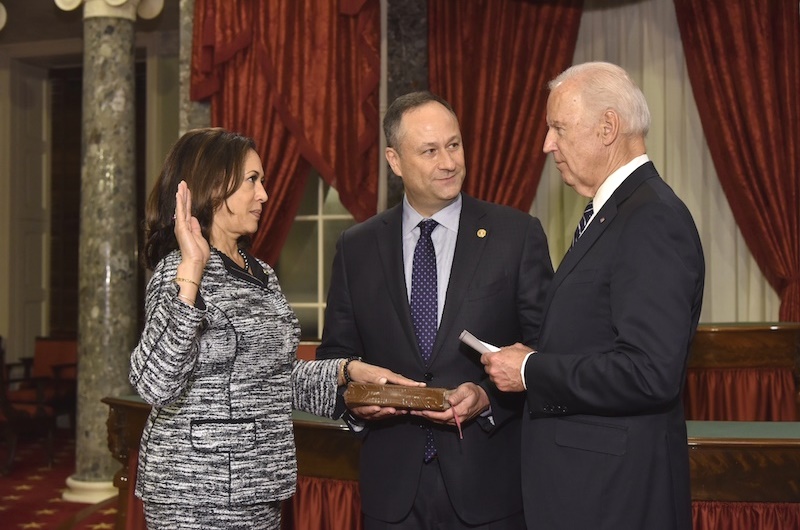
A week after being sworn in, on 10 January Kamala attended the confirmation hearing for John Kelley -- a retired US Marine general who Trump had picked as his Homeland Security Secretary. Given Trump's focus on sweeping up illegal aliens, Kelly was in a position to inflict a lot of pain. Kamala chose to focus on the "Deferred Action on Childhood Arrivals (DACA)" program, which had been set up in 2012 by the Obama Administration to deal with illegals who had been brought to the USA by their parents when they were children. They were called the "Dreamers", the term derived from a dead-end predecessor of DACA, the "Development, Relief, & Education for Alien Minors (DREAM) Act".
The Obama Administration had been energetic in deporting illegals, but sending the Dreamers back "home" would be banishing them to what they could only see as a foreign country. Under DACA, young people with proper identification and a good record could be shielded from deportation and given work permits, with a path towards citizenship. There was much public sympathy for the Dreamers, with Trump even saying they had nothing to worry about -- but Trump said a lot of things, many of them contradictory, and anybody with sense knew better than to believe most of what came out of his mouth.
One of the issues with the Dreamers was that their background information could tag others for deportation. The policy of the Department of Homeland Security (DHS) had been not to use that information for law enforcement purposes, except in highly specific cases. Kamala asked Kelly: "Do you agree that we would not use this information against them?" Kelly wouldn't give a straight answer.
She elaborated on the issue, then asked: "Do you intend to use the limited law enforcement resources to remove Dreamers from the country?" Kelly wouldn't give a straight answer. Kamala went on to explain that, if the Trump Administration was concerned about illegals being a threat to the community, state and local law enforcement were in a better position to ensure public safety than the DHS, and they also relied on the cooperation of immigrant communities to deal with criminal activity.
She asked Kelly: "Will you make it your priority to become aware of the impact on immigrant communities, in terms of their reluctance to report crimes against themselves, their family members, or others, when they are concerned that DHS may direct sweeps against entire immigrant communities?"
He replied: "You have my commitment. I'll get briefed on this ... the law will guide me, if confirmed, in everything that I do." She wasn't impressed, voting against his confirmation, and encouraging others to vote against him as well. He would be confirmed on the 20th anyway, with only a minority among the Democrats voting NO.
Kelly was regarded as highly credible by most of the Senate, but that was not the case for all of Trump's nominees. Betsy DeVos, for example, was a wealthy Republican fund-raiser, being lined up as Education Secretary, despite the fact that she had no background in education; her confirmation hearing was on 17 January. Kamala and other Democrats saw her as an enemy of public education, with a clear agenda to redirect government money to unregulated private schools via "school vouchers" -- a scheme camouflaged under the label of "school choice". DeVos had also said the states should determine how schools should handle children with disabilities, instead of following Federal law, and even advocated arming schoolteachers, an idea that few schoolteachers liked. Democrats were united against her, and polls showed the public didn't much care for her either.
BACK_TO_TOP* Donald Trump's inauguration was on 20 January, Kamala and Doug being in the audience. It was cloudy and rainy that day; Trump later claimed he got more attendance than Obama did in 2008, but that was another Trump lie. Kamala found the event ominous.
The next day, the streets of Washington DC were packed with Woman's March, one of a number of marches across the USA that involved over four million people in total. She ran into old family friends from California in the DC march; she was overwhelmed by the size and energy of the crowd. Kamala was asked to speak and did so:
QUOTE:
"Even if you're not sitting in the White House, even if you are not a member of the United States Congress, even if you don't run a big corporate super PAC [political action committee], you have the power. And we the people have the power!" I told the marchers. "And there is nothing more powerful than a group of determined sistahs, marching along with their partners and their determined sons and brothers and fathers, standing up for what we know is right!"
I talked about women's issues, at least what I see as women's issues: the economy, national security, health care, education, criminal justice reform, climate change. I said that if you are a woman who is an immigrant and you don't want your family torn apart, you know that immigration is a women's issue. I said that if you are a woman who is working off student loans, you know that the crushing burden of student debt is a women's issue. I said that if you are a black mother trying to raise a son, you know that Black Lives Matter is a women's issue.
"And if you are a woman, period, you know we deserve a country with equal pay and access to health care, including a safe and legal abortion, protected as a fundamental and constitutional right." I affirmed that together we are powerful, and cannot be written off.
END_QUOTE
After the march, Senate confirmation hearings continued. The confirmation vote on Betsy Devos was to be on 7 February; the Democrats knew they couldn't stop the confirmation, but they wanted to make their disapproval known, and so conducted an all-night "talk-a-thon" from the evening of the 6th. When it was Kamala's turn to talk, she got up and spoke of her own background as a public school student and daughter of two educators, to say that DeVos had no real comprehension of or sympathy with the public school system, teachers, or students. Kamala asked the Senate to vote NO. DeVos was, as expected, confirmed, with Vice President Mike Pence having to tilt the 50:50 vote -- all the Democrats and independents voted against her, along with Republican Senators Susan Collins and Lisa Murkowski.
What DeVos would do at the Department of Education was, however, less an immediate concern than the Trump Administration's actions on immigrants. As Kamala wrote later:
QUOTE:
... in the first 100 days of the [Trump] Administration, immigration arrests increased by more than 37 percent. The administration chose to make all unauthorized immigrants a priority for deportation, regardless of whether they were otherwise law-abiding members of the community. Arrests of undocumented immigrants with no criminal record nearly doubled.
END_QUOTE
Trump's claim that the Immigration & Customs Enforcement (ICE) service was only deporting the criminal element was quickly revealed to be, as expected, a fraud. The Trump raids spread terror through the immigrant community.
Trump had other targets besides immigrants, issuing an executive order on 27 January that banned travel to the USA from seven Muslim-majority countries: Iraq, Iran, Libya, Somalia, Sudan, Syria, and Yemen -- for 90 days, with all refugees barred for 120 days. Syrian refugees were an exception; they were barred indefinitely. Trump, his generous xenophobia on full display, claimed the USA was letting in terrorists. The EO would be followed up by modified versions, altering the target list.
There was chaos at airports, travelers being snatched up by airport security. Kamala called up John Kelly at his home to figure out exactly what was going on, and to make sure people detained could get a lawyer. She felt, as a member of the Senate Homeland Security Committee, she was entitled to answers -- but Kelly was just annoyed. He didn't have much sense of what was actually happening, and seemed unconcerned; he told her he would get back to her, but never did.
Kamala concluded that talking with Trump Administration officials was not a good use of time. That led to working with Representative Pramila Jayapal to introduce an "Access to Counsel Act", which would block US officials from denying counsel to anyone detained under the Muslim ban. For both women, it was their first bill. Not surprisingly, it didn't pass.
On 31 January, Trump had nominated Neil Gorsuch, a judge from the Tenth Circuit Court of Appeals, to the Supreme Court. A seat had been vacated almost a year earlier, when conservative Justice Antonin Scalia had died unexpectedly. With Scalia gone, the court was evenly divided between conservatives and liberals, giving Obama an opportunity to tip the court to a liberal majority.
With Republicans in control of the Senate, that wasn't much of an opportunity. Obama had nominated Merrick Garland of the DC Circuit Court for the seat, but Senate Majority Leader Mitch McConnell had refused to even give Garland a hearing, saying it was too close to the election to do so. That was part of the obvious strategy to stack SCOTUS with conservatives, and it worked. Democrats had plenty of reasons to be angry with McConnell, but his stalling infuriated them. Kamala was not impressed by Gorsuch, writing:
QUOTE:
Gorsuch's record shows he is willing to favor corporations over the American people. From imposing religious views on employees to outright hostility toward federal agencies, he has a history of rulings that directly hurt working families, consumers, women, and more.
END_QUOTE
When it came to the critical ROE V WADE judgement, which had established reproductive rights across the nation, Gorsuch was non-committal -- saying that it was a significant precedent, but then saying he didn't want to establish a judgement on it before he had a case to consider. Kamala voted NO on Gorsuch, but he was confirmed in April, cementing the conservative majority on the court. The next year, he would cast the deciding vote upholding the travel ban, which Kamala described as "one of the Court's most shameful decisions in recent history." Worse would follow.
* Kamala made her first major speech to the Senate on 16 February 2017, inspired by the knowledge of the great events that had taken place there. She started out by speaking of her honored mother, imagining what Shyamala might be saying about what the White House was doing: "Kamala, what on earth is going on down there? We have got to stand up for our values."
Kamala believed Trump's EOs targeting immigrant and religious communities were "striking a chilling fear in the hearts of millions of good, hard-working people." She pointed out that spreading fear diminished public safety, since people became afraid of the law and less likely to report crimes. The crackdown wasn't good for the economy either -- immigrants made up 10% of California's workforce, and contributed over a hundred billion dollars every year to the state's economy. She elaborated:
QUOTE:
Immigrants own small businesses, they till the land, they care for children and the elderly; they work in our labs, attend our universities, and serve in our military. So these actions are not only cruel; they cause ripple effects that harm our public safety and our economy.
END_QUOTE
She ended with a call for action, to uphold the ideals of the USA -- to stop the bigoted witch hunts. Kamala had a particular concern for the Dreamers, having met many of them, knowing them as university students, professionals, and other entirely Americanized children of immigrants.
On 5 September, Attorney General Jeff Sessions announced that the Trump Administration was ending the DACA program. Three days later, the University of California filed suit against the administration "for wrongly and unconstitutionally violating the rights of the University and its students" by canceling DACA "on nothing more than unreasoned executive whim" -- which was exactly how Trump did everything.
It was no coincidence that the president of the UC system was Janet Napolitano, who had been Obama's secretary of Homeland Security; in that capacity, she had been a prime mover in pushing through DACA in the first place. In January 2018, a Federal judge sided with the university, placing a temporary block to preserve the DACA program. The judgement was to remain in place until Congress decided what to do with DACA, leaving the Dreamers hanging in the air. The next month, budget negotiations between Congress and the Trump White House did include a proposal to introduce a new DREAM Act -- the catch being that it was tied to Trump getting $25 billion USD to put up his border wall.
Kamala wasn't buying it. In the first place, the wall was an absurdity; in the second, nobody with sense would trust a "deal" with a swindler like Donald Trump. Most importantly, Kamala found it un-American, thinking that huge border wall, a KEEP OUT sign of enormous scale, was what the USA was supposed to be about. A bill to protect the Dreamers and to provide border wall funding was introduced -- to be countered by a bill introduced by Democratic Senator Chris Coons of Delaware and Republican Senator John McCain of Arizona that protected the Dreamers, but neither passed. Things would get worse.
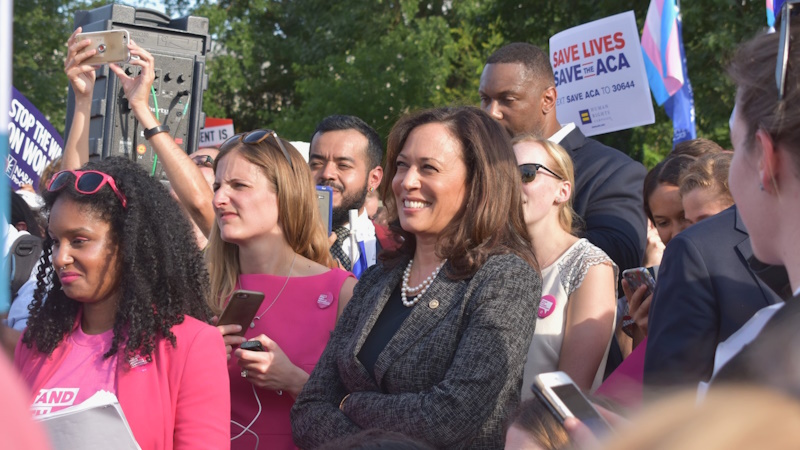
* In the meantime, the Trump Administration's attitude towards illegals took a particularly vicious turn, with reports coming out that children were being taken from their parents -- one case of a blind child, another of an 18-month-old infant. The Trump Administration proclaimed they didn't have a policy of separating children from parents, but anyone with a clue knew they always lied.
That was evident when the current DHS secretary, Kirstjen Nielsen -- who had been confirmed in December 2017, after John Kelly became White House Chief of Staff -- testified to the Senate Homeland Security committee on 15 May. Kamala listed her concerns about DHS policy to Nielsen, in particular asking: "Have you been directed to separate parents from children as a method of deterrence of undocumented immigration?"
Nielsen dodged the question: "I have not been directed to do that for purposes of deterrence, no."
Kamala didn't buy that answer, Kamala asking again: "What purpose have you been given for separating parents from their children?"
"So my decision has been that anyone who breaks the law will be prosecuted. If you're a parent or you're a single person or you happen to have a family, if you cross between the ports of entry, we will refer you to prosecution."
"So your agency will be separating children from their parents -- "
"No, what we'll be doing is prosecuting parents who have broken the law, just as we do every day in the United States of America."
"But if the parent has a four-year-old child, what do you plan on doing with that child?"
"The child, under law, goes to [the Department of Health & Human Services / HHS] for care and custody.
"They will be separated from their parent. And so my question -- "
"Just like we do in the United States every day." Nielsen neither noticed nor cared that, as phrased, she was admitting there were daily separations of parents of children.
Kamala noticed it: "So they will be separated from their parent." She then asked about the procedures in place for handling the children, and what training personnel were given to do tell them how to do it.
Nielsen replied: "I'm happy to provide you with the training information." She never would. She parroted the same lies: "Again, we do not have a policy to separate children from their parents. Our policy is that if you break the law, we will prosecute you. You have an opportunity to go to a port of entry and not cross illegally into this country."
Kamala was getting thoroughly fed up with the evasions, doubletalk, and cruelty of Trump Administration officials. With the Trump Administration, as was widely understood: Cruelty is the point. However, the news media was diligent in reporting on events at the border, with the result that Americans broadly came to realize that something was wrong. On 20 June 2018, the president signed an executive order ending the family separations.
* Unfortunately, as could be expected from the Trump Administration, there was no real change in policy: immigrant families were locked up indefinitely until their status was determined, and children were still separated from their parents. Kamala called for the resignation of DHS Secretary Nielsen.
In late June 2018, Kamala visited the Otay Mesa Detention Center in California, not far from the Mexican border, and talked to some of the detainees there -- to get consistent stories of mothers whose children had been taken away, with the mothers not knowing little or nothing about what had happened to the children. Guards told Kamala that detainees had the opportunity to videoconference with their children -- but that never happened.
She asked an official: "Who is responsible for leading the process to reunite these families?" He replied: "That would be me." -- then admitted he had no idea of what the plan, was or the status of any reunification efforts. Later on, Kamala would find out that Federal records linking children and families had been lost; when a Federal court finally ordered children to be reunited with their families in 30 days, DNA tests sometimes had to be performed to determine which children belonged to which families.
To be sure, many of the cruelties and absurdities involved in handling the immigrants were because ICE had been given tasks far beyond what the service had the resources to handle, with personnel who didn't have the training nor competence to do the job right. That was another characteristic of the Trump Administration: an inability, an indifference, to planning or thinking things out, the only real concern being to put on a show for Trump voters. At least the public wasn't indifferent, Kamala writing:
QUOTE:
Before I left the detention facility, I reassured the mothers that they weren't alone -- that there were so many people standing with them and fighting for them, and that I would do everything in my power to help them. As I walked down the long driveway towards the exit, I saw that solidarity personified. Hundreds of people had gathered outside the fence, holding vigil in support of the families. People of all ages and backgrounds -- children, students, parents, and grandparents -- had traveled to Otay Mesa because they shared the anguish and heartbreak of the people inside.
END_QUOTE
* Also in June, Supreme Court Justice Anthony Kennedy, a significant swing vote on the court, announced he would retire in July. On 9 July, Trump nominated Judge Brett Kavanaugh, of the DC Circuit Court of Appeals, to take Kennedy's place. Hearings on Kavanaugh took place on 4 to 7 September. Of course, there were particular concerns over his stance on ROE V WADE. Kavanaugh had repeatedly said that ROE V WADE was "settled as precedent" -- but less emphatically said it could be "revisited".
Kamala did not find Kavanaugh reassuring, giving him a tough grilling -- in particular asking him: "Can you think of any laws that give government the power to make decisions about the male body?"
After a pause, Kavanaugh replied: "I'm happy to answer a more specific question." Kamala wasn't having it: "Male versus female." They sparred for a bit, with Kavanaugh finally answering: "I'm not thinking of any right now."
During the hearings, one Christine Blasey Ford had come forward with claims that Kavanaugh had sexually assaulted her while the two were in high school. Other similar accusations followed. Kamala told Ford during the hearings: "I want to thank you for courage and I believe you. I believe you, and many Americans around the country believe you, too."
The claims against Kavanaugh were clearly damaging, and he did himself no favors with a bitter diatribe in response, saying: "My family and my name have been totally and permanently destroyed by vicious and false additional accusations." Kavanaugh said that he was the target of a "political hit" against him, because his critics "couldn't take me out on the merits."
That was, to a degree, true: the accusations were effectively unproveable, with the real issue being his qualifications, or lack thereof, for the job. Most Democrats didn't think he was qualified, but Kavanaugh was confirmed in early October, the only Democrat to vote for him being the notably fence-straddling Joe Manchin of West Virginia. Trump would complain -- he was always complaining -- that Kamala had been "extraordinarily nasty" to Kavanaugh.
Later in October, a pro-Trump extremist sent 16 pipe bombs through the mails, mostly to Democratic politicians. One was found in the Sacramento post office on 26 October, the package being addressed to Kamala. None of the bombs went off, since they lacked a trigger mechanism. One Cesar Sayoc JR was arrested in Florida the same day; he would be sentenced to a maximum of 20 years behind bars in 2019.
* As yet another action taken in June, Kamala joined with the other two black senators, Cory Booker and Tim Scott, to introduce the "Justice for Victims of Lynching Act". It was a largely symbolic exercise, intended to classify lynching -- defined as bodily injury on the basis of perceived race, color, religion or nationality -- as a Federal hate crime. The Senate would unanimously pass it in December, but it would die in the House. It wouldn't stay dead, however.
BACK_TO_TOP* While engaged in publicly visible actions, Kamala more quietly did her work in the Senate Intelligence Committee. It was a prestigious assignment, but she also couldn't talk about it much, since it generally covered classified issues. Kamala went slightly viral in the news media for using wired earphones instead of bluetooth earphones as a security measure -- since bluetooth might be vulnerable to eavesdropping.
The Intelligence Committee had a wide brief, including support for counterterrorism efforts, in particular dealing with Islamic extremism; protecting and securing America's borders; limiting nuclear proliferation; and finding the balance between national security and the rights of citizens. Kamala was particularly interested in cybersecurity, above all relative to elections.
When she came on to the committee, it was performing a detailed investigation Russian meddling in the 2016 election, in parallel with a similar investigation by Special Counsel Robert Mueller at the Department of Justice, which would lead to indictments and convictions. In the course of the Senate investigation, she became thoroughly aware of what the Russians had been doing:
QUOTE:
They focused on hot-button issues, from race to LGBTQ to immigrant rights. This means they knew that racism and other forms of hate have always been our nation's Achilles' heel. They knew precisely where to strike us, deliberately targeting -- and tearing away at -- some of the most painful, divisive parts of our nation's history.
END_QUOTE
The Russians knew the weak points; they were tuned in to American hate groups and provided support to them. In any case, after making these same points in committee, Kamala was approached by Senator James Lankford, an Oklahoma Republican, who told her:
QUOTE:
Kamala, I've been listening to what you've been saying about race being our Achilles' heel, and I think you're on to something important. Personally, I think it starts with the question: "Have you ever had a family over to your house that doesn't look like you?" ... I think that's a good place to start.
END_QUOTE
Kamala replied she was glad to hear him say that, adding: "We have to start someplace." The two senators formed a close relationship; they were also both on the Senate Homeland Security Committee. Together, they helped push a "Secure Elections Act", introduced in December 2017, that tightened standards to ensure the security of voting. It never made it to the floor, and certainly wouldn't have been welcomed by the Trump Administration. Trump did not want secure elections, doing everything he could to undermine free and fair elections.
Beyond election security, there was also the threat to American infrastructure. The intelligence community released a "Worldwide Threat Assessment" document in 2018 that said:
QUOTE:
The use of cyberattacks as a foreign policy tool outside of military conflict has been mostly limited to sporadic lower-level attacks. Russia, Iran, and North Korea, however, are testing more aggressive cyberattacks that pose growing threats to the United States and U.S. partners.
END_QUOTE
North Korea, for example, paralyzed Britain's healthcare system at one time, and had conducted major robberies, while China's hackers made off with intellectual properties. Criminal groups also performed hacks, with the whole bottom line being losses to the USA of hundreds of billions a year.
There was another threat to US national security that was becoming more menacing by the year. Only day after Kamala was sworn in, the Senate Intelligence Committee conducted a confirmation hearing for Mike Pompeo, who Trump had selected as CIA director. When it came Kamala's turn to query Pompeo, she asked him how his public position rejecting the science of climate change would affect his work as director.
Pompeo -- and it seems some Republicans on the committee -- were somewhat taken aback by the question, while the far Right media was contemptuous. In reality, climate change was not only solidly confirmed by all reputable scientific research, it was becoming obvious to any sensible person with an education, and the far Right's denial of its existence was on the level of believing in the Flat Earth. As Kamala wrote:
QUOTE:
The CIA had already made an unclassified assessment regarding the threat of climate change. Pompeo's previous statements disregarded the CIA assessment. How would he brief the president? Would he let his personal views override the findings of CIA professionals when it came to climate change -- and if so, what would that mean for other dire threats against our nation?
... when you speak to generals, when you speak to senior members of the intelligence community and experts on international conflicts, you will find that they look at climate change as a national security threat -- a "threat multiplier" that will exacerbate poverty and political instability, creating conditions that enable violence, despair, even terrorism. An unstable, erratic climate will beget an unstable, erratic world.
END_QUOTE
Pompeo thought climate change was a hoax. That wasn't the only strike against him, Kamala announcing:
QUOTE:
I oppose Mike Pompeo's nomination as Secretary of State. He has often cheered on military conflict instead of diplomacy. I also strongly disagree with statements he has made regarding Muslim and LGBTQ Americans.
END_QUOTE
Pompeo was confirmed by the Senate, 57 to 42, with five Democrats voting YEA. Kamala wasn't one of them. He proved, like all other senior officials of the Trump Administration, subservient to Trump. With the Republicans in control of the Senate, she was always pushing uphill.
BACK_TO_TOP
