
* In 2020, Kamala decided to run for president, competing in a crowded field against a number of rivals. Ultimately, she had to drop out -- but Joe Biden, who won the Democratic primary, picked her as his vice president. After an intense campaign against Donald Trump and his vice president, Mike Pence, Joe and Kamala won handily. However, Trump didn't take losing gracefully, inciting a mob to overrun the Capitol Building in an attempt to overturn the election. It failed; Joe and Kamala were sworn in and got down to business.
* The midterm elections of November 2018 went well for the Democrats: although the GOP gained seats in the Senate, the Democrats won a whopping 40 seats in the House and regained control. They also gained seven state governorships and control of six state legislatures. Kamala had been considered a credible presidential candidate since the 2016 election, and she had visibility as part of the "Hell-No Caucus", which included Senators Cory Booker, Kirsten Gillibrand, Elizabeth Warren, and Bernie Sanders. All of them voted consistently against Trump nominees, all were seen as presidential candidates.
By that time, Kamala was seriously considering a presidential campaign for 2020. She stayed quiet at the time, another crisis having emerged. On 22 December, President Trump, unable to get Congressional backing for his megalomaniac border wall, deliberately shut down his own government. He expected the public would blame the Democrats for the shutdown -- but the public blamed him, and he would finally cave in on 25 January 2019, after 35 days. It was the longest shutdown to that time.
Four days earlier -- 21 January, Martin Luther King Day -- Kamala had announced her candidacy on the TV show GOOD MORNING AMERICA, becoming one of over two dozen candidates headed for the Democratic primary election. She quickly picked up endorsements from California political figures, with campaign contributions coming in, and had an overflow crowd estimated at 20,000 at the campaign kickoff event in Oakland on 27 January. An informal association of "Friends of Kamala" came together online under the hashtag "#KHive" to defend her from smears.
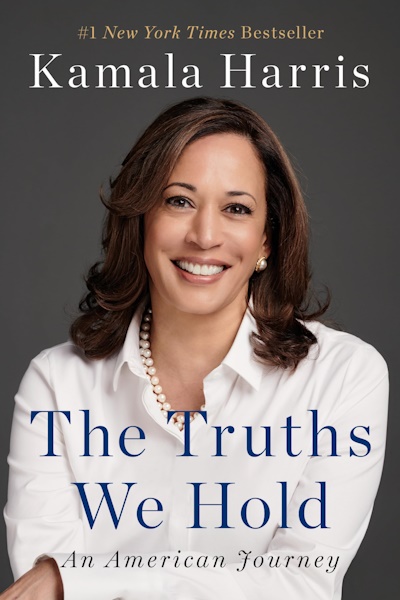
Her campaign slogan was, of course, "For the People". She had released a memoir, THE TRUTHS WE HOLD, to back up the campaign earlier in the month -- along with an inspirational children's book, SUPERHEROES ARE EVERYWHERE.
Kamala presented her campaign platform along with her declaration of candidacy. Trolls were fond of slamming the Democratic contenders as campaigning solely on "not being Donald Trump" -- but that was inevitable, since Trump was against almost everything Democrats stood for, and all the candidates had platforms. Kamala's platform was obvious to anyone who knew her, including:
More broadly, Kamala wanted to reaffirm America's commitment to "diversity, equality, & inclusiveness (DEI)", providing support for programs intended to help underprivileged minorities, and guaranteeing the rights of Americans regardless of ethnicity or sexual orientation. The Trump Administration, in contrast, used "DEI" as a smear word.
* Kamala's campaign got of to a good start, but then stumbled. In late January 2019, an actor named Jussie Smollett told Chicago police that he had been attacked by two MAGA men, who verbally abused him, poured bleach on him, and put a noose around his neck. The incident got national attention, with Kamala calling it a "modern day lynching". However, Chicago police were suspicious and investigated -- to find out that Smollett had paid two men to play-act the attack, it seems as a promotional stunt. Smollett ended up in legal hot water; Kamala had to walk back her statements, posting online on 21 February:
QUOTE:
Like most of you, I've seen the reports about Jussie Smollett, and I'm sad, frustrated, and disappointed. When anyone makes false claims to police, it not only diverts resources away from serious investigations but it makes it more difficult for other victims of crime to come forward.
END_QUOTE
Her critics accused her of shooting from the hip, being too quick to believe accusations that fit her preconceptions. MAGA trolls crowed loud, some even ridiculously claiming Smollett was her nephew. It mattered little; their wrath was mostly focused on Smollett, and they weren't being any nastier to Kamala than they usually were.
Kamala also got into tiny trouble in February, during a radio interview in which admitted she smoked dope in her younger years, saying: "Half my family's from Jamaica. Are you kidding me?" That didn't cause her campaign much difficulty -- but it didn't go over well with her father, Donald, who was indignant:
QUOTE:
My dear departed grandmothers ... as well as my deceased parents, must be turning in their grave right now to see their family's name, reputation and proud Jamaican identity being connected, in any way, jokingly or not with the fraudulent stereotype of a pot-smoking joy seeker and in the pursuit of identity politics. Speaking for myself and my immediate Jamaican family, we wish to categorically dissociate ourselves from this travesty.
END_QUOTE
Her campaign had no comment. Kamala pressed on. In March, she held a fundraiser with prominent Hollywood donors, and on 1 April she delivered a speech at a labor dinner in Sacramento. In mid-April, she released her tax returns from 2004 to 2018; on 5 May, she delivered a speech to the Detroit branch of the NAACP -- notably stating she would "hold social media platforms accountable for the hate infiltrating their platforms, because they have a responsibility to help fight against this threat to democracy." She was well aware of the hate, since much of it was focused on her.
Earlier in May, Kamala had "gone viral" during a Senate Judiciary Committee hearing of Attorney General Bill Barr, concerning the public release of the Mueller report on Russian election interference in April. The report did not implicate President Trump -- as Mueller made clear, going after the president was not part of his brief -- but it emphasized that it provided "no exoneration" of Trump over possible obstruction of justice.
Barr, however, said the report showed that Trump hadn't obstructed justice. Kamala thought he was dissembling, asking Barr in so many words if he'd really considered the evidence. He got flustered, with Kamala cutting him off by saying: "I think you've made it clear you've not looked at the evidence. We could move on." There was an even more memorable exchange in the hearing:
QUOTE:
KH: Has the President or anyone at the White House ever asked or suggested that you open an investigation of anyone. Yes or no, please, sir.
BB: Umm, the President or anybody else ...
KH: Seems you'd remember something like that and be able to tell us.
BB: Yeah but I'm trying to grapple with the word "suggest". I mean, there have been discussions of matters out there that they have not asked me to open an investigation, but --
KH: Perhaps they've suggested?
BB: I don't know, I wouldn't say suggest ...
KH: Hinted?
BB: I don't know.
KH: Inferred? You don't know. OK.
END_QUOTE
After the hearing, Kamala issued a statement:
QUOTE [EXCERPTS]:
After today's hearing before the Senate Judiciary Committee, it is clear that Attorney General Barr lacks all credibility. The American public deserves an attorney general that will fairly and impartially enforce the law. Barr must resign.
Attorney General Barr refused to provide a straight answer about whether the president or anyone in the White House had directed him to open an investigation into any individual, and he acknowledged that he did not review the underlying evidence of the Mueller report before deciding not to charge the president with obstruction of justice. We need a new attorney general immediately.
END_QUOTE
Predictably, Barr did not resign. Kamala continued on the campaign trail, running into a little excitement on the first day of June. She was speaking at a San Francisco event when an animal-rights activist got up, snatched the microphone out of hands, and started to address the crowd. A group of men grabbed him and hustled him out the door -- the group including a clearly angry Doug Emhoff. She told the crowd it was "all good", and continued from there.
By late June, Kamala was picking up endorsements from members of the Congressional Black Caucus (CBC), and took part in the first of three primary debates, in Miami. There she had a notable confrontation with Joe Biden, who was also in the running for the nomination, calling him out for dealing with segregationist senators in the past -- and also took him to task for his associations with segregationist senators and misgivings about school busing, Kamala saying:
QUOTE:
I do not believe you are a racist, and I agree with you when you commit yourself to the importance of finding common ground. But I also believe, and it's personal -- it was hurtful to hear you talk about the reputations of two United States senators who built their reputations and career on the segregation of race in this country. And it was not only that, but you also worked with them to oppose busing. And, you know, there was a little girl in California who was part of the second class to integrate her public schools, and she was bussed to school every day. And that little girl was me.
END_QUOTE
That got Biden's attention; he replied that she had mischaracterized his position. Yes, Biden had reached out to segregationist senators, but he'd been in the Senate for over a quarter-century, and in the old days the Senate was still a collegial environment; he'd been educated there not to regard differences of views as obstacles. As for school busing, Biden had long had misgivings about it, but he wasn't opposed to it on principle; he just didn't think it should be mandated by the Federal government. If localities wanted to bus their kids, he had no objection -- and besides, school busing was no longer such an issue in 2019. His record on civil rights had been outstanding from day one; he was clearly a good friend of the CBC.
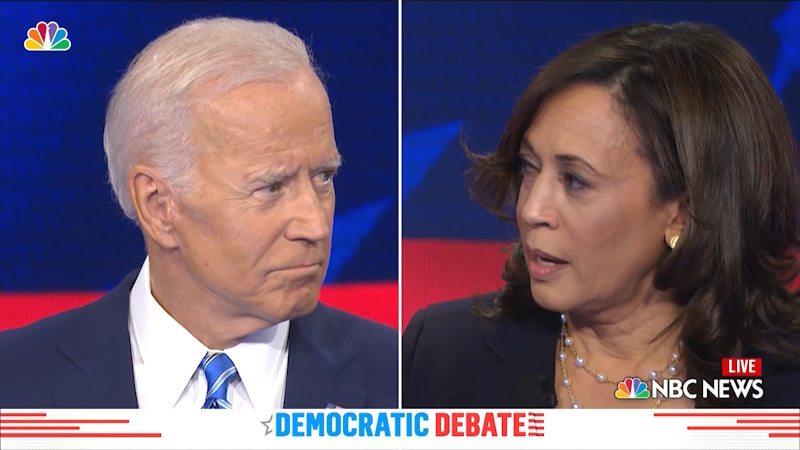
Kamala's team were aware of Biden's record on civil rights, and had questioned taking him to task on that score -- but she felt it she needed to do it both on principle, and political advantage. Biden's defenders were unhappy with Kamala; he did not hold a grudge over the debate, he didn't hold grudges, but some of his people did.
The second debate was at the end of July, Kamala notably crossing swords with Representative Tulsi Gabbard, a Trump loyalist in Congress -- though that exchange didn't amount to much. A week later, she was interviewed by CNN on her campaign bus, being highly critical of Trump, pointing out the obvious in saying "a long list of statements and tweets and behaviors from this president that make it very clear that he possesses hate and that he is divisive and that he is a racist."
In October, Harris participated in a CNN-Human Rights Campaign town hall on LGBTQ citizens to say she would support the rights of "all of the folks who are fighting for equality" under Federal law -- and in particular drawing attention to the epidemic of hate crimes committed against black trans women, saying that LGBTQ people of color suffered from double discrimination.
The third debate was in mid-September, but Kamala was clearly trailing the front-runners -- by that time Warren, Sanders, and Biden. She was on uncertain ground with the hard Left, who preferred Warren and particularly Sanders, while being skeptical of "tough cop Kamala". Her background as a prosecutor was an asset in some ways, a liability in others; a comedian named Dulce Sloan ran a monologue with Kamala portrayed as a "mean high-school vice principal". Similarly, comedian Maya Rudolph, impersonating Kamala on the SATURDAY NIGHT LIVE show, described herself as a "cool aunt, a fun aunt", who would "give you weed but then arrest you for having weed." Rudolph's portrayals of Kamala on SNL, incidentally, would win her the Emmy Award.
Anyway, the hard Left called themselves "progressives", even though most modern Democrats were progressive by the historical definition. Although Kamala had long called herself a "progressive prosecutor", the hard Left wasn't so sure of her.
* At the end of the month, all the campaigners were disrupted when the news broke that Trump had attempted to extort Volodymyr Zelenskyy, president of Ukraine, into aiding a Trump smear job against Joe Biden. The story was complicated, the core fact being that Joe's son Hunter Biden had been hired onto the board of Burisma, a Ukrainian energy company, in 2014, and had remained with Burisma until 2019. Joe was still vice president to early 2017, and he had been paying close attention to Ukraine -- one of his concerns being a Ukrainian prosecutor, Viktor Shokin, who wasn't doing his job. Joe and European officials wanted Shokin fired, Joe threatening to hold up aid to Ukraine if he wasn't, and so Shokin was dismissed.
Trump's people wanted to push a malign variation on the story, in which Shokin had been investigating Burisma -- he hadn't -- and so, according to the tale, Joe threatened to withhold US aid if he wasn't fired. Trump wanted Zelenskyy to say the Ukrainian government was opening an investigation of the charge, using a shipment of anti-tank missiles as a bribe. Zelenskyy made agreeable noises but knew the story was a fraud; there was nothing timid about him, so he sat on it.
A US government whistle-blower who knew what was going on finally went public. The wheels began to turn towards an impeachment of Trump for abuse of power; conviction would require a 2/3rds majority in the Senate and there was no chance it would happen, but Congressional Democrats had to act with what they had.
The grueling primary campaigning continued, with a fourth debate on 14 October, following by a fifth on 20 November. By that time, it was obvious that Kamala was falling behind and her campaign was running out of steam. Kamala ended the campaign on 3 December 2019, citing lack of money.
It was a great disappointment, but primaries by definition start with a wide field of contenders that is whittled down to one, and first tries are hardly guaranteed to succeed. Joe Biden's first shot at the presidency in 1988 was a dismal failure, and his second primary, in 2008, was a loss to Barack Obama -- with Joe then becoming Obama's running mate.
* Incidentally, Kamala's niece Meena also wrote a children's book loosely linked to the campaign, titled KAMALA & MAYA'S BIG IDEA. Meena had graduated from Stanford in 2006, spent three years in management at Facebook, then went to Harvard Law School, graduating with a JD in 2012. She worked at the law firm Covington & Burling, then in managerial positions at Slack, a business-communications company, and ride-sharing company Uber.
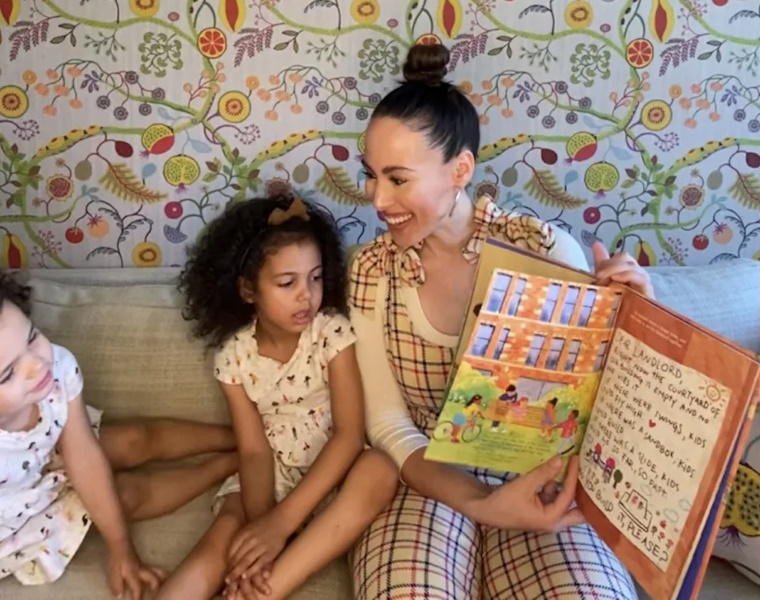
She finally decided to change her career trajectory, setting up the "Phenomenal Woman Action Campaign" in 2016, selling "statement t-shirts" to raise money for women's causes. It started out as a "side hustle" to her corporate work, but it gradually became her full-time work, leading to her work on children's books, musical play production, and even a venture-capital fund.
Meena married one Nicholas Ajagu, a Facebook executive, in 2014. They would have two daughters, Amara and Leela, in 2016 and 2018 respectively. Her link to her Aunt Kamala was a factor in her career success, but Meena had to be cautious because of that connection, lest Kamala be accused of government favoritism towards Meena's business interests.
BACK_TO_TOP* Joe Biden continued his primary campaign, being seen as the leader -- but in February 2020, he did poorly in the Iowa caucuses and the New Hampshire primary, with Bernie Sanders clearly taking the lead. Joe was not too worried; he had many more influential friends than Sanders, who was too much an independent to find large numbers of allies. Joe came in second in Nevada, then moved on to South Carolina, which had a large black voting population.
Again, Joe had credibility with the CBC, and having been Obama's vice-president didn't hurt him either. Prominent Senator Jim Clyburn of South Carolina endorsed Joe, who got a big win. In subsequent primaries, the trailing contenders, such as Liz Warren, dropped out to endorse him; Kamala endorsed Joe in March, with Joe also picking up endorsements from his many other influential friends in Congress. Bernie Sanders began to fall further and further behind, to finally give up in April, leaving the field entirely to Joe, and helping his campaign.
In May, Joe and Bernie set up six task forces -- covering climate change, criminal justice reform, the economy, education, health care, and immigration -- to devise a party platform that would be acceptable to both moderate Democrats and the hard Left. By June, Joe had obtained 1,991 delegates to clinch the nomination.
* From early in the year, a global crisis had been brewing, starting with a cluster of pneumonia cases in Wuhan, China, with cases then starting to crop up around the world. The respiratory disease was based on a "coronavirus", and became known as "COVID-19". Some people shrugged it off, but it could be lethal to others.
There was no vaccine at the outset, so all that could be done was to wear face masks and maintain "social distancing" in public, with quarantine measures, travel restrictions, and wholesale lockdowns implemented as necessary. The result was a big spike in unemployment and an abrupt economic recession. Trump's response to the crisis was to green-light work on a vaccine, but that was only because the experts told him to -- otherwise, he "followed his gut", publicly downplaying the risks of the disease, telling his attentive public to not wear masks, to ignore quarantine measures, while he promoted quack cures.
The pandemic had strong effect on the presidential campaigning, THE NEW YORK TIMES reporting that Biden was seeking the presidency from the basement:
QUOTE:
With the coronavirus outbreak freezing the country's public life, Mr. Biden has been forced to adapt to a cloistered mode of campaigning never before seen in modern American politics. He was unable to embark on a victory tour after the Democratic primaries or hold unity rallies with onetime rivals like Senators Bernie Sanders of Vermont and Elizabeth Warren of Massachusetts. Instead, the former vice president is in a distinctive kind of lockdown, walled off from voters, separated from his top strategists and yet leading in the polls.
END_QUOTE
Along with the global pandemic, another crisis emerged in the USA. On 25 May, Minneapolis police arrested a 46-year-old black man named George Floyd on suspicion of pushing a counterfeit bill. The police handcuffed him and laid him out prone on the street, with a police officer keeping his knee on Floyd's neck for nine minutes -- killing him by suffocation.
That set off a wave of national protests against police brutality, loosely directed by Black Lives Matter (BLM), an activist group set up in 2013 to protest police brutality and seek police reform. At their peak, there were from 15 to 25 million people marching. The great majority of the protests were nonviolent, but a number of them degenerated into riots and looting -- partly, if not completely, due to the actions of far Right provocateurs. Kamala was of course all for police reform, but she also had to make it clear that protests should be nonviolent. That left Tough Cop Kamala vulnerable to criticisms from BLM activists and supporters, as being too much on the side of the cops.
Compounding the problem was the slogan "Defund The Police", pushed by BLM. What it meant was that municipalities needed to shift funding from the police to other entities that didn't use force to solve problems -- but it was too easily interpreted as "Disband The Police", and as such was loudly jeered at by the far Right, who smeared Kamala as a "BLM radical".
* Earlier, in March, Joe had committed to picking a woman as his vice presidential candidate, and also select a black woman as a SCOTUS justice. He was then strongly encouraged by Jim Clybern and others in the CBC to select a black woman as VP as well, since black women were the most faithful Democratic voting bloc.
On 11 August, Joe announced he'd chosen Kamala. According to insiders, she was seen as the "common sense pick" who could "do no harm" -- though apparently some Biden staffers were still annoyed at the rough way Kamala had dealt with Joe in the first primary debate. Joe, again, didn't hold grudges, and he also had a habit of challenging his people to see how they pushed back; Kamala was the kind of person who pushed back, and he liked that.
While the presidential campaigning was underway, the Supreme Court shifted again to the Right. On 18 September, liberal Justice Ruth Bader Ginsburg died of cancer. On 26 September, Trump nominated Amy Coney Barrett, of the Seventh Circuit Court of Appeals, for Ginsburg's position -- and of course, Barrett was strongly Right-leaning. Democrats had not forgotten how the Republicans had derailed Merrick Garland's nomination in 2016, on the basis that it was "too close to the election." It was even closer to the election in 2020, but with Trump in the White House, the Republicans shrugged. Barrett breezed through the confirmation hearings through what was described as "a deft mix of expertise and evasion." She was confirmed on a party-line vote on 26 October, resulting in six Republicans to three Democrats on SCOTUS.
The campaigning didn't let up in the meantime, with the first debate between Trump and Biden on 29 September. From Joe's nomination, Trump had been claiming that Joe was suffering from senile dementia and was taking performance-enhancing drugs; Trump even said Biden should take a drug test. Joe ignored the trolling. The debate was, to no surprise, chaotic, with Trump refusing to follow any rules and the two men continually interrupting each other. Critics called it as a "low point" in presidential politics; since Trump's fans expected him to be a boor and liked it, the debate did him no harm, while dragging Joe down to his level.
The debate between Mike Pence and Kamala took place at the University of Utah in Salt Lake City on 7 October. It was much more polite than the presidential debate, though there were still some interruptions -- ten by Pence, five by Kamala. At one point, Kamala told Pence his interruptions were unwelcome: "Mr. Vice President, I am speaking."
Her comeback went viral online -- as did the fact that a fly decided to take a break on Pence's head during the debate, being clearly visible in the cameras against Pence's white hair. Kamala wanted to tip Pence off, but couldn't figure out any way of doing so without derailing the debate.
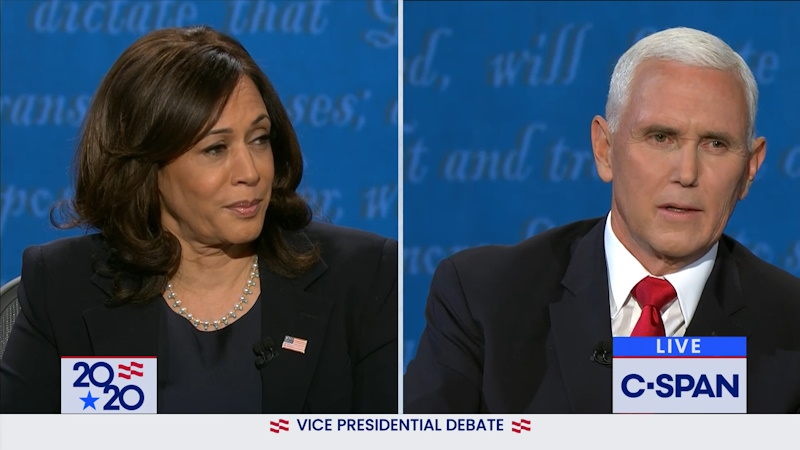
A CNN poll gave Kamala's performance a 50% edge over Pence's. Reporters talked to her Uncle Balachandran in New Delhi -- who commented that Pence was of course a skilled debater, but he was outclassed by Kamala, who had the facts at her fingertips:
QUOTE:
I felt a little sorry for Pence ... poor fellow, the only thing he had is his white hair. He looked like a very kind uncle to whom you'd say: "Come please sit, and have some tea or coffee."
... My daughter in Washington watched it, my sister in Toronto watched and my younger sister in Chennai also watched it. Her mother would have been happy for Kamala -- although maybe Shyamala was far more impatient than Kamala at times. I wouldn't be surprised, if Shyamala was the debater or in the audience, she would have said: "What rubbish are you talking, vice president?" But Kamala was kinder.
END_QUOTE
He said nothing about the fly. That was the only vice-presidential debate. There was a second presidential debate in Nashville on 22 October -- which was much less hostile than the first, since each candidate's mic was muted when it wasn't his turn to speak. The debate was still disorderly, though public opinion gave Joe Biden a modest win.
The election was on 3 November. By the end of the day, although votes were still being tallied, news media was reporting that Biden-Harris has won -- by 306 electoral votes, compared to 232 for Trump-Pence. The popular vote was not very close, with 81 million votes for Biden-Harris -- the biggest voting tally in US history -- and 74 million for Trump-Pence.
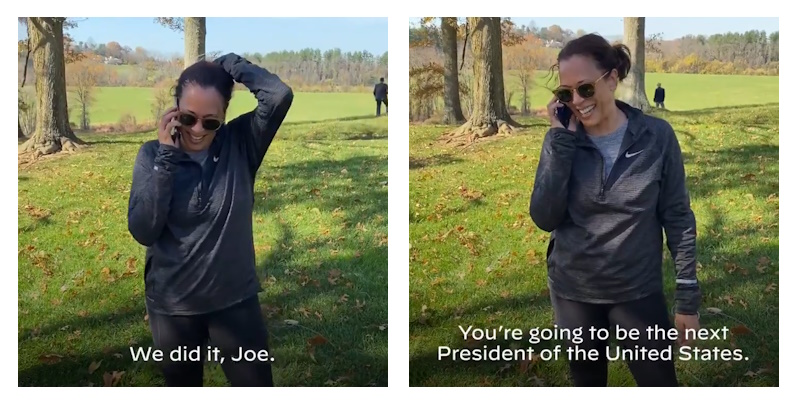
A video of Kamala taken by Doug went viral, with her standing in a park, talking over a smartphone: "We did it, we did it Joe. You're gonna be the next President of the United States -- Hahahahahaa!"
BACK_TO_TOP* Trump did not concede defeat. Even before the election, he had waffled on whether he would accept the results of the election if he lost; everyone with sense knew he wouldn't, and he didn't. He refused to cooperate with the transition, and had dozens of lawsuits filed challenging vote results, with all of them thrown out by the courts.
The general assumption was that Trump would eventually be forced to vacate the White House anyway, and that would be that. That was misreading Trump. On 6 January, Congress was to certify the vote, with Vice President Pence signing off on the certification. Trump leaned on Pence very hard to refuse to sign, ignoring Pence's protests that the signing was only a formality.
When the 6th arrived, Trump conducted a rally in front of the White House, inflaming a mob to go over to the Capitol Building and "fight for freedom!" The mob stormed over, broke into the building and overwhelmed Capitol Police, threatened to hang Pence, sending Congress in flight before ransacking the place. Trump watched the riot on TV with obvious pleasure, refusing to tell the mob to disperse -- only belatedly releasing an approving statement: "Go home. We love you, you're very special."
6JAN21 was completely unexpected and a national shock; even many Republicans, normally obedient to Trump, were outraged. On 13 January, the House adopted an article of impeachment, the charge being "incitement of insurrection" -- though only ten Republicans voted in favor. That wasn't a good sign, and by the time the Senate began deliberations, it was becoming obvious that Trump voters didn't have a problem with the 6JAN21 riot. Such enthusiasm for impeachment as remained in Senate Republicans drained away.
On 13 February, the Senate voted on the impeachment, with 57 votes for GUILTY -- including seven Republican votes -- and 43 for NOT GUILTY. 67 were needed to convict, so Trump was acquitted. One of the explanations made by those who voted NOT GUILTY was that it made no sense to impeach an official who had already left office by the time of the vote, but that wasn't true: once impeached, Trump could then have been denied the right to run for office again, by a simple majority vote of the Senate. Failure to impeach meant Trump could run for a second term.
There was a broad expectation that Trump would be indicted, tried, and convicted by the DOJ -- but it was hard to imagine a messier and more difficult criminal case. It would obviously take years to bring to court, with the fact that Trump had been President of the United States adding layers of complication. Worse, the failure of Senate Republicans to convict Trump hobbled the investigation from the start, while Republicans continued to blindly support and protect him.
BACK_TO_TOP
