
* The incoming Biden Administration hit the ground running, working to deal with the ongoing COVID pandemic and its associated economic downturn, and pushing an ambitious package of reforms through Congress. Kamala worked closely with Joe Biden on a range of subjects, playing a significant role on issues ranging from immigration, to reproductive rights, artificial intelligence, and climate change. She also traveled the globe, performing high-level diplomacy.
* Kamala resigned from the Senate on 18 January 2021, with Joe and Kamala sworn into office on 20 January 2021; Joe was sworn in by Chief Justice John Roberts, Kamala by Justice Sonia Sotomayor. Kamala became the first woman vice-president and the first non-white vice president. Later that day, Kamala swore in Alex Padilla -- her successor in the Senate, moving up from his position as California secretary of state -- as well as freshman senators Raphael Warnock and Jon Ossoff, both from Georgia. With that done, the Democrats controlled both houses of Congress, though the Senate was split 50:50. That meant Kamala was the tie-breaking vote in the Senate, and she would set a record of 33 tie-breaking votes as vice president.
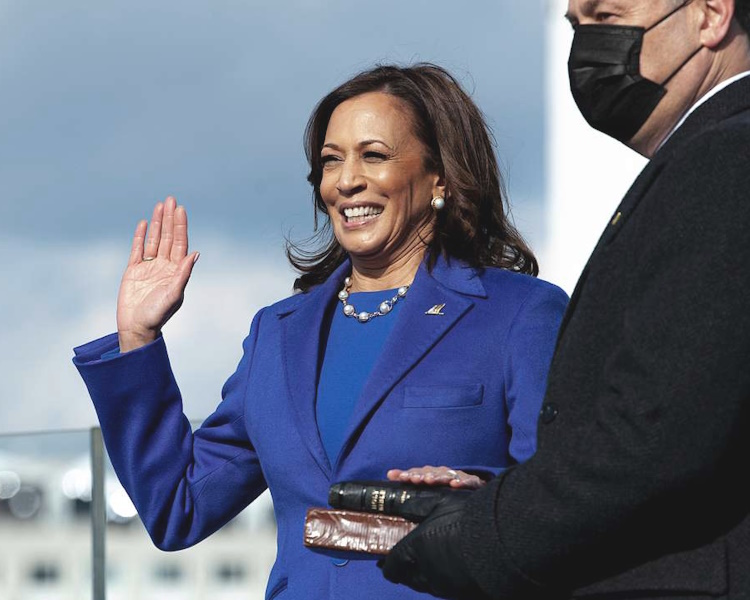
After being sworn in, Kamala and Doug moved into the Blair House, the presidential guest house across Pennsylvania Avenue from the White House. The proper vice-presidential residence was the Naval Observatory, but it was being renovated at the time, and the couple wouldn't move in there until April. During that time, Doug was getting accustomed to his full-time job as "second gentleman", operating in support of Kamala, learning the ropes from other "official spouses" who had served in that role.
In any case, on his first day in office, Joe Biden restored US participation in the Paris Agreement on climate, from which Trump had withdrawn early in his term. The next day, Joe issued a set of executive orders to deal with the COVID-19 pandemic, in particular to drive mass production of vaccines.
From the start, Kamala worked closely with Joe. When Joe was vice president himself, nobody in the White House had been closer to Obama, and Kamala had the same relationship with Joe. Ashley Etienne, at the time Kamala's communications director, commented:
QUOTE:
They started to spend a lot of time together, so she was really shadowing the president. They were together every morning in the presidential briefings, was standing next to him when he would sign bills. She was almost at every decision table. Was the last one in the room. She was learning the job day one. That was the aim and the goal, is to stick with the president and learn as much as you possibly can about the job.
END_QUOTE
Jake Sullivan, the National Security Advisor, said that "Biden insists she be in every core decision-making meeting. She weighs in during those meetings, often providing unique perspectives."
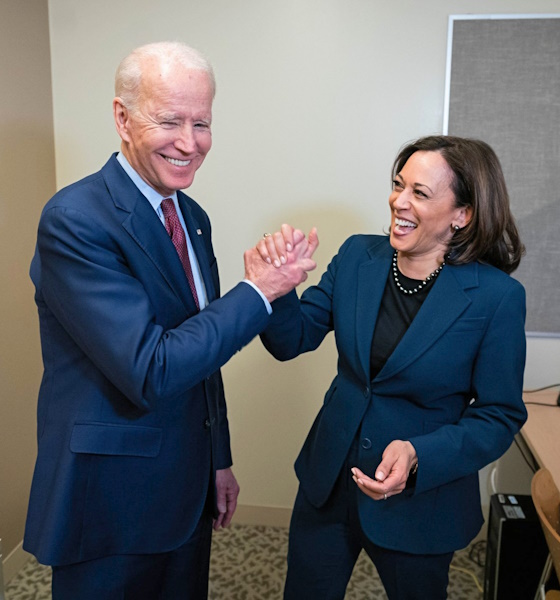
One of the first major actions of the Biden Administration was the $1.9 trillion USD "American Rescue Plan (ARP)", intended to deal with the COVID-19 pandemic. After being processed through Congress, it was passed in March -- with all of the Republicans voting against it, and Kamala's vote breaking the tie in the Senate. The act provided stimulus payments for most Americans, extended unemployment benefits, provided relief for small businesses, and supported efforts to control the pandemic.
Late in March, Joe asked Kamala to work with Mexico and the Northern Triangle nations to try to slow down the migration of people from those countries, with a focus on addressing the root causes of the migration. News media labeled her a "border czar" -- though in reality border security wasn't her responsibility, instead being the brief of Homeland Security Secretary Alejandro Mayorkas. Besides, "czar" in government terms means "a person with broad and vague responsibilities, little authority, who nobody takes seriously." Inevitably, the far Right jeered at her as the "border czar" anyway, meaning she was responsible for the wave of immigrants coming north.
Compounding that problem was the fact that Joe Biden's White House communications team didn't go out of their way to stand up for Kamala. Presidential and vice-presidential staffs traditionally did not mesh well; Kamala perceived that the old-line "Biden team" was not inclined to back her up. There were also suggestions that Kamala had been given a "no-win" task in dealing with the immigration, reflecting the traditional irrelevance of the vice presidency. In reality, although tackling the immigration issue was a dirty job, Kamala had regarded it as a major concern even when she was California AG -- and as vice president, she could do more about it.
She took her first international trip as vice president in June, visiting Guatemala and Mexico to discuss means of stemming the flow by addressing the root causes. During her visit, in a joint press conference with Guatemalan President Alejandro Giammattei, Harris announced to those thinking of coming north:
QUOTE:
I want to be clear to folks in the region who are thinking about making that dangerous trek to the United States-Mexico border: Do not come. Do not come. The United States will continue to enforce our laws and secure our borders.
END_QUOTE
Kamala was bitterly criticized for that statement by the hard Left, who called it "tone deaf" -- though she could have hardly said that illegal immigrants would receive a welcome if they tried to enter the USA. Indeed, the Biden Administration was deporting about as many illegal immigrants as the Trump Administration had, though the Biden Administration tried to not be as rough about it.
The far Right continued to snipe as well, angrily denouncing her for never actually having visited the border, and claiming she said she had. She had, having visited the Otay Mesa Detention Center in 2018 as a senator, but the sniping went on without a letup.
The sniping from the hard Left was more troublesome. They accused Kamala of ignoring the root problems that led to the migration, but that was failing to understand how deep-rooted the problems were. The governments of the three Northern Triangle countries were not easy to work with, corruption being a major problem; Kamala knew a great deal about the corruption there, having had discussions with exiled Guatemalan prosecutors and judges in Washington DC before going on the trip. What was said during her visit was not publicly revealed, but there was clearly friction between Kamala and Giammatti.
More publicly, Kamala worked with civil society and the private sector to address the root causes -- through the creation of the "Partnership for Central America (PCA)". It was a "public-private partnership", involving US government agencies such as the State Department, international organizations such as the World Bank, international non-governmental organizations (NGO), along with major corporations such as Visa, Nestle, and Meta, as well as smaller nonprofits and Latin American businesses. The PCA raised billions to create a million jobs and promote investment in seven areas -- including digital access, financial access, job skills, and empowerment of women.
That work would result in to the "Los Angeles Declaration on Migration and Protection", launched in June 2022 during the Ninth Summit of the Americas. It set up a regional framework to address migration in the Western Hemisphere, with 21 countries signing the agreement. Latin American countries agreed to work harder to stem illegal immigration into the USA, while the US government set up schemes to allow foreign workers to come to the USA and get jobs. Kamala wasn't the only Biden Administration player in that effort, but she played a major role.
BACK_TO_TOP* In spite of her best efforts, Kamala had an image problem, her public approval ratings being persistently low. Early on, there was sniping about turnover in her office -- but the White House is not an easy work environment, a lot of people who get positions in a new administration decide they can't take it, and there's a lot of quitting early on. The legacy media tended to snipe at Kamala, though not very energetically. The far Right was much more energetic in their abuse, the mildest thing they had to say about her being that she was a "Leftist extremist"; the fact that she was a black woman particularly set them off. Ironically, although Kamala was well Left of center, the hard Left generally did not regard her as one of their own.
One of Kamala's big projects in 2021 was to push the "John R. Lewis Voting Rights Advancement Act", which would have extended the protections of the 1965 Voting Rights Act, and given the Federal government control over certain local election law changes. The bill made it through the House, but it was filibustered in the Senate; it would be filibustered again in 2022, that being the end of it for the time being.
In the face of the difficulties, the Biden Administration still racked up successes. Joe's ARP ended up being one of three elements of a grand "Build Back Better (BBB) Plan", which was also to include the "American Jobs Plan (AJP)" -- focused on developing infrastructure, particularly with to address climate change -- and the "American Families Plan (AFP)", which was a set of social-policy initiatives, including such niceties as paid parental leave.
BBB ran into headwinds -- most significantly from two Democratic senators, Joe Manchin of West Virginia and Kyrsten Sinema of Arizona. West Virginia was a very conservative state, so it was no surprise that Manchin was inclined to question the Biden Administration's legislative initiatives. Sinema was similarly skeptical, though her motives were less obvious. BBB was not going to fly as it was, so the Biden Administration went back to the drawing board.
Other legislation sailed through. In June 2021, Joe signed the "Juneteenth National Independence Day Act" into law. "Juneteenth" meant 19 June 1865, when the final emancipation from slavery was announced; the act made it a Federal holiday. It was not controversial, the vote in the Senate being unanimous, and with only a handful of votes against it in the House. Kamala had co-sponsored the bill while she was still in the Senate.
* From the spring of 2021, Vladimir Putin began to amass forces on Ukraine's border, causing anxiety among the US and Ukraine's European allies. The buildup would continue, with pauses, through the year. Nobody was sure whether Putin was engaging in a demonstration, since he was fond of menacing his neighbors, or really planned to invade Ukraine. On intervals, Putin announced "red lines" that should not be crossed, most significantly, saying Ukraine should not ever join NATO. NATO leadership emphatically rejected the demands -- but for the time being there was a reluctance to do anything that might provoke Putin. For the moment, the crisis was deferred.
However, a crisis in Afghanistan was emerging. In 2020 the Trump Administration, following on Trump's desire to pull the US out of "s###hole countries", signed an agreement with Afghan Taliban insurgents for pulling US troops out of Afghanistan. The deal required the release of 5,000 Taliban from imprisonment, with all foreign forces to be out by 1 May 2021.
On entering office, Joe was confronted with a deadline. It made no sense to reverse the decision, the corrupt Afghan government having been recognized as a lost cause, and on 14 April Joe publicly announced the troops would be withdrawn, saying "it's time to end the forever war." The final exit was put off to September 2021. On 25 April, Kamala said she was the "last person in the room" for his decision, and praised Joe for it:
QUOTE:
This is a president who has an extraordinary amount of courage. He is someone, who I have seen over and over again, make decisions based on what he truly believes ... is the right thing to do. [The president] is acutely aware that it may not be politically popular, or advantageous for him personally; it's really something to see. I have seen him over and over again make decisions based exactly on what he believes is right.
END_QUOTE
Events then charged ahead of American plans. On 1 May the Taliban launched a major offensive. US intelligence told Joe that the Afghan government could hold out for some months, but Afghan troops were demoralized by the withdrawal of foreign forces, and the Taliban swept over the country. In mid-August, the Taliban seized Kabul, leading to an emergency international airlift to get foreign citizens out of the country. 13 American troops were killed during the evacuation and a good number of Afghan civilians were killed as well. The airlift was complete by the end of August.
There was recognition that the evacuation was certain to be messy and ugly, and that US intelligence had been badly wrong. That made no difference, Joe was the man in charge, and had to tell the public: "The buck stops with me." -- adding: "I stand squarely behind my decision. After 20 years, I've learned the hard way that there was never a good time to withdraw US forces."
That was clearly true, and Joe also pointed out that he'd inherited the withdrawal from the previous administration. His only choice was between continuing the withdrawal or reinforcing the mission, and reinforcement was out of the question. Nonetheless, Joe was bitterly criticized from both sides of the aisle, though much more so from the Right, and his popularity took a nosedive. The media became persistently critical.
To be sure, the far Right media had always been critical, often to the point of ridiculous, but the legacy media was becoming increasingly negative as well. The legacy media was suffering in the new online information age, as subscriptions plummeted. Some legacy media organizations were able to adapt to the new world -- but the rest were afflicted by layoffs and demoralization, with journalistic standards declining.
Billionaires were inclined to snap up weakened news outlets, to then find the urge to meddle in editorial policies hard to resist -- if they had any inclination to resist in the first place. The fading of legacy media was parodied online by one "Doug J. Balloon" -- a pen name of an anonymous math professor -- who released Twitter tweets as the "New York Times Pitchbot", for examples:
Every now and then, the Pitchbot would simply run: "Dems in disarray." In any case, as the legacy media declined, it became increasingly inclined to take cheap shots at the Biden Administration -- while minimizing Donald Trump's endless legal problems and continuous bad behavior. After all, Trump's failings were obvious and wearying; they didn't sell as well.
BACK_TO_TOP* In late August 2021, Kamala traveled to Singapore and Vietnam, discussing regional security, the COVID-19 pandemic, and climate change, while affirming American support for a "rules-based international order". The trip was apparently meant in part to show that the USA was not withdrawing from the international scene, despite the chaotic Afghanistan withdrawal then in progress.
In the meantime, the American Jobs Plan had been trimmed down to the $1.2 trillion USD "Infrastructure Investment & Jobs Act (IIJA)", which included investment in transportation and water infrastructure, as well as broadband networking and electrical power grid improvements. It was passed in November 2021, with a slim margin in the House and a strong margin, 69:30, in the Senate. Joe signed it into law on 15 November. The IIJA would prove highly successful, helping to fund innovative new companies -- with the result that Congressional GOP who had voted against it would tell their constituents that they had actually voted for it.
Kamala's next foreign trip had a higher profile. On 15 September 2021, a security treaty was signed by Australia, the United Kingdom, and the USA, defining the "AUKUS" group. The centerpiece of the AUKUS treaty was Australia's acquisition of nuclear-powered attack submarines, built by the US. There was a difficulty, however, in that Australia had originally contracted with France to build the attack submarines; that program had gone off the rails, and the contract had been canceled.
The AUKUS announcement infuriated the French, who recalled their ambassadors in Washington DC and Canberra, derailing trade talks for the moment. Joe Biden was apologetic, saying that the handling of the matter was "clumsy"; apparently the Americans thought Australia and France had come to an accommodation on the cancellation of the submarine deal -- but they hadn't, and the French were angry.
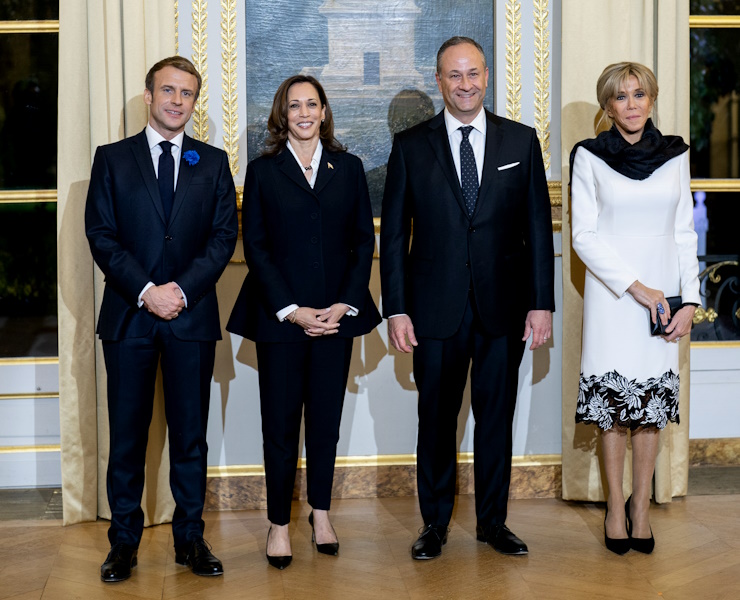
After discussions, in early November Kamala went to Paris on a four-day trip to talk with French President Emmanuel Macron, getting her feet wet in trans-Atlantic diplomacy. In Paris, she discussed a range of topics -- in particular, Putin's intentions towards Ukraine. Recent US intelligence assessments indicated that the Russians did intend to invade, with Kamala outlining the intelligence to Macron and telling him: "We are highly confident that Russia is going to do this."
Macron, as customary for French leaders, was inclined to take positions independent of those coming out of the USA, and knew US intelligence could be far from perfect; he wasn't as sure that Putin was really serious. Kamala pointed out that the Kremlin knew that France would not necessarily follow the American lead and might be banking that NATO would not follow the American lead, either. Kamala suggested that if Macron took the lead in Europe in making it clear to Putin that the invasion of Ukraine would have consequences, Putin would not assume NATO was divided. Macron was agreeable, telling Kamala: "France is prepared to impose costs. I'm on board for that." Macron would prove resolute in his support for Ukraine.
The AUKUS fiasco was not a big part of the discussion, that issue having been generally resolved. That was, not incidentally, typical of such high-level meetings: they rarely had surprises, issues having been roughed out beforehand, with a face-to-face discussion merely tying up issues. Kamala had the seat of honor at the formal dinner that evening, and the next day -- 11 November -- Kamala spoke at the Paris Peace Forum, a yearly event, with Macron sitting in the front row. Her speech focused on global inequality, touching on everything from gender equality to internet access, particularly in light of the COVID-19 pandemic:
QUOTE [EXCERPTS]:
In the 21st century, addressing inequality is a strategic imperative for each of us -- for our security and our health, our shared prosperity and our collective future.
For our part, the United States is committed to addressing our own systemic gaps. In fact, it has been a priority of our administration. ... And as we make progress at home, we recognize our obligation to other nations around the world. ... And we know there is more we can do and more we must do.
No single nation can take on inequality alone. A challenge this sizeable and seismic demands that our world work together in solidarity. And we have seen what is possible when we do. ... It will take all of us to meet this challenge. So, as we go forward from this place, let us not be burdened by what has been. Let us focus on what can be. And let us realize a better future together.
END_QUOTE
Incidentally, Doug accompanied Kamala on the France trip, operating in his supporting role -- visiting an art gallery along with French First Lady Brigitte Macron, along with other visits to cultural sites, a culinary school, and the Institut Pasteur. He also held a session on gender equity, encouraging men to be supportive of women, and escorted Kamala to a formal dinner at Elysee Palace. After Kamala came back home, on 19 November she was acting president for a few hours while Joe got a colonoscopy, this being the first time a woman was (temporarily) the nation's president.
Unfortunately, in the wake of the Paris Peace Forum, dark clouds began go gather. On 17 December, the Russian government had issued a list of demands targeting NATO, insisting that Ukraine and other ex-Soviet states never be allowed to join the alliance, and that NATO deployments in Eastern and Central Europe be rolled back. NATO Secretary-General Jens Stoltenberg replied that the alliance was purely defensive in nature, and no restrictions would be placed on who was allowed to join. Putin didn't take the hint; he was only getting started.
BACK_TO_TOP* Kamala, of course, had been continuing her efforts to deal with illegal immigration and deal with the Northern Triangle countries. In late January 2022, she went to Honduras to attend the inauguration of President Xiomara Castro -- the first woman president of Honduras. The two women discussed cooperation on a range of issues, including US assistance to Honduras in dealing with the COVID-19 pandemic; economic development; migration; and particularly corruption -- the US being highly supportive of Castro's plan to request assistance from the United Nations on setting up an anti-corruption commission in Honduras.
Earlier in January, it became known that SCOTUS Justice Stephen Breyer was planning to retire. During the presidential campaign, Joe had promised to appoint a black woman to the Supreme Court, and he re-affirmed his pledge. Relevant public opinion polls were all over the map, one saying almost three-quarters of Americans didn't want to restrict the choice to a black woman, another saying that almost two-thirds were for it.
That was a reflection of the difficulties that polling had fallen into. Traditional methods such as phone surveys had become less effective, since people tended to regard them as "spam" and ignore them. That led more voluntary schemes that were inclined to bias; pollsters tried to compensate for the bias, with limited success. The market was also flooded with fake and clearly biased polls.
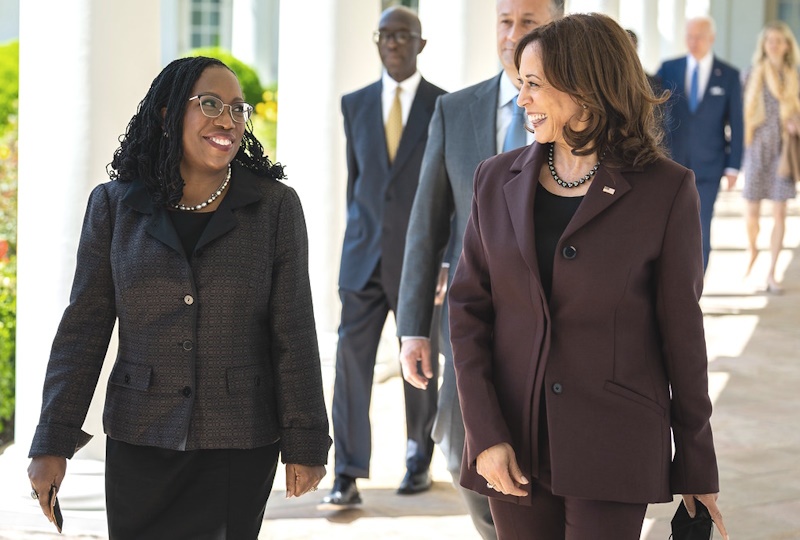
On 25 February, the White House nominated Judge Ketanji Brown Jackson -- of the DC Circuit Court of Appeals, who had been a legal clerk for Breyer. She was then endorsed by Democratic leadership and by 83 former state attorneys general -- but with GOP leadership preposterously calling her a "Leftist extremist", though their accusations against her failed fact checks. A "meta-poll" of 14 surveys said Americans endorsed Jackson's appointment by a ratio of 2:1.
The Senate Judiciary Committee was split along party lines on the nomination and so gave no recommendation. She was confirmed on 7 April, 53:47, with three GOP crossing the aisle to vote for her. Jackson became the first black woman on the Supreme Court.
Another gratifying event had taken place near the end of March, when Joe signed the "Emmett Till Anti-Lynching Act", which was a revised version of the "Victims of Lynching Act" that Kamala had helped to push when she was in the Senate. Emmett Till was a 14-year-old black lad who had been lynched in Mississippi in 1955, the event being a major landmark in the civil rights movement of the era. The Emett Till Act added a "serious bodily injury" standard to the Victims of Lynching Act, and handily passed the House.
* In the meantime, the Build Back Better Act came to final ruin in the Senate on the basis of its expense. It didn't stay dead, to be more or less revived in a trimmed-down package, as the $891 billion USD "Inflation Reduction Act". The COVID-19 pandemic and its economic dislocation had led to a burst of inflation, reaching a high of 8% in 2022, so the repackaging got a new label.
The Inflation Reduction Act included major investment in climate and domestic clean energy production; tax credits for solar panels, electric cars, and other home energy programs; a three-year extension of Affordable Care Act subsidies plus an insulin price cap -- and, last but not least, a long-awaited provision allowing Medicare to negotiate drug prices. It came to a vote in August 2022, with all Republicans voting against it; Kamala had to break the tie in the Senate. Joe signed it into law on 16 August.
Across the Atlantic, tensions with Russia began to ratchet up. In January, French President Macron and German Chancellor Olaf Scholz attempted to engage in diplomatic discussions with Vladimir Putin -- who proved evasive, encouraging discussion but saying Russian demands were not being met. By mid-February, US satellite intelligence was showing clear signs of preparation for offensive operations in the near future.
With war looming, on 19 February Kamala went to the Munich Security Conference, which was a yearly meeting that was usually attended by the American vice president. She delivered a blunt speech, warning of the imminent Russian threat:
QUOTE [EXCERPTS]:
Today, as we are all well aware, the foundation of European security is under direct threat in Ukraine. Let us remember: From the wreckage of two world wars, a consensus emerged in Europe and the United States. A consensus in favor of order, not chaos; security, not conflict. So by forging relationships and bonds, forging organizations and institutions, laws and treaties, we, together, established a set of rules, norms that have governed ever since.
As we have said all along, there is a playbook of Russian aggression. And this playbook is too familiar to us all. Russia will plead ignorance and innocence, it will create false pretext for invasion, and it will amass troops and firepower in plain sight. We now receive reports of what appears to be provocations. And we see Russia spreading disinformation, lies, and propaganda. Nonetheless, in a deliberate and coordinated effort, we, together, are: one, exposing the truth and, two, speaking with a unified voice.
As President Joe Biden has made clear: The United States, our NATO Allies, and our partners have been and remain open to serious diplomacy. We have put concrete proposals on the table. We have encouraged and engaged Russia through NATO, the Organization for Security and Cooperation in Europe, the United Nations, and bilateral dialogues. We have engaged in good faith. Russia continues to claim it is ready for talks while, at the same time, it narrows the avenues for diplomacy. Their actions simply do not match their words.
And let me be clear. I can say with absolute certainty: If Russia further invades Ukraine, the United States, together with our Allies and partners, will impose significant and unprecedented economic costs.
We have already taken steps to strengthen our deterrence and collective defense. We have deployed an additional 6,000 American service members to Romania, Poland, and Germany. We have put another 8,500 service members in the United States on a heightened sense of readiness. As President Biden has said, our forces will not be deployed to fight inside Ukraine, but they will defend every inch of NATO territory.
Since Russia launched its proxy war against Ukraine nearly eight years ago, the people of Ukraine have suffered immensely: nearly 14,000 people killed, more than a million displaced, and nearly 3 million in need of aid. The United States has provided significant support to Ukraine: security assistance, humanitarian assistance, and economic assistance. And we will continue to support the people of Ukraine.
Today, the United States, our Allies, and our partners are closer together. Today, we are clear in our purpose. And today, we are even more confident in our vision. Our strength must not be underestimated, because, after all, it lies in our unity. And as we have always shown, it takes a lot more strength to build something up than it takes to tear something down.
END_QUOTE
The speech was well received. Afterwards Kamala and Philip Gordon, her national security advisor, met with Ukrainian President Zelenskyy and some of his people in a hotel room, with Kamala telling Zelenskyy: "You need to take seriously the likelihood that any day, the Russians will invade your country."
Zelenskyy downplayed the threat: "We just don't think they're going to invade. Yes, they're threatening us, they're bullying us. That's what they do."
Kamala provided relevant intelligence, but the Ukrainians -- it seems concerned that acknowledging the possibility of invasion might end up a self-fulfilling prophecy -- still insisted, not with deep conviction, that Putin was bluffing. Zelenskyy was apparently put off by the Tough Cop Kamala persona and finally shot back: "What do you want me to do?" Kamala replied:
QUOTE:
Start thinking about things like having a succession plan in place to run the country if you're captured or killed or cannot govern. Have an escape plan so that you won't be captured or killed. Possibly mobilize more Ukrainian troops. Have a plan for continued governance. But you can't decide the right things to do if you're just going to pretend that this isn't happening. If they do this, they're coming to Kyiv.
END_QUOTE
Kamala tried to reassure Zelenskyy, telling him: "We're with you." She had to privately admit, however, that her message to him came across as weak. In any case, it was clear Zelenskyy was going to stay in Kyiv.
Early on 24 February, Putin announced the start of a "special military operation", with the assault jumping off immediately. The US & NATO responded, imposing stiff economic sanctions on Russia, and expediting the delivery of munitions. Few expected that Ukraine would survive -- but the Russian offensive was poorly planned and executed, while it ran into energetic and determined Ukrainian resistance. Zelenskyy stayed in Kyiv, famously saying in response to foreign suggestions that he evacuate: "I need ammunition, not a ride."
In March, Kamala returned to Europe, visiting Poland and Romania, the trip being intended to provide reassurance that the USA was on board with its European allies in confronting the Russians, most importantly to coordinate collective action in the support of Ukraine and the Ukrainians. By that time, it had become obvious that Ukraine was not going to cave in -- by April, the Russians had given up their "blitz" offensive, such as it was, to instead begin what would become a grinding war of attrition from the east of Ukraine, with the Ukraine War became an ongoing test of the Biden Administration.
BACK_TO_TOP* In late April, Kamala tested positive for COVID-19 and spent a week in isolation, working from home. She was fully vaccinated and asymptomatic. She was back in circulation on 3 May, speaking at the Emily's List National Conference and Gala in Washington DC -- "Emily's List" being a Democratic political action committee, focused on getting women elected and supporting reproductive rights.
Kamala had something to say, since the day before a leaked draft clearly indicated that the Supreme Court planned to overturn ROE V WADE, leaving reproductive rights up to the states. She blasted the judgement:
QUOTE:
Those Republican leaders who are trying to weaponize the use of the law against women. Well, we say: How DARE they? How dare they tell a woman what she can and cannot do with her own body? How DARE they? How dare they try to stop her from determining her own future? How dare they try to deny women their rights and their freedoms?
... It has never been more clear which party wants to expand our rights, and which party wants to restrict them.
END_QUOTE
She said that Democrats are "not going back", that Democrats were going to "fight with everything we have got." Late in the year, journalist Jonathan Capehart of THE WASHINGTON POST published a flattering article about Kamala, which in part outlined what she did after that:
QUOTE:
After the leaked draft in May of what would later become the Supreme Court's DOBBS V. JACKSON WOMEN'S HEALTH ORGANIZATION decision to end the constitutional right to abortion, the former California attorney general saw plainly the implications for other rights, such as marriage equality. She was eager to speak out, Harris told me, and instructed her staff: "I'm getting the f### out of DC."
She traveled to 18 cities in 14 states, plus the District of Columbia, to host reproductive rights events. During those trips and at the White House, Harris met with 200 state legislators from 18 states, state attorneys general, students and clergy. All to build a coalition to push back against what was coming.
"This is about freedom and liberty," the vice president recalled telling everyone she met. "Let's take back the flag on this." She was never more confident in her role as vice president -- nor in herself -- than during her barnstorming on privacy rights. I've known and covered Harris for a decade. Whenever she talks about these issues, passion wells up and her most authentic self comes through.
I said as much to her, and Harris pushed back. "I'm always myself, Jonathan," Harris said with a laugh before raising a broader point. "There are things that I've done as vice president that fully demonstrate the strength of my leadership as vice president that have not received the kind of coverage that I think Dobbs did receive," Harris said. She specifically mentioned her Munich speech. "What you've been able to see," she admonished, is "based on what gets covered."
END_QUOTE
* On 8 July 2022, Japanese Prime Minister Abe Shinzo was gunned down by an assassin. That led to Kamala's first Far East trip as vice president, traveling to Tokyo on 25 September for discussions with Japanese leaders and Abe's state funeral on 27 September, then flying on to South Korea.
In South Korea, Kamala met with President Yoon Suk Yeol in Seoul, reaffirming America's commitment to defend the country against attack -- while also discussing economic and technology partnerships between South Korea and the USA, and encouraging cooperation between South Korea and Japan. She then visited the demilitarized zone between North and South Korea, her visit being followed by North Korean ballistic missile tests.
One of the items Kamala brought up in Tokyo was cooperation in space exploration between the US and Japan -- that being part of her authority as the chair of the US National Space Council, another of the multiple hats she wore in the Biden Administration. That led to her office issuing a general statement in November on the joint efforts of the two nations in space.
More generally, as the lead in the National Space Council, Kamala helped promote the "Artemis Accords", which had been originally signed by eight space-faring nations in 2020, committed them to principles for space operations such as using space for peaceful purposes; transparency; interoperability; emergency assistance; and the safe and sustainable use of space resources. One particularly significant facet of the accords was an international commitment to reduce "space debris", meaning components of space launch vehicles shed into orbit, where they could damage spacecraft through collisions. The accords were associated with the US Artemis program, which was a long-term plan for returning humans to the Moon, and conducting deep-space operations beyond the Moon.
* In early November 2022, the US conducted mid-term elections. The Democrats gained a seat in the Senate, but lost control of the House by nine seats. That was better than expected, since incumbent parties tend to suffer in midterms; it still meant the Biden Administration could no longer get significant legislation through the House. Joe had to rely more heavily on executive orders and promote his economic agenda, "Bidenomics" -- which seemed to be going well enough, with inflation falling, if slowly, while employment and real wages went up. The loss of the House to the Republicans also meant incessant sniping from Republican-controlled House committees, most prominently in seeking pretexts to impeach Joe.
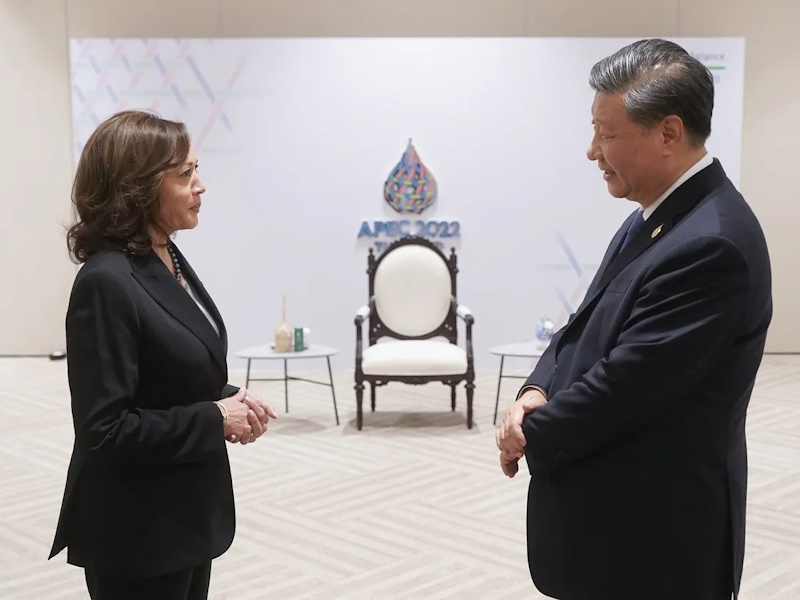
In mid-November, Kamala -- accompanied by Doug -- went to Bangkok for the "Asia-Pacific Economic Cooperation (APEC)" Leaders' Meeting, which was also attended by Joe; Kamala had a brief chat with Chinese President Xi Jinping, telling him: "We invite competition. We do not seek conflict. We do not seek confrontation."
At the APEC meeting, Kamala:
The couple then went on to the Philippines, where they met with President Ferdinand Romualdez Marcos JR. It was Doug's second trip to the Philippines that year; he had led a US delegation to the inauguration of Marcos in June. The primary objective of the visit was to underline America's disapproval of "other states" (read as "China") bullying America's allies in the South China Sea -- which China claimed as its territorial waters, in contradiction of international law:
QUOTE:
We must stand up for principles such as respect for sovereignty and territorial integrity, unimpeded lawful commerce, the peaceful resolution of disputes, and the freedom of navigation and overflight in the South China Sea, and throughout the Indo-Pacific.
END_QUOTE
-- and to reassure President Marcos that the USA had his back:
QUOTE:
An armed attack on the Philippines armed forces, public vessels, or aircraft in the South China Sea would invoke US Mutual Defense commitments. And that is an unwavering commitment that we have to the Philippines.
END_QUOTE
Kamala also met with social activists and young Filipino women, in support of democratic values and human rights in the Philippines. Doug had a number of separate engagements, including a visit to a school, where he announced new US funding for COVID-19 control efforts in the Philippines.
BACK_TO_TOP
